
For years, the top prize in SEO was the number one spot on the results page. That's changing. In the new era of AI-powered search, the ultimate goal is to have your brand mentioned directly within an AI-generated summary. When a potential customer asks a question, you want the AI to name your company as the solution. This is the new top spot, and it builds immediate trust and authority before a user even has to click. But how do you get an AI to notice you? It comes down to building a strong, credible brand that AI models recognize as a reliable source. This article will break down how to create content and build a digital presence that earns these valuable brand mentions.
Key Takeaways
- Aim for Mentions, Not Just Top Ranks: Success in AI search means your brand is named in the AI-generated answer. Build a strong, recognizable brand that AI systems see as a credible source.
- Answer Questions, Don't Just Target Keywords: Your content needs to provide comprehensive solutions to the complex, conversational questions people ask. Focus on creating in-depth, helpful resources that satisfy the user's true intent.
- Build Your Presence Across Multiple Platforms: AI gathers information from the entire web, so a single-channel strategy is no longer enough. Show up consistently with valuable content on the platforms your audience frequents to establish authority.
What is AI Search Optimization?
AI search optimization is the practice of adapting your digital strategy so your brand, products, and services appear in AI-generated search results. You may have heard terms like Answer Engine Optimization (AEO) or Generative Engine Optimization (GEO), but they all point to the same fundamental shift. We're no longer just optimizing for a list of blue links. The core action of searching isn't disappearing, but how people find information is changing rapidly with features like Google's Search Generative Experience.
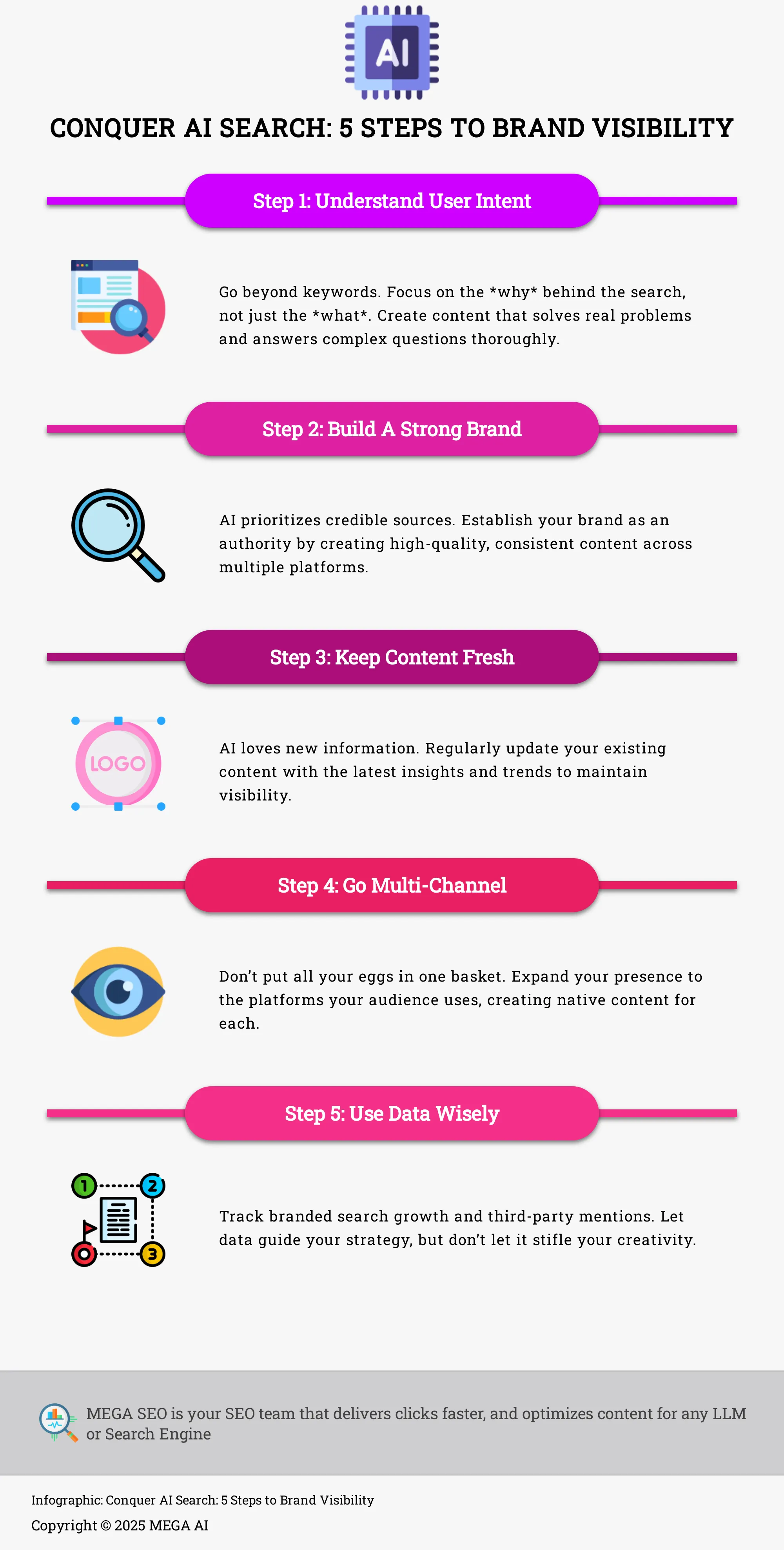
Instead of only aiming for the top spot on a results page, the new goal is to have your brand mentioned directly within an AI-generated summary. This is a more indirect, but powerful, way to build authority. AI models work to understand concepts and entities—your brand name, your products, your key people—and the relationships between them. The objective is to become such a trusted source on a topic that AI systems cite your information and recommend your brand to users. This means your brand name itself becomes a critical asset, and it needs to be unique and recognizable.
This requires a different approach than traditional SEO. Simply targeting keywords is no longer enough. The focus shifts to creating high-quality, comprehensive content that clearly establishes your expertise and answers user questions thoroughly. It’s about building a strong, consistent digital presence that AI can easily recognize and reference as a reliable source. Tools like MEGA AI's SEO platform help you create and maintain the kind of authoritative content that performs well in this new search environment, ensuring your brand is part of the conversation from the start.
How AI Redefines Search: Beyond Keywords to User Intent
The core of search isn't changing—people are still looking for answers and solutions. What is changing is how they search. AI-powered search engines are moving past a simple keyword-matching game. They now focus on understanding the context and intent behind a query, even if it’s a full paragraph. This shift means your content strategy needs to evolve. Instead of just targeting keywords, the goal is to provide the best, most comprehensive answer to the user's underlying question. It’s about creating content that satisfies the why behind the search, not just the what.
How AI Deciphers User Intent
Think about how you use search yourself. You might type or speak a long, conversational question. AI is designed to understand this natural language. It deciphers the nuances and context to figure out what you truly need. The fundamental principle of search remains the same: people are looking for solutions to their problems. Your job is to provide that solution. This means creating content that is thorough, helpful, and directly addresses the user's pain points. An effective SEO strategy focuses on building content that answers these complex queries, establishing your brand as a reliable source of information.
Adapt Your SEO Strategy for AI
In this new environment, it helps to approach your strategy as if you're starting from the ground up. This doesn't mean discarding all your previous work, but it does require a fresh perspective. You need to build a strategy that aligns with how AI search works today. This involves creating a strong brand presence across multiple platforms, not just your website. For example, sending users to a helpful YouTube video can build more trust than directing them to a simple landing page. The goal is to show up wherever your audience is looking for solutions, making your brand the clear and helpful answer.
Why Brand Visibility Matters in AI Search
In the world of AI-powered search, the game is no longer just about ranking number one. The new primary goal is getting your brand mentioned directly within the AI-generated answers. When a user asks a question like, “What are the best tools for automating paid ads?” you want the AI to name your company in its response. This is the new top spot. Being featured as part of an AI summary builds immediate authority and positions your brand as a trusted resource before a user even clicks a link.
AI models synthesize information from countless sources to formulate their answers. To earn a mention, your brand needs to be recognized as a credible and relevant entity across the web. This means your focus should shift from pure keyword optimization to building a strong, recognizable brand identity. Your content, online presence, and customer feedback all contribute to how AI perceives your authority. The objective is to create such a strong signal that AI models can’t ignore you when generating results for your niche. This is where tools that help improve CTR and rank become essential for signaling your relevance.
Focus on Quality Engagement, Not Just Traffic
For years, marketers have chased traffic volume, but this has always been a less-than-ideal metric. Attracting thousands of visitors who aren't interested in what you offer does little for your bottom line. The good news is that AI search naturally prioritizes quality over quantity. Because AI provides direct answers, the users who do click through to your website tend to have much higher intent. They are actively seeking more detailed information, which means you are connecting with a more engaged and qualified audience. Focusing on the quality of the traffic you receive, rather than just the volume, will lead to better engagement and higher conversion rates.
How to Measure Success with AI Search
If traffic is no longer the main indicator of success, what should you measure instead? Start by tracking your branded search growth. When you see an increase in people searching for your brand name directly, it’s a strong sign that your marketing efforts are working and your brand visibility is growing. Another critical area to watch is third-party signals. AI models rely heavily on external validation to decide which brands to trust. These signals include mentions on other reputable websites, positive reviews, and discussions in online communities. Your off-page strategy and digital PR are now more important than ever for influencing whether your brand appears in AI-driven search results.
How to Create Content for AI-Powered Search
Creating content for an AI-driven search landscape means shifting your focus from simply targeting keywords to providing comprehensive, high-quality answers. AI models are designed to understand context and user intent on a deeper level. Your goal is to create content that is so clear, relevant, and authoritative that an AI has no choice but to feature it as the best possible answer for a user's query. This involves keeping your information current and structuring it to match the conversational way people now search.
Keep Your Content Fresh and Relevant
AI search engines prioritize new and updated information. An article that was a top performer three years ago may lose its standing if it isn't regularly refreshed. This concept, sometimes called "citation freshness," is about consistently getting new links and current brand mentions. To stay visible, you need a strategy for regularly updating your content to reflect the latest information and trends. This shows AI models that your content is a living, reliable resource. An automated SEO platform can help by identifying which articles need updates and even suggesting new content to add, ensuring your information remains timely.
Match Your Content to User Behavior
Understanding how people search is fundamental. Users are moving beyond short keywords and are now using longer, more complex queries—sometimes entire paragraphs. Your content needs to be structured to answer these detailed questions. The traffic from these specific queries is often highly motivated and converts at a better rate than standard search traffic. To capture this audience, create in-depth content that addresses a topic from multiple angles. Think about the follow-up questions a user might have and build those answers directly into your articles. This approach aligns with how AI works to satisfy user intent completely.
Build a Strong Brand Presence Across Multiple Channels
Relying on a single channel for customer acquisition is becoming a high-risk strategy. As AI search models pull information from across the web to formulate answers, your brand’s visibility depends on having a broad and consistent presence. The goal is to be discoverable wherever your potential customers are asking questions or looking for solutions. This means showing up on social media, in video content, on forums, and in professional communities. A comprehensive AI SEO strategy isn't just about your website anymore; it's about creating a digital footprint that AI can easily recognize and trust.
A strong multi-channel presence does more than just increase your reach. It sends powerful signals to AI systems that your brand is a credible and authoritative source of information. When your name, products, and expertise appear consistently across different platforms, you build brand recognition with both your human audience and the algorithms that serve them. This approach makes your business more resilient to sudden algorithm shifts and positions you as a trusted leader in your field. Being seen as an authority is a key factor for success in AI-driven search, as these systems prioritize reliable and well-vetted sources.
Expand Your Reach Across Different Platforms
The way people search is fundamentally changing. Queries are more complex and conversational, and users are turning to a wider variety of platforms to find answers. To stay relevant, your content strategy must extend beyond your website. You need to meet your audience where they are. Start by identifying the platforms your target customers frequent. This could be YouTube for tutorials, LinkedIn for professional advice, or forums like Reddit and Quora for specific niche discussions.
Once you know where your audience is, create content that is native to each platform and directly addresses their problems. The objective is to "show up when they are looking," as SEO expert Nathan Gotch explains in his analysis of modern search behavior. For businesses serving a local area, optimizing your Google Business Profile is critical, as it’s a primary source for AI-powered local search results. By diversifying your presence, you create more opportunities for your brand to be the solution your audience finds.
Find Ways to Engage Your Audience Indirectly
The modern customer journey is not a straight line. A potential customer might watch your YouTube video, listen to a podcast you were featured on, read your LinkedIn posts, and see your brand mentioned on Reddit before ever visiting your website. As Nathan Gotch notes, the sales cycle is no longer a linear process. Each of these interactions is a touchpoint that builds familiarity and trust. Your content strategy should focus on creating this web of engagement that guides people to your brand over time.
This means shifting focus from direct sales pitches to providing value and building authority. Participate in industry conversations, share your expertise in guest posts or podcast interviews, and create helpful resources that solve real problems. This indirect engagement establishes your brand as a credible voice. When you consistently provide value across multiple channels, you remain top-of-mind. Then, when a customer is finally ready to make a purchase, your brand is the one they trust.
Why Personalization is Key for AI Search
As AI search engines become more sophisticated, they get better at understanding exactly what a user wants. Generic, one-size-fits-all content is becoming less effective. The key to visibility is personalization—creating content that speaks directly to an individual’s specific needs and questions. This means shifting your focus from broad keywords to the detailed intent behind every search. When you personalize, you’re not just answering a query; you’re building a connection with your audience, which is exactly what AI algorithms are designed to reward. This approach helps you create a stronger brand presence and ensures your content remains relevant as search technology continues to evolve.
Tailor Content to Individual User Needs
The way people search is changing. Instead of short keyword phrases, users are typing or speaking full, complex questions. To show up in these results, you need to understand the specific intent behind these queries and tailor your content to provide a direct answer. Building a real brand in the AI era means deeply understanding your audience’s pain points and preferences. Your content should reflect this understanding, resonating with their specific needs rather than casting a wide, generic net. By focusing on personalized answers, you create content that AI models recognize as genuinely helpful. MEGA AI’s SEO tools can help you identify these nuanced user needs and pinpoint new content opportunities within your existing articles.
Create Content That Adapts to Your Users
The modern customer journey is not a straight line. A user might discover your brand on social media, read a blog post, and then ask an AI assistant a follow-up question. Your content must be flexible enough to be relevant at every touchpoint. Adopting a "ground zero" mindset helps here; constantly re-evaluate your content as if you're starting fresh. This encourages you to create adaptable assets that can evolve based on user feedback and performance data. An effective strategy involves creating content that can be easily remixed for different platforms. With a tool like MEGA AI's Maintenance Agent, you can automatically re-optimize existing articles to perform well on any search engine or platform, ensuring your message stays consistent and effective wherever your audience finds you.
Understand the Modern Customer Journey
The path your customers take to find you is no longer a straight line. It's more like a web of interactions spread across different platforms and formats. A potential customer might watch a YouTube video, listen to a podcast you were featured on, see your posts on LinkedIn, and then ask an AI chatbot about your services. This complex journey requires a shift in how we think about reaching our audience. Instead of guiding them down a single funnel, the goal is to be the best answer wherever they happen to be looking. AI is a central part of this new landscape, both as a tool for customers and as a powerful way for you to personalize their experience and make sense of their scattered path to purchase.
How AI Influences the Path to Purchase
The modern sales cycle is no longer a linear process. A customer's journey might start with a YouTube video, move to a podcast, and then involve reading your LinkedIn posts before they ever visit your website. AI influences this path by personalizing the content users see on these platforms. It also adds new touchpoints, like AI chatbots, where people ask questions and form opinions about your brand. Your strategy should be to create helpful, relevant content for each of these potential interactions. By anticipating the questions and needs of your audience at every stage, you build trust and position your brand as the go-to resource, no matter how they find you. MEGA AI's SEO tools can help you generate this diverse content efficiently.
Identify Key Customer Touchpoints
To succeed in this multi-platform environment, you need to build a real brand that shows up consistently wherever your audience spends their time. This is the core of "search everywhere optimization." Key customer touchpoints are any points of contact a person has with your brand, from reading a blog post to seeing a paid ad or finding you on a review site. The goal is to identify these touchpoints and ensure your message is clear and helpful at each one. A critical sign that your marketing is working is growth in your branded search traffic. When more people search for your company name directly, it shows your brand is memorable and your multi-channel efforts are paying off.
Use Data to Inform Your AI Search Strategy
Data is your guide for navigating the modern customer journey. In the context of AI search, data helps you move beyond simple metrics like traffic and rankings. It offers a window into user intent, showing you what questions people are asking and what solutions they need. Using these insights allows you to create a more effective content strategy that resonates with both AI algorithms and human users. The key is to use data to inform your decisions, not dictate them, creating a strategy that is both intelligent and human-centric.
Use Data Insights to Create Smarter Content
The goal of traditional SEO was to attract relevant traffic. With AI search, the focus shifts to earning brand mentions and attracting high-intent users. While traffic from AI platforms might be lower in volume, it often converts at a much higher rate because the user has a very specific need. Your job is to use data to identify these needs and create content that is so helpful and authoritative that AI models cite it as a source. This approach positions your brand as a trusted expert. MEGA AI's SEO tools can help you analyze search data to find these opportunities and generate content that directly addresses high-intent queries.
Balance Data with Creative Content Ideas
While data provides the "what," your brand's creativity provides the "why." A purely data-driven approach can lead to generic content that fails to build a lasting connection with your audience. In a world where the sales cycle is no longer linear, a strong brand identity is what keeps you top-of-mind. It’s important to find a balance. Use data to understand where search is headed, but don't overcorrect so much that you lose sight of what works right now. Combine data insights with creative storytelling to build a brand that is both visible in search and memorable to your customers.
How to Prepare for the Future of Search
The world of search is shifting, but that doesn't mean you have to be left behind. Preparing for the future is less about predicting every change and more about building a resilient strategy. By focusing on foundational principles like brand building and adapting to new user behaviors, you can position your business for long-term success, no matter what the next search algorithm looks like.
Stay Ahead of AI Changes in Search
AI search optimization is already here. The conversation is shifting from traditional SEO to a more holistic approach where brand authority is paramount. The primary goal is no longer just about getting clicks from a list of blue links. Instead, the focus is on getting your brand mentioned directly in AI-generated summaries and conversational answers. To achieve this, you need to build a real, authoritative brand that AI models recognize as a trustworthy source. This requires a deep focus on your brand strategy and creating high-quality, reliable content to establish your expertise within your niche.
Adapt to New Search Trends and Tools
People will always search for information, but their methods are evolving. Search queries are becoming more complex and conversational, with users sometimes typing full paragraphs into the search bar. Your strategy must adapt to this behavior. This isn't a one-time fix; it requires continuous marketing efforts to keep acquiring brand mentions and building authority. Think beyond your website. Your brand needs to be visible on relevant directories, social platforms, and forums where AI models gather information. A strong, multi-platform presence ensures you show up wherever your audience is looking for answers.
Optimize for AI Search with MEGA AI
The shift to AI-powered search means your strategy needs to evolve. It's no longer enough to target a few keywords and call it a day. AI search engines prioritize brands that consistently provide fresh, authoritative, and comprehensive answers to increasingly complex user queries. For startups and small businesses, keeping up with these demands can feel like a full-time job. This is where having a dedicated AI-powered platform becomes a strategic advantage.
MEGA AI simplifies the entire process, from initial research to ongoing optimization. Our SEO tools are designed for the new era of search, helping you identify the long-tail, conversational questions your audience is asking. From there, you can generate high-quality content that directly addresses user intent. But creating content is only the first step. In an AI-driven world, maintaining the relevance and freshness of your existing articles is just as important as publishing new ones.
Our Maintenance Agent product is built specifically for this challenge. It automatically analyzes your published content to find opportunities for improvement, like updating information to improve click-through rates or adding new sections to make an article more comprehensive. This continuous optimization process helps establish your site as a reliable, up-to-date resource, which is a key signal for AI search algorithms. By automating these critical maintenance tasks, MEGA AI helps you build a strong foundation for long-term visibility and authority without draining your resources.
Use AI Tools to Improve Visibility and Engagement
In the landscape of AI search, the primary goal shifts from simply driving traffic to earning brand mentions. When a user asks an AI assistant a question, you want your brand, product, or service to be part of the answer. This requires building a real, recognizable brand that AI models identify as a credible source of information. It's about creating a strong enough signal that you become an unavoidable part of the conversation in your niche.
MEGA AI provides the tools to build that signal. Our platform helps you consistently create valuable content that answers the detailed questions your audience has. By focusing on user intent and producing comprehensive resources, you position your brand as an authority. This isn't about gaming an algorithm; it's about genuinely serving your audience with high-quality information. When you do that consistently, AI search engines take notice. See how our platform can streamline your content strategy when you book a demo.
Related Articles
- AI SEO: A Modern Guide to Optimizing for AI
- Mastering Google AI SEO in 2024: A Complete Guide
- Understanding NLP and Its Impact on SEO
- AI SEO Strategies: Optimize Content & Improve Rankings
- How AI Changes SEO: Tips & Strategies
Frequently Asked Questions
What is the biggest difference between traditional SEO and AI search optimization? The main difference is the goal. Traditional SEO focuses on getting your website to rank at the top of a list of links. AI search optimization aims to have your brand mentioned directly within the AI-generated summary that answers a user's question. It’s a shift from winning a spot on the page to becoming a trusted source that the AI cites.
If website traffic isn't the main goal anymore, what should I track instead? Instead of focusing only on traffic volume, you should start tracking the growth of your branded search queries. When more people are searching for your company name directly, it shows your brand is becoming more visible and memorable. You should also monitor third-party signals like mentions on other reputable sites, positive reviews, and discussions about your brand in online communities.
How do I get my brand mentioned in an AI-generated answer? There isn't a single trick to guarantee a mention. The key is to consistently build your brand's authority on a specific topic. This involves creating high-quality, comprehensive content that thoroughly answers the questions your audience is asking. When AI models see your brand as a reliable and expert source across multiple platforms, they are more likely to reference your information in their answers.
Does this mean I have to create content for every single social media platform? Not at all. The goal is to be strategic, not to be everywhere at once. Identify the few key platforms where your target audience is most active and looking for information. It's more effective to build a strong, authoritative presence on two or three relevant channels than to spread yourself thin across ten.
Do I need to rewrite all my existing blog posts for AI search? You don't need to discard your existing content. Instead, think about how you can update and improve it. Regularly refreshing your articles with new information, adding more depth, and answering follow-up questions keeps them relevant. This signals to AI systems that your content is a current and reliable resource, which is a critical factor for visibility.