Artificial intelligence might seem like a complex, even intimidating, force in the world of SEO. However, instead of viewing AI as a disruptor to be feared, it's more helpful to see it as a powerful ally. AI tools are becoming incredibly adept at handling tasks that once consumed hours of manual effort, from in-depth keyword research to refining content for better engagement. This doesn't make the SEO professional obsolete; it elevates our role. By letting AI manage the operational heavy lifting, we can focus more on strategy, creativity, and understanding the nuances of our audience. This piece will explore how to effectively integrate AI into your workflow, turning it into a valuable partner for achieving your SEO goals.
Key Takeaways
- Think Beyond Google for Wider Reach: Your SEO strategy should now cover various online platforms, not just Google search results; let AI tools help you manage this expanded presence so you can focus on the bigger picture.
- Become a Strategic Digital Marketer: Concentrate on understanding your audience, analyzing data, and guiding content creation across different channels, using AI to assist with the detailed execution.
- Use AI to Optimize and Stay Flexible: Make AI tools a core part of your SEO workflow for tasks like content improvement and performance tracking, and be ready to adjust your approach as search algorithms and user habits change.
AI-Driven SEO: What Are the New Rules?
If you've heard whispers that "SEO is dead," especially with the rise of AI, let me offer a different perspective. SEO isn't dead, but the way we've traditionally approached it—aiming solely for those top ten blue links on Google—is certainly evolving. The good news is that this shift, largely driven by AI, brings more opportunities than ever before, provided you're ready to adapt to some new rules.
One of the biggest changes is that you can no longer put all your SEO eggs in the Google basket. While Google is still a giant, relying on it exclusively can leave you vulnerable. The new game is about thinking much broader and aiming to own as much digital real estate as possible. This means your website is just one piece of the puzzle. We now need to consider how our brand appears across multiple platforms. Think about optimizing your presence on YouTube, your Google Business Profile, and other platforms where your audience spends their time.
This expansion also shifts where your human effort is most valuable. With AI tools increasingly capable of handling execution tasks like keyword research and content generation, your role becomes more strategic. The real advantage now lies in your ideas, your understanding of customer awareness, and your ability to direct AI effectively. It's less about the manual grind and more about insightful strategy. Finally, adaptability is paramount. As new technologies emerge and search algorithms change, the ability to pivot and integrate these advancements into your SEO practices will be key to sustained success.
Key Skills for Today's SEO Professionals
The world of SEO is always changing, and with AI in the mix, the skills needed to succeed are evolving too. It’s no longer just about keywords and backlinks. To truly make an impact, SEO professionals now need a broader toolkit. Let's look at some essential skills that will help you stay effective.
Master Digital Marketing Strategies
To be a successful SEO professional now, you really need to think like a well-rounded digital marketer. It's about understanding how to create, or guide the creation of, effective content across many platforms, not just your website's blog. This means seeing SEO as one important piece of a larger puzzle. Consider how your SEO efforts integrate with email marketing, social media campaigns, and paid advertising. When all these channels work together, they amplify your message and reach, leading to much stronger results than SEO could achieve in isolation. This holistic view helps you build a more resilient and comprehensive online presence.
Analyze Data and Interpret AI Insights
The ability to analyze data and make sense of AI-generated insights is more critical than ever. With AI tools influencing search results on platforms like Google, understanding performance requires looking at multiple fronts to see where your brand is gaining visibility. This isn't just about tracking rankings; it's about digging into user behavior, engagement metrics, and conversion paths. AI can help process vast amounts of data, but human expertise is needed to interpret these insights correctly and translate them into actionable SEO strategies. Strong analytical skills allow you to identify what's working, what's not, and how to leverage AI tools effectively to refine your approach.
Create Diverse, Multi-Platform Content
The goal now is to secure as much relevant online real estate as possible. This means being present wherever your potential customers are searching and spending their time. To do this, you need to move beyond traditional text-based articles. Think about creating a variety of content formats like videos, podcasts, infographics, and interactive tools. Each platform, from YouTube and Instagram to LinkedIn and industry forums, has its own best practices and audience expectations. Developing a strategy to create and adapt content for these different channels helps you reach a wider audience and reinforce your brand's authority across the digital landscape.
Understand AI and Large Language Models
A foundational understanding of AI and Large Language Models (LLMs) is becoming indispensable. Search engines and content platforms increasingly use natural language processing (NLP) to understand the meaning and context of published content. Knowing how these technologies work, even at a basic level, helps you create content that is more easily interpreted and favored by AI algorithms. This includes understanding how LLMs generate text, what kind of data they are trained on, and how they determine relevance. This knowledge allows you to optimize your content more effectively and even see AI in action to better grasp its capabilities for your SEO work.
Using Customer Awareness Stages in Your SEO
Understanding where your potential customers are in their buying journey is fundamental to effective SEO. Not everyone searching online is ready to make a purchase right away. Some are just beginning to realize they have a problem, while others are actively comparing different solutions. This spectrum of understanding is often described through customer awareness stages. When you align your SEO efforts with these stages, you meet people with the right information at the right time, making your content far more relevant and impactful.
Think of it like this: you wouldn't suggest moving in together on a first date, would you? Similarly, you shouldn't present a hard sell to someone who has only just become aware of a problem your product or service can solve. By recognizing these distinct phases, you can develop a more nuanced and successful SEO strategy. This involves creating different types of content, targeting different keywords, and even using different platforms to reach people effectively at each point. AI-powered tools can significantly streamline this process, helping you identify user intent and generate content that resonates, regardless of where someone is on their path to purchase. This targeted approach not only improves the user experience but also ensures your SEO budget is working efficiently for you.
Tailor Content for the Buyer's Journey
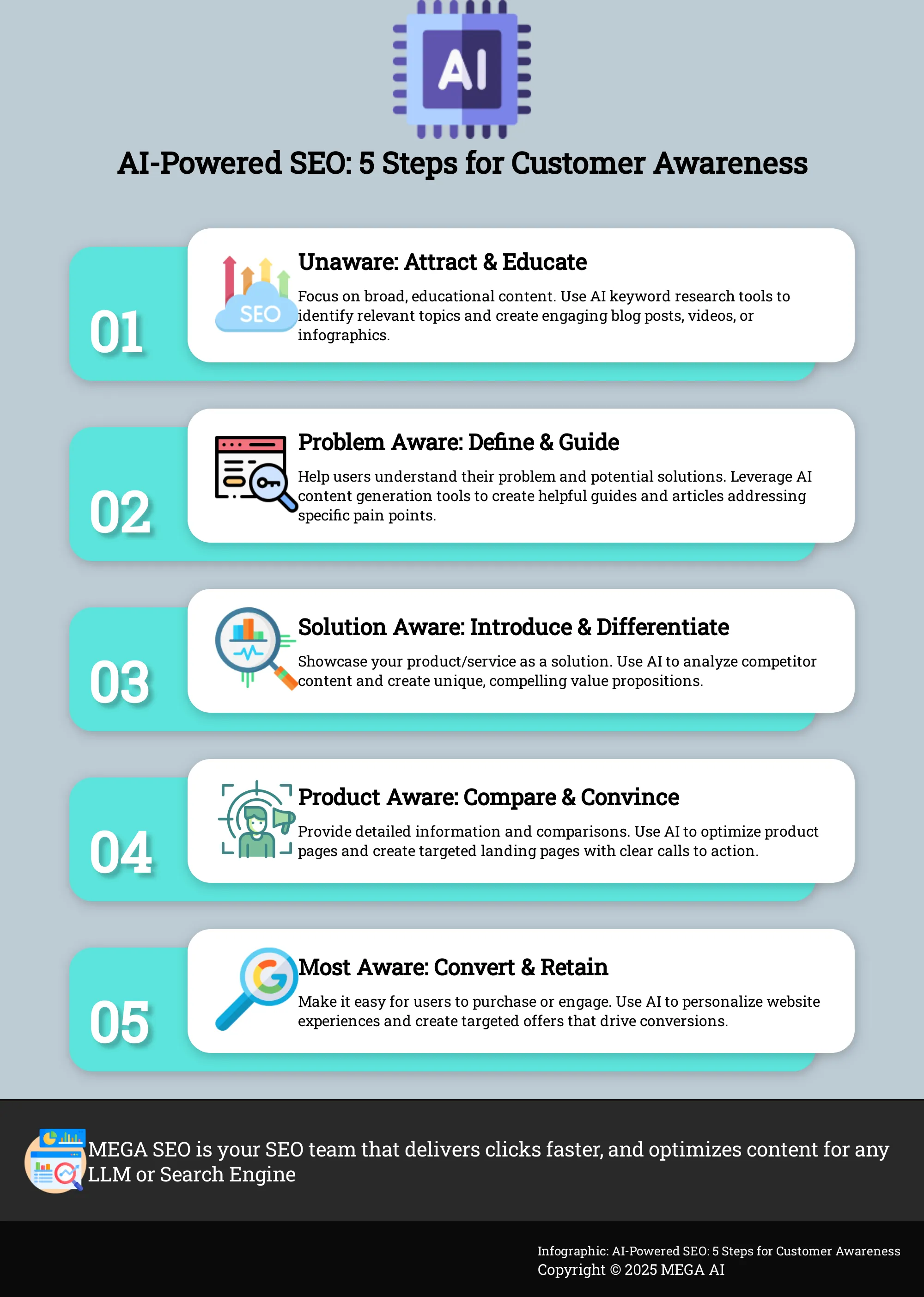
To truly connect with your audience, your content needs to speak directly to their current level of awareness. Understanding the five general stages of customer awareness is a great starting point for creating this tailored content. First, some individuals are Unaware; they don’t yet recognize they have a problem that needs solving. For them, content should be educational and engaging, often touching on broader topics related to their interests, gently leading them toward problem recognition. Next, Problem Aware individuals know they have an issue but aren't sure about solutions. Your content here should help them define their problem and understand its implications. Then comes Solution Aware, where people know solutions exist but aren't familiar with your specific product or service. This is where you can introduce different types of solutions, including yours. At the Product Aware stage, they know about your offering but are comparing it with others. Content like detailed feature breakdowns, comparisons, and case studies works well here. Finally, the Most Aware are ready to make a decision. They need clear calls to action, pricing information, and reassurance. By crafting content specific to each stage, you guide potential customers smoothly through their decision-making process.
Implement Stage-Specific SEO Tactics
Once you understand how to tailor your content, your SEO tactics should follow suit. This means more than just keyword selection; it involves a holistic approach to how and where you present your information. For early awareness stages (Unaware, Problem Aware), your keyword strategy might focus on broader, informational queries. Think "how to" articles, guides, and explainer videos. Platforms like YouTube and your blog are excellent channels for this type of content. Your Google Business Profile can also play a role in initial discovery.
As potential customers move to being Solution Aware and Product Aware, your SEO tactics should shift. Keywords will become more specific, often including brand names or comparative terms. This is where detailed product pages, landing pages, and customer testimonials become crucial. You'll want to ensure these pages are thoroughly optimized for search engines, making it easy for interested buyers to find the exact information they need to evaluate your offerings. Exploring various platforms that align with your target audience at each stage ensures your message reaches them effectively.
Measure Content Effectiveness Across Stages
Creating stage-specific content and applying tailored SEO tactics is a significant step, but it's equally important to measure how effective your efforts are. The metrics you track should also align with the awareness stage you're targeting. For content aimed at the Unaware or Problem Aware stages, you might focus on metrics like organic reach, impressions, click-through rates (CTR) from search results, and engagement rates such as time on page or video views. These indicators tell you if you're successfully capturing attention and educating your audience.
For later stages, like Solution Aware and Product Aware, you’ll look at metrics such as lead generation—think form submissions or demo requests—and conversion rates on product or service pages. Remember, the ultimate goal is to support your business growth. Regularly analyzing your content's performance across these stages helps you understand what’s working, what’s not, and where to adjust your strategy. This data-driven approach ensures your SEO efforts are continually refined and contribute directly to your bottom line.
How AI is Reshaping SEO
Artificial intelligence is fundamentally changing the landscape of search engine optimization. It's moving beyond simple automation to offer sophisticated ways to understand user behavior, optimize content, and predict trends. For businesses and marketers, this shift presents new opportunities to connect with audiences more effectively and build a stronger online presence. AI tools can handle complex data analysis and content refinement, allowing you to focus your energy on strategy and creative execution. By embracing these advancements, you can create more impactful SEO strategies that deliver better results. Let's explore a few key ways AI is making its mark on how we approach SEO.
Optimize Content with AI's Help
AI offers powerful assistance in refining your content to meet the sophisticated demands of modern search algorithms and user expectations. It's no longer just about inserting keywords; it's about creating content that genuinely resonates with your audience. As expert Nathan Gotch notes, "Every single one of these platforms is using natural language processing (NLP) technology to understand the content that's published and then trying to push that content out to the appropriate people based on the interest graph." AI tools can analyze your content for readability, tone, and relevance, suggesting improvements to better align with user intent. Platforms like MEGA AI can even automate content updates to maintain its freshness and improve click-through rates over time, ensuring your message consistently hits the mark and stays relevant.
Predict Trends with Analytics
AI takes data analysis to a new level, enabling you to anticipate market shifts and user preferences with greater accuracy. Instead of only looking at past performance, AI algorithms can identify emerging patterns and predict future trends, giving you a valuable head start in your strategy. This proactive approach is crucial for staying competitive. Focusing on revenue growth as a key performance indicator, as Nathan Gotch suggests—"The one KPI that we should be really focused on as our lagging goal should be just month over month and quarter over quarter and year-over-year revenue growth"—becomes more achievable when AI helps you interpret complex datasets. By understanding these AI-driven insights, you can make more informed decisions, allocate resources effectively, and tailor your SEO strategy to capitalize on upcoming opportunities.
Use Natural Language Processing for Better Search
Natural Language Processing (NLP) is a cornerstone of how AI understands and processes human language, and it's becoming increasingly vital for effective SEO. Search engines and large language models rely on NLP to grasp the nuances of search queries and the meaning behind the content they index. This means that, as Nathan Gotch highlights, "The traditional signals that we use to rank in organic are going to influence what happens in a large language model." To stay ahead, your content needs to be optimized for how people actually speak and write. AI tools can help you craft content that uses natural language effectively, making it more discoverable and engaging for your target audience, ultimately leading to better search performance and a stronger connection with users.
Create a Cohesive Yet Diverse Content Strategy
Developing a content strategy that truly connects with your audience means striking a careful balance. You want your message to be consistent and recognizable, yet flexible enough to perform well across the many different places your potential customers spend their time online. It’s about crafting a core narrative for your brand and then skillfully adapting it for various channels and formats. This approach ensures your brand voice remains clear and strong, while your content stays fresh and engaging. Without a cohesive strategy, your efforts can feel disjointed, making it harder to build brand loyalty and guide customers effectively.
The foundation of a strong, diverse content strategy lies in deeply understanding your audience and your core message. What are their needs? Where do they look for information? What kind of content do they prefer? Once you have these insights, you can define the central themes and values your brand stands for. This core message becomes the thread that ties all your content together. From there, the task is to creatively and strategically adapt that message for different platforms and formats, ensuring each piece feels tailored yet unmistakably yours. This thoughtful planning prevents your content from becoming a scattered collection of ideas and instead transforms it into a powerful tool for connection and growth. The following sections will explore how to optimize for platforms, develop varied content formats, and maintain that crucial brand consistency.
Optimize for Each Platform
While Google is often the first search engine that comes to mind, a truly effective content strategy looks beyond it. To maximize your visibility, it's important to consider how your content will perform on other significant platforms. As SEO expert Nathan Gotch advises, "we have to start thinking about how do we do SEO on YouTube... Focus on the Google own properties first... but then also start to explore the other platforms. You should be looking at Reddit. You should be looking at social media because Google these days is pulling from all kinds of different places." This means your SEO efforts should be tailored. Think about the unique search behaviors on YouTube, the community-driven discussions on Reddit, and the discovery algorithms of various social media channels. Each platform requires a slightly different touch to ensure your content reaches and resonates with its specific user base.
Develop Engaging Multi-Format Content
The heart of impactful content, no matter the format, is relevance. Whether you're crafting a detailed blog post, producing an instructional video, or designing a shareable infographic, the underlying message must connect with your audience's interests and needs. Nathan Gotch puts it well: "Yes, it is certainly different creating a video versus writing an article... but at the end of the day, all the core of this at the center is relevance." Understanding this principle allows you to choose the most effective format for your message on any given platform. Don't be afraid to experiment with different content types to discover what your audience engages with most. Utilizing tools that help streamline content creation can make it easier to repurpose your core ideas into multiple engaging formats, ensuring your valuable insights reach a wider audience.
Keep Your Brand Consistent Across Channels
As you expand your content across various platforms, maintaining a consistent brand identity is absolutely key. Every piece of content, from a tweet to a comprehensive guide, should clearly communicate your brand's voice, values, and visual style. These platforms serve as important touchpoints, driving traffic and introducing new people to your business. However, simply getting a click isn't the end goal. You want to build a recognizable and trustworthy presence. This consistency helps cultivate familiarity and makes it easier for your audience to connect with your brand, regardless of where they first find you. A unified brand experience encourages users to learn more about your offerings and build a lasting relationship with your business.
New Technologies to Improve SEO Performance
The world of SEO is always evolving, and new technologies, particularly artificial intelligence, are leading many of these exciting changes. Keeping up with these advancements isn't just about staying current; it's about discovering smarter, more effective methods to reach your SEO objectives. These tools can help you refine your strategies, automate tasks that used to take hours, and even help you build a stronger connection with your audience. By incorporating these new technologies, you can significantly improve your website's visibility and how well it performs in search results. Let's explore a few important areas where new tech is making a real difference.
Use AI for Advanced Link Building
Acquiring high-quality backlinks continues to be a vital part of a strong SEO foundation, and artificial intelligence can provide a sophisticated advantage in this area. It's time to think beyond simply collecting a large number of links. The true value comes from "earned media"—authentic mentions and links from websites and sources that are already trusted and hold authority. AI tools can be incredibly helpful in identifying these high-value opportunities by sifting through extensive data to find relevant and reputable websites or influencers within your specific niche.
Moreover, AI can assist you in crafting "linkbait," which is content so valuable, insightful, or unique that other websites naturally want to share it and link back to it. This could be anything from data-rich reports and in-depth articles to interactive tools. AI can support the research phase and even help with the initial drafting of such content. The main goal is to secure backlinks from entities that search engines and users alike already trust.
Automate Performance Tracking and Adjustments
Manually keeping track of every detail of your SEO performance and constantly making small adjustments can take up a significant amount of your time. This is where automation, driven by AI, truly shines and becomes an invaluable asset. Consider AI agents that can monitor the technical health of your website, for example, by pinpointing ways to improve your site's loading speed or by helping to streamline your front-end code to make it more efficient and faster for users.
These intelligent systems can also continuously monitor your search rankings, the flow of organic traffic, and other important metrics, alerting you to any notable changes or new opportunities. Some advanced platforms, such as MEGA AI, offer features like a Maintenance Agent that can automatically update your existing content to enhance click-through rates or integrate new, relevant information to help it rank higher. AI can even serve as a quality assurance check, reviewing content or code for potential issues before they affect your users or your SEO.
Connect Emotionally with Vibe Coding
The term "vibe coding" might sound a little unusual, but it highlights an important development: using technology to create online experiences that genuinely resonate with users on an emotional level. It’s about constructing websites and applications that not only work flawlessly but also evoke a particular feeling or foster a sense of connection. AI-powered platforms are now emerging that can help you design user interfaces or generate content that aligns with a specific brand "vibe" or desired emotional tone.
This approach extends beyond traditional SEO metrics. When users feel an emotional connection to your website—perhaps through its intuitive design, personalized content, or a compelling brand narrative—they are more inclined to engage with your content, spend more time on your site, and ultimately convert. AI can assist in analyzing user sentiment and preferences, enabling you to tailor your website's atmosphere to better connect with your target audience and cultivate a more memorable brand presence. This, in turn, indirectly supports your SEO efforts by improving user engagement signals.
Adapt to Evolving Search Algorithms
Search algorithms are always in motion. What helps you rank today might not be as effective tomorrow. This means your approach to SEO can't be a "set it and forget it" task; it needs to be flexible and ready to change. Staying current, or even slightly ahead, involves understanding that search engines are constantly refining how they deliver the most relevant and helpful results to users. This is why grasping the nuances of these algorithm shifts is so important for your strategy. It's less about frantically reacting to every minor update and more about consistently aligning your efforts with the fundamental goal of search engines: satisfying user queries effectively and comprehensively.
This continuous evolution might sound daunting, but it also presents opportunities to connect more meaningfully with your audience. When you adapt your content and technical SEO to meet these changing standards, you're essentially improving the user experience on your site. AI tools, such as those offered by MEGA AI, can be incredibly valuable here. They offer insights and automation capabilities that help you adjust your strategies more quickly, identify emerging trends, and maintain your content's relevance in a dynamic search landscape. By leveraging such tools, you can focus on the strategic aspects of SEO while AI handles some of the more data-intensive and repetitive tasks involved in adaptation.
Focus on User Intent and Context
The foundation of any robust SEO strategy, particularly as search algorithms become more sophisticated, is a deep understanding of user intent and the context surrounding their searches. It’s about deciphering the "why" behind a search query. Is the user looking to learn specific information, make a purchase, find a particular website, or compare options? As Nathan Gotch points out, if you understand that relevance is the central pillar, you'll better grasp what it takes to optimize effectively across various platforms. This means creating content that directly addresses what your audience is searching for, within the specific situation or context of their search. AI can significantly aid in analyzing search data and user behavior patterns, offering a clearer picture of this intent and enabling you to craft more targeted and effective content that truly meets user needs.
Optimize for Voice and Conversational Search
Voice search is increasingly common, and it's changing the way people look for information online. Instead of typing short, fragmented keywords, users often ask full questions, much like they would in a conversation with another person. To effectively optimize for this trend, your content needs to adopt a more natural, conversational tone. Understanding the five stages of customer awareness can be a useful framework here, guiding you in creating content that answers these natural language questions appropriately at each point in their journey. Think about the specific questions your audience might ask aloud and structure your content to provide clear, direct, and concise answers. AI-powered tools can assist in generating and refining content that naturally fits these conversational patterns, making your website more accessible and useful to the growing number of voice search users.
Measure and Improve Your AI SEO Results
Using AI in your SEO strategy is a fantastic start, but the real magic happens when you consistently measure your efforts and refine your approach. Think of it like tending a garden; you plant the seeds (your AI-driven content and strategies), but you also need to water, weed, and adjust based on how things are growing. This continuous loop of action, measurement, and improvement is key to long-term success. Let's look at how you can effectively track and enhance your AI SEO performance.
Define Clear Key Performance Indicators (KPIs)
First things first, you need to know what success looks like for your business. While AI can help you track a multitude of metrics, it's crucial to focus on the Key Performance Indicators (KPIs) that truly matter. Often, the ultimate goal is to drive conversions and bring valuable traffic to your website, which is your digital home base. Metrics like organic traffic growth, conversion rates from organic search, and keyword rankings for your target terms are excellent starting points. Remember, various platforms and search results are merely channels; your website is where the meaningful interactions and conversions happen. Clearly defining your KPIs will help you gauge the real impact of your AI SEO efforts.
Adapt Strategies When Algorithms Change
The digital landscape, especially search engine algorithms, is always evolving. What worked wonders yesterday might not be as effective tomorrow. This is where adaptability becomes one of your greatest assets. It's important not to get too attached to past strategies if they're no longer yielding results; this is often referred to as avoiding sunk costs. AI tools, like those offered by MEGA AI for SEO, can be incredibly helpful here. They can assist in quickly identifying shifts in search patterns or algorithm impacts, allowing you to adjust your content and technical SEO strategies proactively. Staying flexible and responsive means you're always positioning your content for the best possible performance, regardless of algorithm updates.
Use A/B Testing for Content Optimization
How do you know if one headline is better than another, or if a particular call to action resonates more with your audience? A/B testing is your answer. This involves creating two or more versions of your content and testing them against each other to see which performs better based on your KPIs. When you optimize content, especially with AI's help in generating variations, A/B testing allows you to make data-driven decisions. Understanding the different stages of customer awareness can also guide what types of content variations you create for testing. For instance, MEGA AI's Maintenance Agent can help identify opportunities to refine existing articles, and A/B testing those changes can confirm their positive impact on metrics like click-through rates.
Future-Proof Your SEO Approach
The landscape of search engine optimization is in a constant state of flux, and the integration of artificial intelligence has significantly quickened this pace of change. If you want your SEO efforts to remain effective and deliver consistent results, it's vital to develop an approach that’s prepared for what’s next. This involves being receptive to new methodologies, maintaining flexibility in your strategies, and adopting a forward-thinking perspective on your team's operations and skillsets. The old ways of simply targeting keywords and building links are no longer sufficient. Today, a future-proof SEO strategy means understanding the deeper mechanics of search, user intent, and how AI can become a powerful ally rather than a disruptive force.
Thinking ahead isn't just about reacting to changes; it's about proactively building resilience into your SEO framework. This means anticipating shifts in search algorithms, user behavior, and the technological tools at your disposal. By fostering a mindset of continuous learning and adaptation, you can position yourself or your agency to not just survive but thrive. The following sections will explore practical steps you can take to ensure your SEO practices are robust and ready for the evolving digital environment, focusing on embracing new technologies, cultivating an adaptable strategy, and building a modern team equipped for the AI era. This proactive stance will help you maintain a competitive edge and achieve sustainable growth.
Embrace Emerging Technologies
The idea that SEO is merely about securing "10 blue links" on a search results page is a relic of the past. As industry expert Nathan Gotch highlights, "SEO is dead if you're still thinking about 10 blue links. But if you're willing to adopt some new SEO skills, you can benefit massively in this new AI world." The potential within SEO is arguably more significant than ever, but tapping into it requires an openness to explore innovative tools and methodologies.
To genuinely succeed in this new environment, it's beneficial to expand your expertise beyond conventional SEO tasks. Think of yourself as a comprehensive digital marketer who grasps how to create, or oversee the creation of, engaging content across a multitude of platforms. This wider perspective enables you to understand SEO's role within the broader marketing ecosystem and effectively use emerging technologies, such as AI-driven platforms, to amplify your reach and impact.
Cultivate an Adaptable SEO Strategy
In this swiftly changing digital space, sticking to the same old methods can be a considerable disadvantage. If your SEO strategy doesn't evolve, you risk being overtaken by advancements in AI and search technology. Nathan Gotch puts it starkly: "Never before has it been more dangerous than right now to be to stay the same. Because if you're willing to stay the same, you're basically accepting that you're just going to let this... AI movement steamroll you."
Strategies that were effective previously aren't guaranteed to yield results now, and past achievements don't automatically translate to current relevance. The emphasis must be on present-day outcomes and ongoing education. An adaptable strategy means you consistently review your performance metrics, keep up-to-date with algorithm modifications, and stand ready to pivot your tactics when necessary. This could involve re-optimizing existing content for new search paradigms or trying out different content formats to align with shifting user preferences.
Build and Lead a Modern SEO Team
The composition and required skills of SEO teams are undergoing a significant transformation. While artificial intelligence can automate many of the operational aspects of SEO, human oversight and strategic direction remain indispensable. Nathan Gotch foresees a collaborative future where "a human still has to get the ball rolling." This human component, the "search strategist," will operate in synergy with AI.
The necessity for large teams dedicated primarily to manual SEO tasks is likely to decrease as AI tools become more advanced and capable. Instead, as Gotch suggests, future teams will likely comprise "many strategists and architects and then many agents and large language models." This shift means that team members, or individual consultants, will increasingly concentrate on high-level strategic planning, creative problem-solving, and interpreting AI-generated insights to inform and guide the overall SEO direction. Utilizing platforms that offer comprehensive automation solutions can empower these more agile, strategically-focused teams to achieve remarkable outcomes.
Integrate AI Tools into Your SEO Workflow
To truly succeed in SEO now, it's about more than just keywords; it's about becoming a well-rounded digital marketer. This means understanding how to create, or guide the creation of, effective content across various platforms. Integrating AI tools into your SEO workflow isn't just a suggestion anymore—it's a fundamental shift in how we approach search optimization. Think of AI as your super-efficient assistant. For instance, you can use AI tools to improve technical aspects like loading speed by making your website's front-end code leaner and faster. This kind of efficiency frees you up to focus on the bigger picture.
The key is to let AI handle much of the heavy lifting. You, as the SEO professional, become the strategist. You guide the tools, set the direction, and then let them execute tasks that would otherwise consume hours of your time. This allows you to focus on higher-level planning and analysis. For example, AI can significantly streamline automated keyword research and even assist in generating initial content drafts, which you can then refine and perfect. Your role shifts to ensuring the AI's output aligns with your brand voice and strategic goals.
Understanding the different stages of customer awareness is crucial for creating content that resonates, regardless of the platform. AI can help you tailor your content for each stage of the buyer's journey, ensuring your message hits the mark. While you can't directly "game" AI platforms like ChatGPT, Gemini, or Google's AI Overviews, a multi-faceted approach that consistently produces high-quality, relevant content across multiple fronts will increase your brand's visibility within these AI-driven environments. Platforms like MEGA AI can help you optimize existing content or create new pieces designed for specific search engines or even LLMs, ensuring your efforts are well-placed and your content strategy is robust.
Related Articles
- AI SEO: A Modern Guide to Optimizing for AI
- The Role of Artificial Intelligence in SEO: Transforming Search Engine Optimization - MEGA SEO | Blog
- AI in SEO: How Artificial Intelligence is Changing Search
- AI Content for SEO: Benefits, Risks & Best Practices
Frequently Asked Questions
Is AI making SEO obsolete? Not at all. AI is changing how we approach SEO, but it's not replacing the need for it. Think of AI as a powerful assistant that can handle many of the execution tasks, like initial keyword research or drafting content. This frees you up to concentrate on strategy, understanding your audience, and guiding the AI to produce the best results. The core principles of connecting with users through valuable content remain central.
With AI handling so much, what should I focus on as an SEO professional? Your strategic thinking is more valuable than ever. Focus on understanding the bigger picture of digital marketing – how SEO integrates with other channels. Develop your ability to analyze data, interpret AI-generated insights, and direct content creation across various platforms. Understanding customer awareness stages and how to tailor content for them is also a key area where your human insight is crucial.
The post mentions optimizing for multiple platforms. Where should I start if I've mostly focused on Google? A great starting point is to consider where your audience spends their time online besides Google. YouTube is often a strong contender, as it's a massive search engine in its own right. Also, review your Google Business Profile; it’s a Google-owned property that can significantly impact local visibility. From there, explore relevant social media channels or industry-specific forums where your potential customers are active.
How can I make my content more effective for different customer awareness stages? Begin by identifying the main problems your product or service solves. Then, think about someone who isn't even aware they have that problem yet – what kind of educational content would gently introduce the topic? For someone who knows they have a problem but not the solution, what information would help them understand their options? Match your content's depth and call to action to where someone is in their journey, from initial awareness to being ready to decide.
What's the best way to keep up with all these changes in SEO and AI? Cultivate a mindset of continuous learning and adaptability. Stay curious about new technologies and how they might apply to your work. Follow reputable industry sources, but also experiment with new tools and strategies yourself. Do not be afraid to adjust your approach when you see that algorithms are shifting or when new platforms gain traction. The ability to pivot and integrate new knowledge is key.