
Search engines like Google have been using artificial intelligence for years to better understand content and rank search results. To succeed on a platform that thinks like an AI, you need to use tools that speak its language. Relying on old-school manual methods is like trying to navigate a modern city with an outdated map. AI-powered SEO tools help you understand the complex signals that search engines use to evaluate websites. They decipher user intent, analyze content quality, and identify technical issues with precision. This article will show you how to integrate AI into your strategy to stay aligned with search engine evolution.
Key Takeaways
- Automate analysis, not strategy: Implement AI to manage data-intensive tasks like competitor analysis and keyword research. This allows you to focus your expertise on strategic planning and creating content that connects with your audience.
- Focus on the 'why' behind the search: Use AI to decode search intent, moving beyond simple keywords. This helps you create content that solves user problems, which search engines reward with better visibility.
- Combine AI data with human creativity: Treat AI as a powerful research assistant, not a replacement for your team. Use its data-driven insights as a foundation, then apply your strategic thinking and creativity to build a brand voice that resonates.
What is AI in SEO?
AI in SEO refers to the use of artificial intelligence to enhance and automate search engine optimization tasks. Think of it as a powerful assistant that can analyze massive amounts of data to inform your strategy. Instead of manually sifting through keywords or analyzing competitor sites one by one, AI tools can identify patterns, predict trends, and offer data-backed recommendations to improve your website's visibility in search results. This includes everything from smarter keyword research and automated content creation to technical site audits.
The core strength of AI in this context is its ability to understand the nuances of language and user behavior. As search engines have become more sophisticated, success is less about stuffing keywords and more about understanding search intent—the underlying reason for a user's query. AI helps decipher this intent by analyzing search patterns and the context around them, allowing you to create content that truly meets your audience's needs. This shift helps you move from simply matching keywords to providing valuable answers and solutions.
For small businesses and startups, this technology levels the playing field. AI-driven platforms can simplify complex SEO tasks, giving smaller teams the ability to compete with larger corporations without needing a massive marketing department. By handling the heavy lifting of data analysis and routine optimization, AI frees you up to focus on the bigger picture: your brand, your customers, and your overall business strategy. Platforms like MEGA AI are designed to make these advanced SEO capabilities accessible, helping you build a stronger online presence more efficiently.
How AI is Changing SEO
Artificial intelligence is reshaping the entire SEO workflow. It handles time-consuming analysis, uncovers data-driven opportunities, and automates complex tasks, freeing you to focus on high-level strategy. As search engines become more sophisticated, using AI is essential for staying competitive. It impacts everything from how you find keywords to how you create and maintain your website's technical health.
Automate Keyword Research
AI tools transform keyword research from a manual guessing game into a precise science. Instead of spending hours in spreadsheets, you can use AI to instantly generate a list of relevant keywords, complete with metrics like search volume and difficulty. More importantly, AI helps you understand the "why" behind a search. By analyzing patterns across the web, it can clarify the search intent for a given term, ensuring the content you create actually matches what users are looking for. This allows you to prioritize keywords that have the highest potential to attract and convert your target audience.
Generate and Optimize Content
AI's role in content extends far beyond initial creation. While it can help draft outlines and generate text, its true value lies in ongoing optimization. AI platforms provide real-time insights into your content's performance, identifying which articles are underperforming and why. They can suggest specific improvements, such as adding new sections to increase topical authority or updating titles to improve click-through rates. This continuous content optimization ensures your website's pages remain fresh, relevant, and aligned with the ever-changing algorithms of search engines, helping you maintain and improve your rankings over time.
Automate Technical SEO Fixes
Technical SEO is the foundation of a successful website, but it can be complex and difficult to manage. AI simplifies this process by automatically auditing your site for issues like broken links, slow page speed, and poor mobile usability. It can pinpoint the exact source of a problem and recommend a clear solution. AI also helps with more advanced tasks, such as implementing structured data markup. This helps search engines better understand your content, which can lead to enhanced search results like rich snippets and improved visibility, all without requiring you to be a technical expert.
What AI Technologies Drive SEO?
When we talk about AI in SEO, we aren't referring to a single, magical technology. Instead, several distinct AI disciplines work together to automate tasks and provide deep insights. Understanding these core technologies helps you see exactly how AI tools find opportunities and optimize performance. The three main drivers behind modern AI SEO platforms are natural language processing, machine learning, and process automation, which combine to create a powerful toolkit for digital marketers. These components allow AI to deconstruct search engine logic and user behavior, giving you a clear path to improve your online visibility.
Analyze Content with Natural Language Processing (NLP)
Natural language processing, or NLP, is the technology that allows computers to understand human language—both written and spoken. In SEO, NLP is critical for moving beyond simple keyword matching. It helps AI analyze the context, sentiment, and topical relevance of your content and compare it to what users are searching for. As search engines become more sophisticated, understanding what AI SEO is and how it uses NLP is essential. This technology helps tools prioritize the most effective keywords based on user intent, search volume, and difficulty, ensuring your content strategy is built on a solid, data-informed foundation.
Predict Search Intent with Machine Learning
Machine learning (ML) involves training algorithms on massive datasets to recognize patterns and make predictions. For SEO, its most powerful application is predicting search intent. By analyzing millions of search queries, ML models can determine whether a user is looking for information, trying to find a specific website, or intending to make a purchase. A Semrush report notes that queries triggering AI Overviews are often longer and ask for clarifications or comparisons, which are classic informational query shapes. This predictive ability allows you to create content that directly addresses the user’s underlying need, leading to higher engagement and better rankings.
Automate Reporting and Analytics
Manually tracking rankings, traffic, and backlinks is a time-consuming process that often leaves you looking at outdated information. AI automates this entire workflow, providing real-time insights into your website's performance. These systems can monitor your KPIs around the clock, identify significant trends, and alert you to both problems and opportunities as they happen. With the help of AI, you can adjust your strategies quickly and stay ahead of competitors. Platforms like MEGA AI use this technology to deliver automated SEO analytics, freeing up your time to focus on high-level strategy instead of getting lost in spreadsheets.
How AI and Human Expertise Work Together
The most effective SEO strategies don't treat AI as a replacement for human marketers. Instead, they view it as a powerful partner. AI excels at processing massive datasets, identifying patterns, and automating repetitive tasks at a scale no human team could manage. This frees up marketing professionals to focus on what they do best: creative thinking, strategic planning, and building genuine connections with their audience. Think of AI as your tireless research assistant, one that can sift through mountains of data on keyword performance, competitor rankings, and technical site health in seconds.
This partnership is where the magic happens. By combining the computational power of AI with human intuition and experience, you can create an SEO strategy that is both data-driven and creatively compelling. This synergy allows you to work smarter, not just harder, by leveraging technology to enhance your natural skills. The goal isn't to automate creativity but to automate the tedious work that gets in the way of it. When you let AI handle the number-crunching and pattern-spotting, you have more time and mental energy for high-level strategy and crafting content that truly connects. Let’s look at how this collaboration works across the key areas of planning, content development, and execution.
Plan Your Strategy
A solid SEO plan starts with understanding the digital landscape, and AI is your perfect reconnaissance tool. It provides real-time insights into your website's performance, tracking metrics like traffic and engagement to help you spot trends and opportunities. While a human can track this data, AI can analyze it instantly, comparing your performance against competitors and identifying gaps in the market you might have missed.
Your role as the strategist is to interpret these AI-driven insights. AI might show you that competitors are ranking for certain terms, but you decide if pursuing those terms aligns with your brand's goals. To stay visible, brands must establish topical authority, and AI can help map out the necessary content pillars. You provide the direction, and AI provides the data to make your strategic decisions more informed and effective.
Develop Creative Content
AI tools can significantly streamline the content creation process, but they can't replicate human creativity. You can use AI to generate outlines based on top-ranking articles, draft initial sections, or find relevant keywords to include. This handles the foundational work, allowing you to compete with larger companies by simplifying and optimizing your SEO strategies.
However, the human touch is what makes content resonate with an audience. Your job is to infuse the AI-generated draft with your brand’s unique voice, add personal stories, and ensure the information is accurate and genuinely helpful. You can also use user feedback to guide your content, a task where your empathy and understanding are irreplaceable. AI provides the structure, but you provide the soul.
Apply AI-Generated Insights
AI is incredibly effective at analyzing data to provide actionable recommendations. For example, it can analyze thousands of keywords and prioritize them based on search volume, competition, and difficulty. More importantly, AI can help you understand the nuances of what users are looking for, allowing you to tailor your content with precision.
Your expertise comes in when deciding how to apply these insights. An AI tool might suggest a high-volume keyword, but you need to use your judgment to determine if the search intent truly matches your content's purpose and your audience's needs. The human element provides the critical context, ensuring that you’re not just chasing metrics but are creating content that provides real value. You are the final filter, turning raw data into a refined and successful SEO implementation.
How to Balance AI and Human Creativity
The most effective SEO strategy doesn't pit AI against human creativity; it pairs them together. Think of AI as a powerful assistant that handles the heavy lifting of data analysis and repetitive tasks, freeing up your team to focus on what humans do best: strategy, creativity, and building genuine connections with your audience. This partnership allows you to make smarter, data-backed decisions without losing the essential human touch that builds brand trust and loyalty.
By integrating AI into your workflow, you can scale your efforts and gain a competitive edge. The key is to understand where AI excels and where human oversight is critical. AI can process vast amounts of data to uncover opportunities, but a human strategist is needed to interpret those findings and weave them into a cohesive and creative marketing plan. This collaborative approach ensures your content is not only optimized for search engines but also resonates deeply with your target customers.
Use AI for Data-Driven Insights
AI is exceptionally good at sifting through massive datasets to give you a clear picture of your website's performance. It can track metrics like traffic and engagement in real time, helping you spot trends and opportunities you might otherwise miss. By using AI to understand search intent, you can grasp what your audience is truly looking for and tailor your content with greater precision. This data-driven approach moves you beyond guesswork, allowing you to make informed decisions that improve your SEO results.
With a platform like MEGA AI, you can automate the analysis of your content's performance and identify areas for improvement. For example, our Maintenance Agent can pinpoint which articles need updates to improve their click-through rate or what new information to add to increase their rank. This leaves your team with actionable insights, so you can focus your creative energy on producing content that meets the specific needs of your users.
Maintain Quality and Ethical Standards
While AI can generate content drafts and outlines, human oversight is essential to maintain quality and uphold your brand's standards. Your team's expertise is what ensures the final product is accurate, helpful, and aligned with your company's voice. As brands work to build trust, AI can be a powerful ally, but it's the human touch that refines the strategy and ensures your content is authentic.
To stay visible and build credibility, brands must focus on establishing topical authority and creating content that truly serves the reader. This means going beyond what an algorithm can produce on its own. A human editor can fact-check claims, add unique perspectives, and ensure the content flows naturally. This commitment to quality is what separates great content from the noise and helps you build a lasting relationship with your audience.
Combine AI Tools with Human Strategy
The most successful marketers combine powerful AI tools with a thoughtful human strategy. AI can handle tedious tasks like identifying question-based keywords for voice search or performing technical SEO audits, which frees up your team for higher-level thinking. This shift allows you to focus on creative campaign development, brand storytelling, and building strategic partnerships. It’s less about replacing conventional tactics and more about evolving toward a smarter, more efficient workflow.
This integrated approach is at the core of what we do at MEGA AI. Our platform automates complex processes like keyword research and content optimization, but it’s designed to execute the strategy you create. You set the direction, and our SEO tools help you get there faster. By letting AI manage the technical details, your team can dedicate its time to crafting innovative strategies that connect with your audience and drive meaningful growth for your business.
How to Analyze Search Intent with AI
Understanding search intent—the “why” behind a search query—is the foundation of modern SEO. It’s about moving beyond simply matching keywords to delivering content that genuinely solves a user's problem. When you align your content with what a user is trying to accomplish, whether it's learning something new, finding a specific website, or buying a product, you provide a better experience. Search engines reward this by ranking your content more highly.
Traditionally, analyzing intent was a manual, time-consuming process of reviewing search results and making educated guesses. AI changes the game by analyzing search intent at a massive scale and with greater accuracy. Using machine learning models, AI can sift through enormous datasets of search queries and user behavior to classify keywords into intent categories like informational, navigational, transactional, or commercial. This allows you to build a comprehensive SEO strategy that meets users at every stage of their journey, from initial awareness to the final purchase decision. By decoding the underlying goal of a search, AI gives you a clear roadmap for creating content that resonates with your audience and performs well in search.
Use AI for Keyword Analysis
The first step in aligning with search intent is finding the right keywords. AI-powered tools transform this process from a manual grind into a strategic advantage. Instead of you having to sift through endless lists of terms, AI can quickly categorize keywords based on the likely intent behind them. This allows you to see which terms are for users seeking information versus those ready to make a purchase. As experts note, "AI tools can help you prioritize the most effective keywords based on user intent, search volume, keyword difficulty, and organic traffic potential." This automated analysis helps you build a content plan that effectively targets different segments of your audience, ensuring you create the right content for the right person at the right time.
Predict Traffic and Ranking Difficulty
Once you have a list of intent-driven keywords, you need to know which ones to prioritize. Not all keywords are created equal, and some are much harder to rank for than others. AI excels at predicting both the potential traffic a keyword can bring and the difficulty of ranking for it. By analyzing the current search engine results pages (SERPs), AI evaluates the authority of competing domains, the quality of their content, and their backlink profiles. This gives you a data-backed understanding of the competitive landscape. You can then prioritize keywords that offer the best balance of high traffic potential and achievable ranking difficulty, focusing your resources where they will have the most impact.
Align Content with User Intent
Creating content that satisfies search intent is both an art and a science. AI provides the scientific foundation for your creative efforts. By analyzing the top-ranking content for a specific query, AI can identify the patterns and elements that successful pages have in common. It can pinpoint crucial subtopics, common questions users ask, and the most effective content formats, whether it's a step-by-step guide, a comparison list, or a detailed review. As one source puts it, "understanding search intent is crucial for mastering SEO and content marketing," and AI gives you the insights to do just that. This allows you to create a comprehensive piece of content that directly addresses the user's needs, making it more likely to rank well and engage your audience.
How to Implement AI in Your SEO Strategy
Integrating AI into your SEO workflow doesn't have to be complicated. By taking a structured approach, you can effectively use these powerful tools to enhance your strategy and achieve better results. The key is to start with a clear understanding of your current standing, choose the right tools for your goals, and ensure your team is prepared to use them.
Assess Your Current SEO Strategy
Before you can improve your SEO with AI, you need a clear picture of where you stand. Start by conducting a thorough audit of your current strategy and performance. AI can provide real-time insights into your website's health, helping you track key metrics like organic traffic, keyword rankings, engagement rates, and conversions. This initial assessment creates a baseline, allowing you to measure the impact of your new AI-driven efforts accurately. Understanding your strengths and weaknesses will help you prioritize which areas to focus on first, whether it's content gaps, technical issues, or backlink opportunities.
Choose the Right AI Tools
With your baseline established, the next step is to select the right AI tools for your needs. The market is full of options, from standalone keyword research tools to comprehensive platforms. Look for solutions that can help you uncover valuable keyword suggestions with metrics like search volume and difficulty. A great tool will also help you analyze search intent to ensure your content aligns with what users are actually looking for. For a more streamlined approach, consider an end-to-end platform like MEGA AI that automates everything from keyword research and content generation to technical fixes and performance monitoring, simplifying your entire SEO workflow.
Train Your Team on AI for SEO
A tool is only as effective as the person using it. To get the most out of your investment, it’s crucial to train your team on how to use AI in their day-to-day tasks. This involves more than just learning the software; it’s about shifting mindsets. Encourage your team to see AI as a collaborator that handles data analysis and repetitive tasks, freeing them up for strategic planning and creative work. As AI continues to reshape the industry, marketers must adopt strategies to secure their brand's visibility. Equipping your team with the right knowledge ensures they can adapt to new search engine updates and focus on creating high-quality, human-centric content.
AI SEO Strategies for Small Businesses
Small businesses often operate with limited resources, making it tough to compete with larger companies in the search results. AI changes the game by making advanced SEO strategies accessible and affordable. Instead of spending countless hours on manual research and analysis, you can use AI to uncover insights and automate tasks, leveling the playing field. By integrating AI into your workflow, you can focus on what you do best—running your business—while your SEO works for you. This approach allows you to implement sophisticated tactics that were once only available to enterprises with large marketing departments. From understanding your competition to creating content that truly resonates with your audience, AI provides the tools to grow your online presence efficiently. It helps you make data-driven decisions without needing a degree in data science. You can pinpoint exactly what your customers are searching for and how to best meet their needs, all while saving time and money. This strategic advantage is critical for sustainable growth. Here are three powerful AI-driven strategies to get you started.
Use AI for Competitor Analysis
Knowing what your competitors are doing is the first step to outranking them. AI tools can automate a deep digital marketing competitive analysis, giving you a clear picture of their strengths and weaknesses. Instead of just guessing, you get real-time data on the keywords they rank for, the content that drives their traffic, and where they get their backlinks. This information is a goldmine for a small business. You can identify gaps in their strategy, discover underserved topics in your niche, and find opportunities to create better, more comprehensive content that search engines and users will prefer. It’s like having a market research team at your fingertips.
Optimize Content for Search Intent
Creating content that ranks well means understanding why someone is searching in the first place. This is known as search intent, and AI is incredibly good at deciphering it. AI tools can analyze top-ranking pages for a target keyword to determine if users are looking for information, a specific website, or to make a purchase. This helps you align your content with what the user actually wants to find. By focusing on intent, you can create articles, product pages, and guides that provide direct answers and solutions, which leads to higher engagement, lower bounce rates, and better rankings. It shifts the focus from simply using keywords to genuinely helping your audience.
Build Authority with Strategic Links
Search engines like Google want to recommend trustworthy sources. Building this trust is essential for long-term SEO success. AI can accelerate this process by helping you develop a smart linking strategy. AI tools can analyze your existing content and suggest relevant internal links to create a strong, interconnected web of information on your site. This demonstrates your expertise on a subject. Furthermore, AI can identify high-quality external websites for backlink opportunities, helping you build credibility within your industry. By strategically building both internal and external links, you signal to search engines that you are a definitive resource, making it easier to establish topical authority and rank for competitive terms.
How to Measure Your AI SEO Performance
Once you integrate AI into your SEO workflow, tracking your performance is essential to ensure your strategy is effective. AI can automate many tasks, but you still need to monitor the results to make informed decisions and refine your approach. By focusing on the right metrics and staying adaptable, you can measure the true impact of your AI-powered efforts.
Key KPIs for AI SEO
To understand if your AI-driven efforts are paying off, you need to track the right key performance indicators (KPIs). AI tools can provide real-time insights into your website's performance, but it’s up to you to interpret the data. Focus on metrics that directly reflect your goals, such as organic traffic growth, keyword rankings for your target terms, and conversion rates. Also, monitor engagement metrics like time on page and bounce rate to see if your content resonates with visitors. When prioritizing keywords, consider their difficulty, relevance to your audience, and the underlying search intent. Chasing high-volume keywords that don't align with your audience's needs won't lead to meaningful results.
Continuously Learn and Adapt
The world of SEO is dynamic, and the integration of AI accelerates that pace of change. Search engines are constantly refining their algorithms, and understanding how artificial intelligence has changed the landscape is essential for long-term success. A strategy that works today might need adjustments tomorrow. To stay effective, commit to ongoing learning. Keep up with major search engine updates and explore new AI-powered tools that can refine your process. The core of your strategy should always be creating high-quality, helpful content that serves your audience. By staying adaptable and focusing on user value, you can ensure your SEO efforts remain effective no matter how the technology evolves.
What's Next for AI in SEO?
The world of SEO is constantly moving, and AI is at the forefront of this evolution. As algorithms become more sophisticated, the strategies we use must adapt. Looking ahead, AI is set to change the game in a few key ways, from predicting trends before they happen to delivering highly personalized search experiences. But even with these advancements, the need for a smart, human-driven strategy remains as important as ever. Here’s a look at what’s on the horizon for AI in SEO and how you can prepare.
Predictive SEO and Voice Search
AI is shifting SEO from a reactive practice to a predictive one. Instead of just analyzing past performance, AI tools can now forecast emerging trends, helping you get ahead of the competition. This means identifying topics that will soon gain traction and keywords that are about to trend. A major part of this is optimizing for voice search. As more people use voice assistants, search queries are becoming more conversational. AI helps you adapt by focusing on natural language processing and question-based keywords, ensuring your content answers the specific questions your audience is asking out loud. This proactive approach allows you to create content that meets future demand.
Personalized Search Results
Search results are no longer one-size-fits-all. AI is driving a shift toward highly personalized experiences, where results are tailored to a user's location, search history, and past behavior. This means your content needs to be discoverable not just by traditional search engines, but also by the AI models that generate direct answers. As users increasingly turn to these tools for information, getting your content referenced in AI-generated responses is crucial for visibility and authority. AI-powered SEO tools can provide the real-time insights you need to understand these trends, helping you adapt your content to appear in these new, personalized formats and connect with your audience more directly.
Why Human Expertise Still Matters
Even with powerful automation, human expertise is the cornerstone of a successful SEO strategy. AI is a tool, and it needs a skilled strategist to guide it. Your creativity, critical thinking, and deep understanding of your brand's voice are irreplaceable. While AI can process data at scale, a human needs to set the overarching goals and ensure the content truly aligns with user intent. To build lasting visibility, you need to establish topical authority and create a cohesive brand story—tasks that require human insight. By combining your expertise with AI's analytical power, you can build a strategy that is both data-driven and genuinely resonant with your audience.
Related Articles
- The Role of Artificial Intelligence in SEO: Transforming Search Engine Optimization - MEGA SEO | Blog
- AI Content for SEO: Benefits, Risks & Best Practices
- AI SEO: A Modern Guide to Optimizing for AI
- AI in SEO: How Artificial Intelligence is Changing Search
- Unlocking Success: How Small Business SEO Tools Can Transform Your Digital Strategy
Frequently Asked Questions
Is AI going to make SEO professionals obsolete? Not at all. The most effective approach combines AI's analytical power with human expertise. Think of AI as a powerful assistant that handles the time-consuming data analysis and repetitive tasks. This frees you up to focus on high-level strategy, creative thinking, and understanding your brand's unique voice, which are things AI can't replicate.
I run a small business. What's the most practical first step to using AI for my SEO? A great place to start is with competitor analysis. Instead of manually researching what your competitors are doing, you can use an AI tool to quickly get a clear picture of the keywords they rank for and the content that drives their traffic. This provides immediate, actionable insights you can use to find gaps in the market and inform your own content strategy without a massive initial investment.
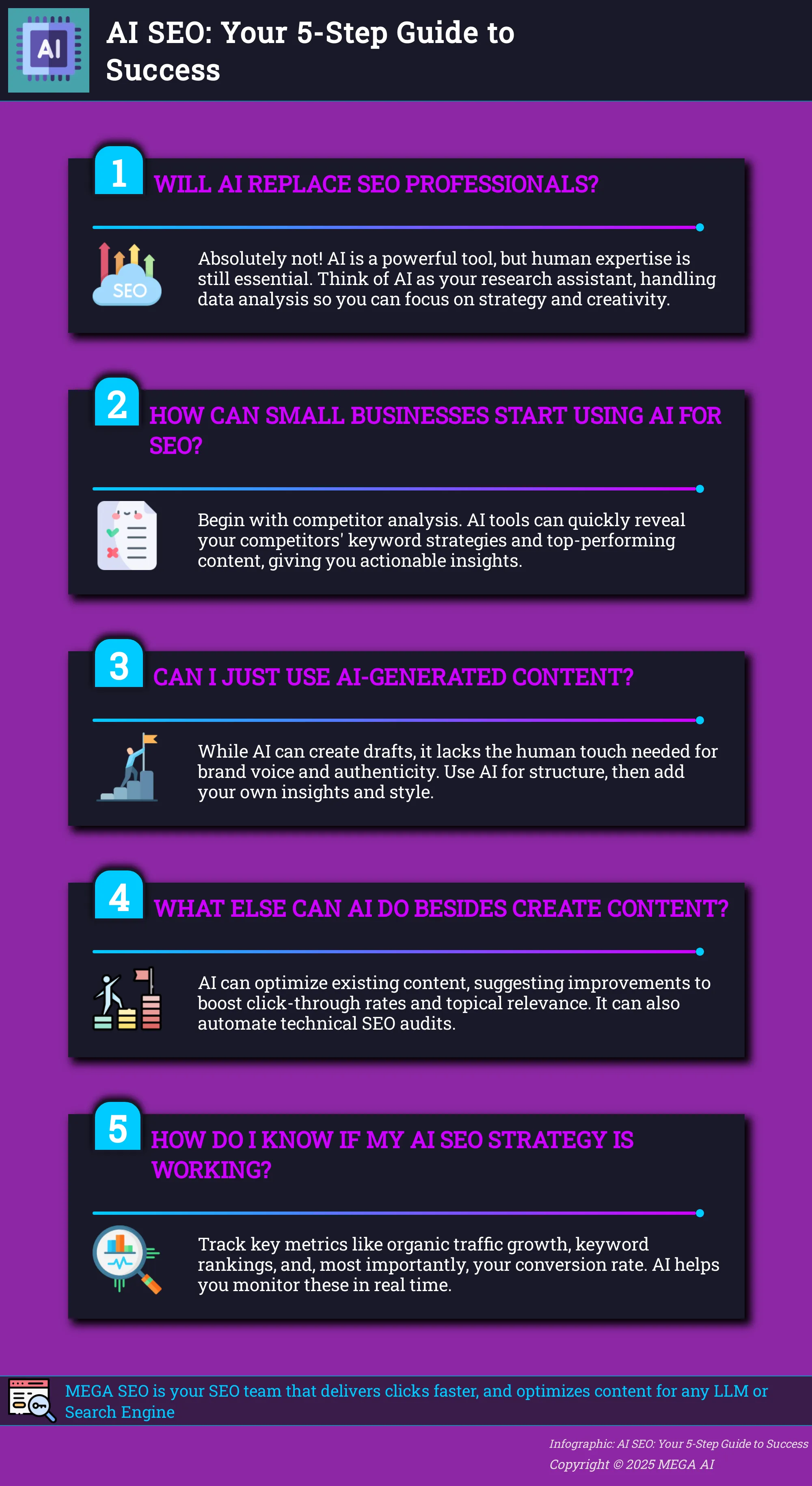
Can I rely solely on AI-generated content for my website? It's not recommended. While AI is excellent for creating outlines and first drafts, it can't capture your unique brand personality or build genuine trust with your audience on its own. The best content comes from using AI to handle the initial structure and research, followed by a human touch to add personal stories, ensure accuracy, and infuse the piece with your authentic voice.
How does AI help with more than just creating new content? AI's capabilities extend far beyond content generation. It can continuously monitor and optimize your existing articles, suggesting updates to improve click-through rates or adding new sections to increase topical relevance. AI tools can also perform technical SEO audits, automatically finding and suggesting fixes for issues like broken links or slow page speeds that can hurt your rankings.
How do I know if my AI SEO strategy is actually working? You should focus on tracking key performance indicators (KPIs) that align with your business goals. Monitor your organic traffic to see if it's increasing, and track your rankings for specific, high-intent keywords. Ultimately, the most important metric is your conversion rate. Seeing an increase in leads, sales, or sign-ups is the clearest sign that your AI-enhanced strategy is delivering real value.