
Competing with big-box retailers online can feel like an uphill battle. But Google's latest update, AI Overviews, might just be the advantage you need. These AI-generated summaries appear directly in search results, and a strong AI Overview product recommendation often favors local expertise over a massive catalog. Your deep product knowledge and community connection are now your most powerful assets. This guide will show you how to turn this search update into a real competitive edge and connect with more customers right in your area.
Key Takeaways
- AI Overviews generate new search demand: Google now acts as a discovery engine by recommending products in its summaries. When a user clicks a product, it triggers a new, highly specific search, moving them directly from research to a buying mindset.
- High-quality product data is your new competitive edge: Success in this new format depends less on a big marketing budget and more on providing clear, helpful, and well-structured product information. This gives small businesses a real opportunity to stand out against larger competitors.
- Prioritize structured data and transactional content: Implement product schema markup so AI can easily understand your product details. Shift your content strategy to focus on product-centric pages, like comparisons and buying guides, that align with a user's intent to make a purchase.
What is Google's AI Overview for Products?
Google is always evolving, and its latest update marks a quiet but powerful shift for anyone selling products online. You’ve likely seen the new AI Overviews at the top of some search results—the AI-generated summaries designed to answer questions directly. Recently, a significant change was rolled out for product-related searches within these overviews. Researchers noticed something interesting: a sudden spike in search volume for a wide range of products. The one thing they all had in common? They were being recommended in Google's AI Overviews.
This isn't your typical algorithm update. Instead of just shuffling rankings, Google has changed how users discover and search for products. When a product gets featured in an AI Overview for a query like "best running shoes for beginners," it gets a powerful endorsement. This feature creates a new pathway for customers to find what they’re looking for, and it presents a huge opportunity for small businesses to get their products in front of motivated buyers. Understanding how this works is the first step to making sure your products are the ones Google’s AI recommends. MEGA AI's SEO agent is designed to help businesses improve their visibility in these new AI-powered search experiences.
The Technology Behind AI Overviews
Think of AI Overviews as a new discovery engine built right into Google. Instead of just listing links, the AI synthesizes information from across the web to recommend products directly. When a user sees your product in an AI Overview and clicks on it, this action often triggers a new, more specific search. This process moves a potential customer from a general research phase straight into a buying mindset. It’s a fundamental change in how people find products. The system gives a powerful endorsement to featured items, and success hinges on providing the AI with clear, high-quality information it can understand and trust. This is where having well-structured product data becomes a major advantage for your business.
Availability and User Access
AI Overviews are not a small-scale experiment; they are currently active in over 120 countries and territories, making this a global shift in search. You won't see them for every query. Instead, they typically appear for more complex questions that don’t have a single, simple answer, such as "what are the best gifts for a new homeowner?" This is Google's way of helping users quickly get the lay of the land and explore different options without having to click through dozens of links. For local businesses, this is a prime opportunity. If you can provide the most comprehensive and helpful answer to these nuanced questions, you have a solid chance of being featured in the overview.
How Do the New Product Links Work?
So, what happens when a user clicks on a product link inside an AI Overview? You might assume it takes them directly to a product page, but that’s not what happens. Instead, Google launches a brand-new search for that exact product name. This simple action instantly creates new search demand. Essentially, the AI Overview acts as a discovery engine, and a click from a user tells Google to start a more specific, product-focused search. This two-step process is designed to refine a user's journey from a broad informational query to a targeted commercial one.
How AI Overviews Turn Searchers into Shoppers
This new search is where the magic happens for your business. The fresh search results page is packed with shopping ads, e-commerce category pages, and direct links to product pages—all the things a person ready to buy wants to see. With this small change, Google is effectively pushing users further down the buying funnel without them ever leaving the search engine. It turns a general researcher into an active shopper in a single click. To earn a spot in these recommendations, your product pages need to provide high-quality, relevant information that signals to Google you’re a great answer for the user.
Understanding the User Experience with AI Overviews
User Criticism and Controversial Answers
The introduction of AI Overviews has not been without its challenges, and public reaction has been mixed. You may have seen some of the more unusual suggestions that have gone viral, such as the AI recommending users put glue on pizza or drink urine to pass kidney stones. These kinds of controversial and incorrect answers have understandably made some users skeptical of the information presented in the overviews. For your business, this user skepticism highlights the enduring importance of brand trust. While appearing in an AI Overview is a valuable goal, a user who is unsure about an AI-generated answer will look for a credible source among the traditional search results to verify the information. This is where your high-quality, accurate content can make a difference and build the credibility that turns a visitor into a customer.
How Users Are Bypassing AI Overviews
Given the occasional inaccuracies, some users are actively looking for ways to return to the classic search results page. It's important to know that Google does not provide a simple setting to turn off AI Overviews permanently. Even users who opt out of Search Labs experiments will still see them in regular search. However, a common workaround has emerged: clicking the "Web" filter at the top of the search results page. This action removes the AI Overview and displays a more traditional list of links. For your business, this user behavior is a clear signal that foundational SEO practices are as relevant as ever. Optimizing for the classic "10 blue links" remains a critical part of any online strategy, ensuring you remain visible to customers who prefer to bypass the AI summary and go straight to the source.
How AI Overviews Change Product Discovery
Google's AI Overviews are reshaping the search results page from a simple list of links into an interactive starting point for shoppers. This shift fundamentally changes how potential customers find your products. Instead of clicking through multiple websites to compare options, users now see curated summaries with product images, key features, and pricing directly in the search results. This means the first impression of your product happens on Google itself, long before a customer visits your site. For small businesses, this presents both a challenge and a massive opportunity to get in front of high-intent buyers.
Think about it from the customer's point of view. They ask a question like "best running shoes for flat feet" and instead of ten blue links, they get a detailed summary comparing three top models with pros, cons, and where to buy them. If your product is in that summary, you've just skipped several steps in the traditional sales funnel. The new format creates a more direct and visual path to purchase, making every detail on your product pages more important than ever. Understanding this new discovery process is the first step to making sure your products are the ones being featured and that you stand out from the competition right on the search page.
Creating a More Shoppable Search Experience
AI Overviews are designed to make the path from search to purchase as smooth as possible. They pull together the most relevant details from across the web to present a comprehensive snapshot. For your business, this means providing rich, detailed product information is critical. The more attributes you associate with a single product—like color, material, size, and compatibility—the more accurately the AI can match it to a customer's specific query. AI search programs learn from your website’s language and visuals, so clear descriptions and high-quality images are both essential for getting noticed in this new format.
How Products Appear Directly in Search Results
The most significant change is that your products can now appear directly within the AI-generated answer, which is prime digital real estate. To secure a spot, you need to focus on your store's AI visibility—how accurately and often your business shows up in these AI-powered summaries. One of the best ways to do this is by using structured data. By implementing schema markup, you give search engines a clear, organized roadmap of your product information. This improves your chances of being featured. Think of it as labeling your data so the AI can easily read and present it to potential buyers.
What Does This Update Mean for Your Small Business?
Google updates can often feel like another hurdle to clear, but this shift toward AI Overviews is a genuine opportunity for small and local businesses. It changes the search results page from a simple list of links into an interactive, shoppable environment. Instead of just competing for a blue link, you’re now competing for a featured spot in a rich, detailed summary that answers a user's query directly. This levels the playing field in a significant way. Success is no longer solely about having the highest domain authority or a massive marketing budget. It’s about providing the best, most direct, and most helpful information about your products. For agile small businesses, this is a chance to get in front of customers in a completely new way, bypassing some of the traditional gatekeepers of search visibility. By understanding how this changes customer behavior, you can adjust your SEO strategy to meet shoppers exactly where they are: at the point of discovery. This new format prioritizes clarity, accuracy, and relevance, rewarding businesses that can structure their product data effectively and answer customer questions before they are even fully asked. It's a move from passive ranking to active engagement right on the search page.
Find More Opportunities for Product Discovery
Think about how people shop online. Research shows that the search bar is the most common tool customers use to discover products on e-commerce sites. AI Overviews essentially turn Google into one giant, universal search bar for products. A potential customer can now find your specific product—complete with images, key features, and pricing—without ever having visited your website before. This creates a powerful new channel for discovery, putting your products on equal footing with those from larger retailers, as long as your information is clear, accurate, and well-structured for Google’s AI to find. It's a direct line to interested buyers who are actively searching for what you sell.
Engage Customers Closer to Their Purchase Decision
This update fundamentally changes the sales funnel. By presenting detailed product comparisons and summaries directly in the search results, Google is pushing users further down the buying funnel before they even click on a link. The initial consideration and comparison stages now happen on the results page itself. This means your product descriptions, images, and key selling points have to work harder than ever. You have a critical opportunity to capture a buyer's interest at the exact moment they are evaluating their options, making the quality and appeal of your product information more important than ever. Your product page content is now your frontline sales pitch, delivered by Google's AI.
Benefit from More Engaged Traffic
Traffic from an AI Overview isn't like your typical website visitor. Since Google now functions as a discovery engine, it handles the initial window shopping for the user by showing them curated summaries with key features and product details. By the time someone clicks through to your site, they’ve moved past the browsing stage. They have already weighed their options and are shifting from a research mindset to a buying one. This means the visitors arriving on your product pages are better informed, more focused, and more prepared to make a purchase, which translates to higher-quality traffic and better conversion rates for your business.
Understand the New Competitive Landscape
Adapting to Google algorithm updates is essential for maintaining your online presence, and this update redefines the competitive landscape. The goal is no longer just to rank number one organically but to have your products featured prominently within the AI Overview. Your new competitors are the other products that appear alongside yours in these generated summaries. The winner is often the business that provides the most helpful, well-structured, and compelling product data. This is an advantage for small businesses, which can often move more quickly to optimize product pages and implement technical changes than larger, more bureaucratic companies. Your agility becomes a key competitive asset.
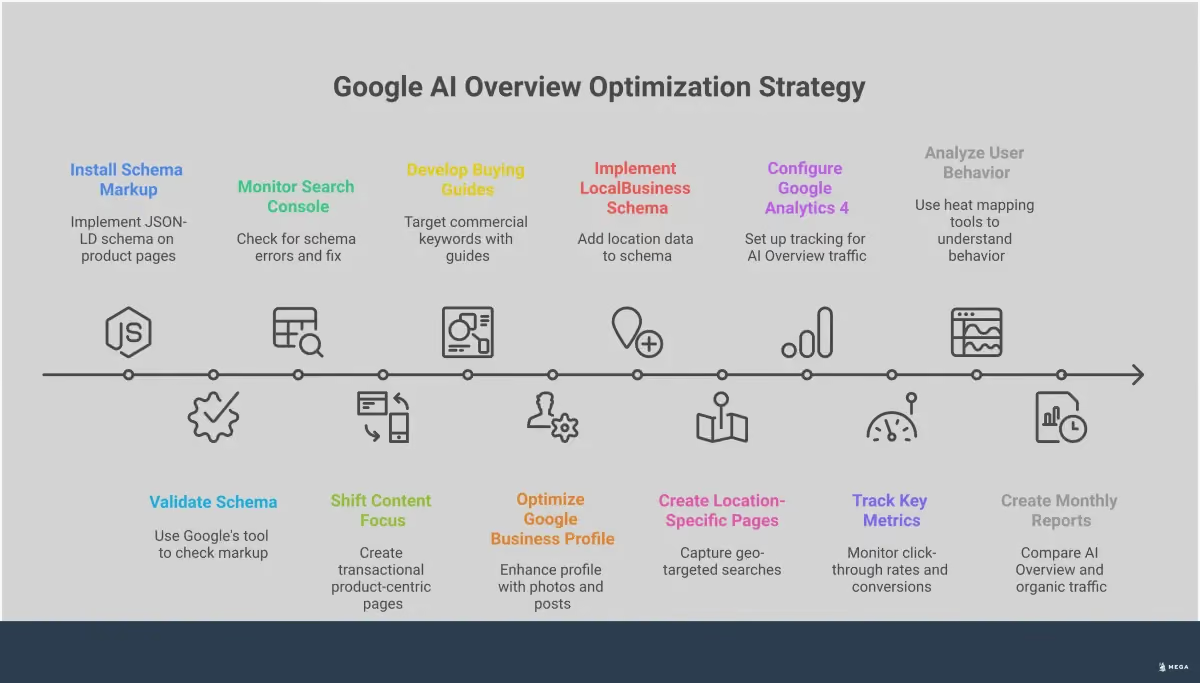
How to Optimize for AI Overview Visibility
Getting your products featured in Google's AI Overviews might seem complex, but it boils down to one core principle: making your product information incredibly clear, structured, and helpful. Think of it as preparing a perfect, easy-to-read spec sheet for Google's AI. The easier you make it for the AI to understand what your product is, who it's for, and why it's a great choice, the more likely it is to be included in a shoppable overview. This isn't about chasing a new algorithm with tricks; it's about doubling down on best practices that serve both your customers and search engines.
Optimizing for this new search experience means focusing on the quality and organization of your data. From detailed product descriptions and high-resolution images to the technical health of your website, every element plays a role. By providing comprehensive and well-structured information, you directly feed the AI the facts it needs to confidently recommend your products. This approach not only positions you for AI Overviews but also strengthens your overall SEO strategy, creating a better experience for shoppers who land directly on your site. It’s a win-win that prepares your business for the future of search.
Understanding When AI Overviews Are Triggered
AI Overviews don't show up for every search. They are most likely to appear when a user is in a research or discovery phase, asking questions that require a summarized answer. Think of queries like "best running shoes for beginners" or "how to choose a coffee maker." For these types of searches, Google's AI acts as a discovery engine, pulling together product recommendations and comparisons to help the user make a decision. The system is designed to move someone from a broad question to a specific buying mindset by presenting curated options directly in the results, pushing them further down the buying funnel before they even click a link.
Structure Your Product Information Clearly
To appear in AI Overviews, your product data needs to be organized and easy for Google to digest. Start with clear, descriptive product titles that include key details like brand, model, and primary function. From there, build out a comprehensive list of attributes. Think like a customer: What questions would they have? Include specifics like dimensions, weight, materials, colors, and compatibility. Using high-quality images with descriptive alt text is also crucial. These actionable insights not only help the AI understand your product but also improve the user experience, setting you up for success in a changing ecommerce market.
Write Compelling Product Descriptions
Your product descriptions are a prime opportunity to connect with both customers and AI. AI search programs learn from your website’s language, so it’s important to write clear, benefit-focused copy. Instead of just listing features, explain how they solve a customer's problem. Use natural language and incorporate keywords that your audience is searching for. This is a chance to innovate your marketing strategies by crafting descriptions that are persuasive for humans and informative for machines. Avoid jargon and focus on creating a narrative that makes your product the obvious choice.
Cover Your Technical SEO Basics
A strong technical foundation is non-negotiable for AI Overview visibility. Google prioritizes websites that offer an excellent user experience, which means your site needs to be fast, mobile-friendly, and secure (HTTPS). Slow loading times or a clunky mobile interface can prevent your products from being considered. Regular technical audits help ensure there are no crawling or indexing issues preventing Google from accessing your product pages. Focusing on high-quality, relevant content and a seamless site experience signals to Google that your website is a trustworthy source for product information.
Implement Product Schema Markup
Schema markup is a type of code that you add to your website to help search engines understand your content more effectively. Think of it as a vocabulary that explicitly tells Google, "This is a product, this is its price, and here are its reviews." By implementing product schema, you make it incredibly easy for AI to pull accurate, structured data for its overviews. This can significantly enhance their visibility and increase your chances of being featured in rich results, including the new shoppable AI Overviews. It’s one of the most direct ways to feed Google the exact information it needs.
How to Control Your Content's Appearance
While getting featured in AI Overviews is a great goal, you might want more control over how your content is presented. Maybe an AI-generated summary misses an important detail about your product, or you have specific pages you'd rather not have summarized. It’s important to know that Google considers AI Overviews a core part of the search experience, so there isn't a simple on/off switch to opt out completely while staying in the search results. Instead, control comes from giving search engines clear, page-level instructions about how you want your content displayed. This approach lets you manage your brand's appearance without hurting your overall visibility.
Troubleshooting Opt-Out Issues
If you need to keep certain content from appearing in AI-generated summaries, your best tools are preview controls. These are meta tags you add to the HTML of a specific page to give Google instructions. The most useful ones include:
- nosnippet: This tag prevents Google from showing any text snippet for your page in the search results. This is a strong signal that can keep the page out of AI Overviews.
- data-nosnippet: For more precise control, this tag lets you wrap specific parts of your text that you don’t want included in a search snippet.
- max-snippet: This allows you to set a maximum character length for your snippet.
Using these tags gives you fine-tuned control over how your information is summarized. While you could use a robots.txt file to block a page, this will likely remove it from Google's index entirely, which is rarely what you want. Managing these technical signals is a key part of a modern SEO strategy, ensuring your content is presented exactly how you intend.
How to Adapt Your Content Strategy
With AI Overviews putting products front and center, your content strategy needs a refresh. This doesn't mean throwing out your existing blog posts or guides. Instead, it's about rebalancing your efforts to meet customers where they are now: closer to the point of purchase. Since Google's updates are designed to improve search quality, understanding and adapting to these changes is crucial for staying visible. The goal is to create a content ecosystem where informational articles support a strong foundation of product-focused, transactional pages that drive sales.
Think of it as building a direct path from a customer's question to your product as the answer. While a blog post on "The Benefits of Organic Skincare" is still valuable for building brand awareness, a detailed comparison of your top three organic face serums is more likely to be pulled into an AI Overview for a search like "best organic serum for dry skin." This shift requires you to think less like a publisher and more like a helpful shopping assistant. Your content should guide users with clear, compelling, and product-centric information that directly addresses their needs and simplifies their decision-making process. This approach not only helps you rank but also builds trust with potential customers by giving them exactly what they need to make a confident purchase.
Shift from Informational to Transactional Content
For years, SEO has focused heavily on informational content that answers broad questions. While that remains important for building authority, AI Overviews prioritize content that helps users complete a task—like buying a product. This means you need to shift your focus toward creating transactional content. This type of content is designed to move a potential customer from consideration to conversion. It includes things like product comparisons, buying guides, detailed product pages, and lists of "best products for X." It directly addresses a user's intent to make a purchase by providing the specific details they need to make a confident decision.
Create More Product-Focused Content
To succeed in this new search landscape, your products need to be the stars of your content. Go beyond basic product descriptions and create rich, detailed pages that answer every possible question a customer might have. This includes high-quality images and videos, specifications, use cases, customer reviews, and FAQs. You can also create content that puts your products in context, such as "How to Style Our Linen Blazer for a Summer Wedding" or "A Step-by-Step Guide to Using Our At-Home Espresso Machine." These product discovery strategies make your items more visible and help customers visualize how your products fit into their lives.
Align Content with Purchase Intent
Every search query has an underlying intent. Your job is to create content that perfectly matches it. When a user searches for "waterproof hiking boots for women," they aren't just looking for information; they are actively shopping. Your content should reflect this by being direct, clear, and focused on the product's benefits and features that align with that specific need. By enhancing your site's content to match these high-intent keywords, you send strong signals to Google that your page is a relevant and helpful result. This alignment is crucial for getting your products featured in AI Overviews, as the AI is specifically designed to find the most direct answer to a user's product-related query.
Advertising Within AI Overviews
Beyond the organic opportunities, Google is also integrating paid advertisements directly into the AI Overview experience. This opens up another powerful channel for reaching customers at a critical moment in their research process. For small businesses, this means your ads can appear in the most prominent position on the search results page, framed by a helpful, AI-generated summary. Understanding how these ads are placed, selected, and managed is key to making sure your advertising budget works effectively in this new landscape. It’s not about a completely new system but rather an evolution of how existing search ads are displayed.
Ad Placements and Formats
When it comes to advertising within this new format, Google provides a few different placements for your ads to appear. According to Google's documentation, ads can show up above, below, or even directly inside the AI Overview. Placements above and below the summary are similar to traditional search ads, acting as bookends to the AI-generated content. The most interesting new format is the placement inside the overview itself, where your product or service can appear as a sponsored link woven into the summary. In all cases, these ads are clearly marked with a "Sponsored" label, so users can distinguish between paid and organic recommendations.
How Ads Are Selected and Displayed
Google uses a two-layered approach to determine which ads are relevant enough to show in an AI Overview. First, an ad must be relevant to the user's original search query, just like any standard search ad. But there's an added layer of scrutiny: the ad must also be contextually relevant to the information presented in the AI-generated summary. For example, if a user searches for "best running shoes" and the AI Overview discusses features like arch support and cushioning for long-distance running, Google will prioritize ads for shoes that match that specific context. This ensures the ads complement the summary rather than distract from it.
What Advertisers Can and Can't Control
One of the most important things for advertisers to understand is that you cannot specifically target AI Overviews as a placement. Ads that appear in this format are pulled from your existing Search campaigns. There is no separate campaign type or opt-in setting just for AI Overviews. This means that if your ads are eligible to run on the main search results page, they are also eligible to appear within an AI Overview. Your control is indirect; by creating high-quality, highly relevant ads and landing pages, you improve your chances of being selected for all valuable placements, including this one.
Recommendations for Advertisers
To increase your chances of appearing in AI Overviews, it’s best to lean into Google's own AI-powered tools. Since AI Overviews often trigger for complex, conversational queries, using broad match keywords with Smart Bidding is a recommended strategy. This combination allows Google’s algorithm to match your ads to a wider range of relevant searches. It's also more important than ever to ensure your ad copy and landing pages are tightly aligned with your keywords. For small businesses managing multiple campaigns, AI-powered platforms can help optimize your paid ads by automatically testing variations and allocating budget to the best-performing creative, ensuring your message stays relevant in this dynamic new environment.
How to Track and Measure Your Results
Optimizing your product pages for AI Overviews is a great first step, but you need to know if your efforts are actually paying off. Tracking your results helps you understand what’s working, what isn’t, and where to focus your energy next. It’s not just about watching numbers go up; it’s about gathering insights to make smarter decisions for your business. As Google rolls out new features like AI Overviews, the way we measure success can also shift. You’ll want to pay close attention to how users interact with these new search formats and how that interaction translates into real business outcomes.
Measuring performance involves connecting your SEO activities to tangible results like sales and leads. This means going beyond surface-level data to understand the entire customer journey, from the moment they see your product in an AI Overview to the final purchase. A structured approach to analytics will give you the clarity needed to refine your strategy and prove the value of your work. For small businesses, this is especially important because every marketing dollar counts. You need to be certain that the time and resources you invest in optimization are generating a positive return. While this can feel like a lot to manage, having a clear measurement plan is the only way to ensure your SEO strategy is driving sustainable growth.
Which Key Performance Metrics Should You Track?
To understand your performance, you need to look beyond simple traffic numbers. Your key performance indicators (KPIs) should tell a story about your visibility and how users are engaging with your products in search. Start by tracking your search engine rankings for important product keywords. Are you appearing on the first page or within the AI Overview itself? Next, monitor your click-through rate (CTR) in Google Search Console. This tells you what percentage of people who see your product in search results actually click on it. A low CTR might mean your product title or image isn't compelling enough to stand out.
Keep a Close Eye on Conversion Rates
Ultimately, the goal of appearing in AI Overviews is to drive sales. That’s why monitoring your conversion rate is so important. A conversion is any desired action a user takes on your site—making a purchase, signing up for a newsletter, or filling out a contact form. You should measure SEO performance by tracking how many visitors from organic search complete these actions. If you’re getting a lot of clicks from AI Overviews but few conversions, it could signal an issue with your product page, pricing, or checkout process. This metric directly connects your SEO efforts to your revenue.
Assess the Quality of Your Traffic
Not all website traffic is created equal. It’s better to have 100 visitors who are genuinely interested in your products than 1,000 who leave your site immediately. To assess traffic quality, look at user behavior metrics in Google Analytics. How long do visitors stay on your product pages? Do they look at multiple products or just one before leaving? Key metrics like a low bounce rate and a high number of pages per session indicate that you’re attracting an engaged audience. You can also analyze product performance by tracking add-to-cart actions and checkout initiations.
Set Up Your Analytics for Success
To track these metrics effectively, you need the right tools and a solid setup. Google Analytics and Google Search Console are essential and free platforms that provide a wealth of data. Make sure you have e-commerce tracking enabled in Google Analytics to connect website traffic directly to sales and revenue. This allows you to see which products are performing best and where your most valuable customers are coming from. Establishing a structured framework for measuring your algorithm's performance from the start will make it much easier to adapt your strategy as AI in search continues to evolve.
How to Prepare for Common Challenges
Adapting to AI Overviews presents a huge opportunity, but it’s not without its hurdles, especially for small businesses with limited resources. Getting your products featured requires more than just having a great product; it means getting your technical and data houses in order. Many business owners find themselves facing a steep learning curve with data management, technical SEO, and resource allocation.
The good news is that these challenges are entirely manageable with a clear strategy. Understanding the potential roadblocks is the first step to creating a plan that works for your business. Instead of seeing them as barriers, think of them as a checklist for building a stronger, more resilient online presence. Let's walk through the three most common challenges and how you can approach them effectively, ensuring your business is ready to compete in this new search landscape. By tackling these issues head-on, you can turn potential weaknesses into competitive strengths.
Address Data and Integration Hurdles
One of the biggest challenges is ensuring your product data is clean, structured, and easy for Google’s AI to understand. This means organizing information like product names, prices, availability, and descriptions in a consistent format. For businesses without a dedicated tech team, integrating this data into your website can feel like a complex puzzle. By implementing schema markup, you can explicitly tell search engines what your data means, which improves your chances of being featured in rich results. This structured data is the foundation that allows AI Overviews to pull your product information accurately and display it directly to shoppers.
Manage the Technical Implementation
Beyond just data, the technical health of your website plays a critical role. AI search programs learn from your website’s language and visuals, so both are increasingly important as user search preferences evolve. This means focusing on technical SEO elements like site speed, mobile-friendliness, and high-quality images is no longer optional. A slow or clunky website can prevent Google from effectively crawling your pages and understanding your products, no matter how great your content is. Ensuring your site provides a smooth user experience is essential for both customers and the AI systems trying to recommend your products.
Allocate Your Budget and Resources Wisely
As a small business owner, your time and budget are precious. Deciding where to invest can be tough. You could spend hours learning the technical details of schema markup and site optimization, or you could allocate resources toward tools that automate the process. AI-powered analytics tools can offer valuable insights into customer behavior and trends, helping you make smarter decisions without a massive investment. The key is to find a balance that works for you. An AI-driven SEO agent can handle the technical implementation and content strategy, freeing you up to focus on running your business.
How Local Businesses Can Win with This Update
When a major search update happens, it’s easy to assume that larger companies with bigger budgets will come out on top. However, Google's AI Overviews create unique openings for local businesses to connect with customers in their area. Your deep understanding of the local community is an asset that big-box retailers can't easily replicate. This update isn't just about having the most products; it's about providing the most relevant and helpful answers to real questions people are asking. The AI is designed to synthesize information and present a direct solution, which is where your specialized knowledge becomes a powerful tool.
By focusing on your specific strengths—your location, your niche expertise, and your direct connection to customers—you can turn this shift into a significant advantage. AI Overviews often prioritize direct, useful information, which is exactly what local businesses are positioned to provide. Instead of trying to outspend national chains, you can outsmart them by being more targeted, authentic, and helpful. The key is to lean into what makes your business unique and ensure that information is clearly communicated online. This means thinking less like a massive catalog and more like a trusted local expert.
Find Your Local SEO Advantage
Your physical location is one of your strongest assets. AI Overviews often consider geographic relevance, especially for searches with local intent like "best running shoes near me." To capitalize on this, make sure your local SEO fundamentals are solid. This starts with a fully optimized Google Business Profile, complete with accurate hours, photos, and plenty of positive reviews from local customers. Small businesses can also implement schema markup on their websites, which structures your data in a way that helps search engines understand your location, products, and services. This technical step significantly improves your chances of being featured in specialized search results, including AI-generated summaries.
Build Authority for Your Products
AI search programs learn from your website’s language and visuals to understand your business, making both increasingly important. To win a spot in AI Overviews, you need to prove you're an authority on the products you sell. Go beyond basic product listings and create content that demonstrates your expertise. Write detailed product descriptions that answer common questions, publish blog posts comparing different models, or create how-to guides for using your products. This kind of high-quality, helpful content signals to Google that you are a trusted source, making it more likely that the AI will pull information from your site when generating an answer.
How to Compete with Big Box Retailers
This update can help level the playing field between small businesses and large retailers. AI Overviews are designed to find the best answer for a user, not just the biggest website. If your small business offers a niche product with excellent, detailed content and strong customer reviews, you have a real chance of being featured over a generic page from a national chain. By using AI-driven tools, you can access powerful data analysis and optimization techniques that were once reserved for large corporations. This allows you to deliver personalized marketing and optimize your online presence to compete more effectively for local customers.
How to Prepare for the Future of AI in Search
The world of search is always changing, and the rise of AI is the next big step in its evolution. While it might feel like you need to throw out your old playbook, the fundamentals of good SEO are more important than ever. Preparing for the future isn't about predicting every single change. It's about building a flexible, customer-focused strategy that can adapt and thrive no matter what comes next. The key is to focus on creating a strong foundation that serves your audience, which in turn serves the goals of search engines.
Instead of reacting to every new headline, you can proactively build a marketing approach that’s ready for the long haul. This involves creating a solid strategy, staying informed about major shifts, and planning your technical optimizations with the future in mind.
Build a Resilient SEO Strategy
A resilient SEO strategy is one that doesn't break every time Google tweaks its algorithm. It’s built on the timeless principle of putting your customer first. This means deeply understanding what your audience is looking for and creating high-quality content and product pages that meet their needs. When your website is the best answer for a customer's question, search engines are more likely to feature it, whether in traditional results or an AI Overview.
Focus on building a strong brand reputation, earning authentic customer reviews, and ensuring your website provides a smooth and helpful user experience. A strong SEO foundation is less about chasing short-term tricks and more about creating a valuable online presence that can withstand industry shifts.
Stay Ahead of Algorithm Changes
Keeping up with search engine updates is essential for any business with an online presence. As The E Digital notes, "Understanding and adapting to Google algorithm updates is crucial for maintaining and improving a website’s search engine performance." Staying ahead doesn’t mean you need to become a full-time SEO analyst. It means paying attention to major confirmed Google Search updates and understanding the general direction search is heading.
The goal is to see the bigger picture. For example, recent updates have consistently prioritized content that demonstrates real expertise and provides a genuinely helpful user experience. By focusing on these core areas, you’ll find that your strategy is already aligned with the principles behind most updates, making it easier to adapt when changes do occur.
Plan Your Long-Term Optimization Strategy
Long-term success in AI-driven search requires a proactive approach to technical optimization. One of the most powerful tools at your disposal is schema markup. As Simply Be Found explains, "By implementing schema markup, businesses can enhance their visibility in search results." Think of schema as a vocabulary that helps search engines understand the specific details on your page, like product prices, availability, and ratings. This structured data is exactly what AI models need to pull accurate information for AI Overviews.
You can also use AI-powered tools to your advantage. According to Pro Relevant, small businesses can use AI analytics to "gain valuable insights into customer behavior, preferences, and trends." Using these insights helps you refine your product offerings and content, ensuring you’re always meeting your customers where they are. This data-driven approach allows you to make smarter, proactive decisions for sustainable growth.