
What if you could attract website visitors who are over four times more likely to become customers? Recent research shows this is the reality for traffic coming from Google’s new AI Overviews. These are not just casual browsers; they are pre-qualified buyers with high purchase intent. The AI has already done the initial research for them, and your business has been presented as a top solution. The key is getting your business featured in the first place. This guide will walk you through the practical strategies needed to appear in these summaries and capture this incredibly valuable, high-converting traffic for your business.
Key Takeaways
- Shift your focus from ranking to being the answer: AI Overviews provide direct summaries at the top of search results, shortening the path to purchase. Your goal is to have your business information featured directly within these answers, not just listed as a link.
- Capture higher-quality leads: Visitors who arrive from an AI Overview are more informed and have a stronger intent to purchase. By optimizing for these placements, you connect with a pre-qualified audience that is closer to making a decision.
- Prioritize structured content and technical precision: To appear in AI Overviews, your content must be authoritative and your website technically sound with structured data. For small businesses, using an automated SEO agent is the most efficient way to manage these LLMO requirements and stay competitive.
What Are Google AI Overviews?
Google AI Overviews are the AI-generated summaries that now appear at the top of many search results pages. Instead of just presenting a list of links, Google synthesizes information from various web pages to provide a direct, comprehensive answer to a user's query. This feature is designed to make the search process faster by removing the need for users to click through multiple sites to piece together information.
For small businesses, this shift is significant. An AI Overview can act as a powerful summary of a topic, product, or service, often pulling in details like pricing, reviews, and key features. The goal is to remove common obstacles in the buying journey by presenting a clear, consolidated snapshot of information right on the search results page. This changes how customers find, compare, and ultimately decide to purchase from a business.
How Do AI Overviews Change Traditional Search?
AI Overviews fundamentally alter the classic search experience. Where users once saw a list of ten blue links and had to do the research themselves, they now get a curated summary that does the initial work for them. This is reshaping the buyer funnel by shortening the distance between discovery and decision. The AI can surface case studies, testimonials, and product details in a conversational format, giving a searcher a much richer first impression than a simple meta description. This means your business can be introduced to a potential customer with more context and authority, right from the start.
What Do AI Overviews Look Like in Search?
You’ll find AI Overviews in a shaded box at the very top of the search results, above the traditional organic listings. These summaries often include images, links to sources, and sometimes carousels for product comparisons. For ecommerce businesses, Google uses high-quality, structured product data to populate these results, making your items more visible and relevant. This is part of a broader trend in how AI is changing consumer search behavior, with visual tools and direct answers becoming more integrated into the search experience. The result is a more dynamic and informative entry point for potential customers.
### How AI Overviews Work AI Overviews are more than just simple summaries. They are the result of a complex process designed to understand a user's intent and synthesize information from across the web to provide a single, cohesive answer. This process relies on advanced AI models and sophisticated search techniques to gather and present information in a new, conversational format. For a small business, understanding the mechanics behind these overviews is the first step toward creating content that gets featured. It’s not about tricking an algorithm; it’s about providing clear, authoritative information that the AI can easily understand and trust as a reliable source for its answers. #### Powered by Google Gemini The engine driving these new search experiences is a specialized version of Google's Gemini AI model. This isn't just a standard chatbot; it's an AI built for multi-step reasoning, which means it can break down complex questions, understand nuance, and pull together information from different sources to form a coherent summary. Because Gemini is designed to process information conversationally, your website content needs to be clear, direct, and well-organized. The AI needs to easily identify the key points you're making to feature them in an overview. This is why structured data and logical content flow are more important than ever. #### The "Query Fan-Out" Technique To build a comprehensive answer, AI Overviews use a method Google calls the "query fan-out" technique. Instead of performing a single search, the AI conducts many related searches at once to gather a broader and more diverse set of information. For example, a search for "best running shoes for beginners" might trigger secondary searches for "running shoe cushioning types," "pronation support," and "beginner running tips." This means your content must be thorough. To be seen as an authoritative source, you need to cover a topic in depth, answering the primary question as well as the likely follow-up questions a user might have. ### Accuracy and Known Limitations While AI Overviews are a powerful new tool, the technology is still evolving and isn't perfect. Google is transparent about the fact that these AI-generated summaries can sometimes contain errors. As a business owner, it's important to be aware of these limitations. The system is constantly learning, and its accuracy depends heavily on the quality of the information available on the web. This presents both a challenge and an opportunity: by creating factually accurate and unambiguous content, you can position your business as a trustworthy source that the AI is more likely to pull from correctly. #### The Risk of Inaccurate Information Google acknowledges that AI Overviews may occasionally provide inaccurate or "hallucinated" information. An AI hallucination is when the model generates information that is factually incorrect but presented as if it were true. This can happen when the AI misinterprets data from a source or combines information from multiple sources in a way that creates a false statement. To protect your brand, the best defense is to ensure your own website content is impeccably accurate and clear. By providing unambiguous facts about your products, services, and industry, you reduce the chances of the AI misrepresenting your business. #### Early Criticisms and Examples Shortly after their wide release, AI Overviews faced criticism for generating some dangerously incorrect answers, such as providing misleading health information. These instances highlighted the risks of relying on AI for critical information and prompted Google to make rapid adjustments to its models. For businesses, these early stumbles serve as a reminder of the importance of E-E-A-T (Experience, Expertise, Authoritativeness, and Trustworthiness). As the AI gets better at identifying reliable sources, websites that consistently provide accurate, expert-backed information will be more likely to be featured and less likely to be associated with incorrect summaries. ### User Control and Experience Google understands that not every user will want an AI-generated summary for every search. Because of this, they have built in options for users to control their search experience. This includes the ability to bypass the AI Overview entirely and view a traditional list of links, as well as upcoming features to adjust the level of detail in the answers provided. This flexibility means that while optimizing for AI Overviews is critical, you can't afford to neglect traditional SEO principles. Your business needs a balanced strategy that caters to both the new AI-driven search format and the classic "ten blue links" that many users still prefer. #### Bypassing AI Overviews with the "Web" Filter For users who prefer a traditional search experience, Google has included a "Web" filter at the top of the results page. With a single click, a user can hide the AI Overview and see only the familiar list of organic web links. This is a crucial feature because it confirms that foundational SEO is still essential. Ranking your website in the traditional results remains a primary goal, as this is the only way to capture traffic from users who opt out of the AI experience. Your strategy should be two-fold: create content structured for AI Overviews while also maintaining strong technical SEO and link-building practices to secure your spot in the standard web results. #### Adjusting AI Overview Complexity Soon, users will be able to adjust AI Overviews to be simpler or more detailed, depending on their needs. This feature underscores the need for highly structured and layered content. Your web pages should be organized in a way that allows an AI to easily extract a high-level summary or dive deeper for more specific details. Using clear headings, bulleted lists, and FAQ schema can help organize your information into digestible chunks. For small businesses, managing this level of technical precision can be time-consuming, which is where an automated SEO agent can be a game-changer, ensuring your content is perfectly structured for this new, flexible search format. ### Scale and Availability AI Overviews are not a limited experiment; they represent a major, global evolution of the search engine. The feature is currently available in over 120 countries and territories, and Google is continuing to expand its reach. This wide-scale rollout signals that optimizing for AI-driven search is not an optional or future-facing task—it's a present-day necessity for any business that relies on online visibility. For small and local businesses, this means the competitive landscape has fundamentally changed. Ignoring this shift is no longer an option if you want to connect with customers who are increasingly starting their journey with an AI-powered answer.
How AI Overviews Change the Buyer's Journey
Google's AI Overviews are fundamentally changing how customers find information and make purchasing decisions. Instead of clicking through multiple blue links to piece together an answer, users now get a synthesized summary at the top of the search results. This shift streamlines the entire buyer's journey, collapsing the traditional marketing funnel and creating a more direct line from discovery to decision. For small businesses, this means the touchpoints where you can influence a potential customer are changing, and the opportunity to get noticed is concentrated at the very top of the page.
The journey is no longer a long, winding road of extensive research across dozens of websites. Instead, it’s becoming a more focused and efficient process. AI Overviews act as a digital concierge, curating the most relevant information and presenting a handful of top options. This reduces the friction and choice paralysis that often stalls a purchase. As a result, businesses that appear in these AI-generated summaries gain a significant advantage, capturing the attention of buyers who are further along in their decision-making process and ready to act. Understanding this new, condensed customer journey is the first step to adapting your strategy and ensuring your business remains visible.
A Faster Path from Awareness to Purchase
In the past, a potential customer might spend hours or even days researching a product, comparing features, and reading reviews across various sites. AI Overviews consolidate this entire process into a single, concise summary. They effectively remove many of the obstacles in the buyer's journey by presenting a curated list of the best products or services for a specific need. This means the distance between a customer becoming aware of a problem and making a purchase is shrinking. Your business needs to provide clear, authoritative answers to appear in these summaries and catch buyers at this critical moment.
Shortening the Customer Research Cycle
The research phase of the buyer's journey is becoming much shorter and more targeted. Buyers can ask complex, conversational questions and receive instant, comprehensive answers. AI-powered search recognizes connected queries as part of a single journey, allowing it to deliver increasingly personalized and relevant information. Instead of a user manually compiling data, the AI does the heavy lifting, curating insights and comparing options. This means your content must be optimized not just for keywords, but for answering the specific questions your target audience is asking at every stage of their decision-making process.
Creating a More Direct Path to Conversion
Because AI Overviews pre-qualify both the information and the user, the path to conversion is much more direct. Users who click through from an AI Overview are typically more informed and have a higher intent to purchase. They’ve already seen a summary of why a product or service is a good fit for them. In fact, users clicking from search results with AI Overviews are often more likely to spend more time on the sites they visit. This higher engagement, combined with higher intent, is why appearing in these curated results positions your business in front of a pre-vetted audience that is ready to take the next step.
The Impact of AI Overviews on Website Traffic
The biggest question for many business owners is how AI Overviews will affect their website traffic. The fear of "zero-click searches," where users get their answers without ever visiting a webpage, is a valid concern, and it's causing a lot of anxiety. However, the reality is more nuanced than a simple drop in visitors. AI Overviews are not eliminating traffic; they are changing its nature. The focus is shifting from the quantity of clicks to the quality of the visitor. While overall traffic numbers might fluctuate, the visitors who do arrive on your site are often more qualified and closer to making a purchase, because the AI has already done the initial vetting for them.
This shift requires a new way of thinking about SEO. Instead of just aiming for the top spot in the blue links, the goal is to become the source of truth that powers the AI's answer. When your business is featured, you gain credibility and attract high-intent customers who have already been warmed up. The visitors who click through are not just browsing; they are actively seeking a solution that the AI has already recommended. This section explores how user click behavior is evolving and the broader implications of relying on AI-generated answers, so you can adapt your strategy accordingly.
Changes in User Click Behavior
AI Overviews change the search experience by providing a curated summary upfront, which does the initial research for the user. Instead of sifting through ten blue links, a user gets a consolidated answer that addresses their query directly. According to Google, this doesn't stop them from exploring further. In fact, people who use AI Overviews tend to search more frequently and visit a wider variety of websites. The key difference is intent. Visitors arriving from an AI Overview are more informed because the summary has already answered their basic questions. This means the traffic you receive is from a pre-qualified audience that has a stronger interest in what you offer.
Concerns About Reduced Critical Thinking
While AI Overviews offer convenience, they also raise concerns about how users engage with information. Some worry that a reliance on AI-generated summaries could discourage critical thinking, leading people to accept answers without verifying them. This is particularly relevant because these summaries are not always perfect. Google itself acknowledges that AI Overviews can make mistakes or present inaccurate information. For businesses, this highlights the importance of being a source of truth. By creating authoritative, well-researched, and accurate content, you build trust. When users encounter a questionable AI summary, they will look for reliable sources to confirm the details, and your website can be that trusted destination.
3 Conversion Obstacles AI Overviews Solve
The traditional path a customer takes from discovering a need to making a purchase is rarely a straight line. It’s often filled with friction points that can cause them to lose interest, get confused, or simply give up. For small businesses, every one of these friction points is a lost opportunity. AI Overviews change this dynamic by smoothing out the buyer's journey and removing some of the biggest hurdles that stand between a search query and a sale.
By summarizing information, comparing options, and presenting a clear path forward, AI Overviews directly address the common frustrations that cause potential customers to drop off. Understanding these obstacles is the first step to positioning your business as the solution. When your brand appears in an AI-generated answer, you’re not just getting visibility; you’re being presented as the most direct answer to a buyer’s problem. Optimizing for this placement is a core part of modern SEO strategy, as it helps you meet customers at a critical moment of decision.
Solving Information Overload for Buyers
A simple search for a product or service can quickly spiral into chaos. A potential customer might open twenty different tabs, skim a dozen listicles, and watch a handful of video reviews. This is information overload, and it’s a major conversion killer. Faced with too many choices and conflicting details, many people simply quit their search. AI Overviews solve this by acting as a powerful filter. They digest the vast amount of information online and present a concise, relevant summary. Instead of ten pages of results, the user gets a handful of curated options, making it much easier to avoid decision fatigue and move forward with confidence.
Ending the Endless Research Loop
The next obstacle is the research loop, also known as analysis paralysis. This happens when a buyer gets stuck comparing features, prices, and reviews, clicking back and forth between websites without ever making a decision. They overthink every detail until they feel too overwhelmed to choose anything at all. AI Overviews break this cycle by doing the initial comparison for the user. The summary often highlights key differences and presents a clear, side-by-side look at the top contenders. This ends the endless loop by providing a digestible analysis right on the search page, helping buyers make a choice instead of getting lost in the process of researching.
Building trust and credibility
In a world of sponsored posts and affiliate marketing, trust is hard to earn. Customers are naturally skeptical of recommendations from sources that might have a hidden motive. This is perhaps the biggest obstacle to conversion. AI Overviews help overcome this by positioning the recommendation as coming from Google itself—a neutral and authoritative source. When your business is featured in an AI-generated answer, it carries an implicit endorsement from the search engine. This instantly builds a level of trust and credibility that would otherwise take much longer to establish, making customers more comfortable with their decision to engage with your brand.
Why AI Overview Visitors Convert 4.4x More
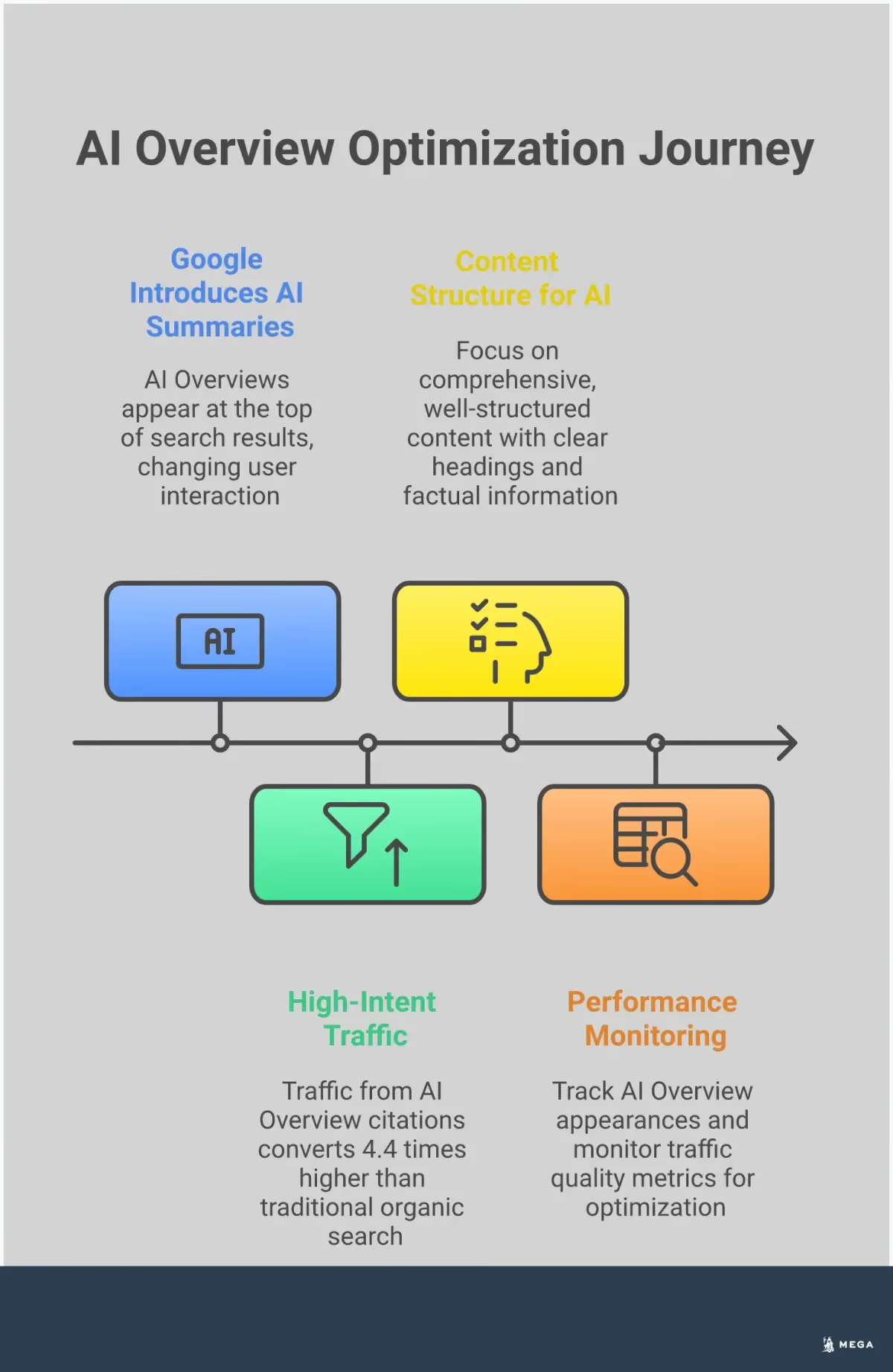
It’s not just about getting more traffic; it’s about getting better traffic. Research shows that visitors who arrive on your site from an AI-generated search result are significantly more likely to become customers. In fact, some studies indicate that AI search visitors convert up to 4.4 times more than those from traditional organic search. This shift is a game-changer for small businesses, turning search engine visibility into a powerful tool for generating high-quality leads.
So, what makes this traffic so valuable? It comes down to the user’s journey. By the time someone clicks a link within an AI Overview, they’ve already moved past the initial discovery phase. The AI has done the heavy lifting of gathering, comparing, and summarizing information, which means the user arriving on your site is more informed and closer to making a decision. They aren't just browsing; they are actively evaluating their options. This creates a more efficient path to purchase, connecting you with customers who are not just looking, but are ready to act. Understanding this dynamic is key to adapting your SEO strategy for a new era of search.
Capturing High-Intent Buyers
When a user interacts with a detailed AI Overview and then clicks through to your website, they are sending a strong signal about their intentions. They are no longer just casting a wide net with a broad query. Instead, they have digested a summary of information and are taking a deliberate next step. According to research from Google, users who click from search pages featuring AI Overviews tend to spend more time on the sites they visit. For your business, this means the visitors you get are more engaged, more invested in finding a solution, and ultimately, more likely to be serious about making a purchase. They are looking for confirmation, not just information.
Attracting Pre-Qualified Buyers
Traditional search results can present a user with dozens of options, leaving them to sort through which ones are relevant. AI Overviews change this by acting as a filter. They synthesize information from multiple sources to present a curated list of the best options. As Ahrefs notes, AI Overviews reduce the choices by presenting a handful of vetted products or services. When your business is featured in that summary, the visitor who clicks through is already pre-qualified. They arrive with a baseline understanding of what you offer and why it’s a good fit for their needs. This means you spend less time convincing them and more time closing the sale.
Reducing Customer Decision Fatigue
One of the biggest hurdles in any online purchase is information overload. Faced with too many choices and conflicting details, many potential customers simply give up. AI Overviews help solve this by simplifying the decision-making process. They cut through the noise and present clear, concise answers, which helps build a user’s confidence. By doing the initial research for the customer, the AI reduces the mental effort required to make a choice. This creates a smoother customer journey where buyers feel more certain about their decisions. When they land on your site, they are less overwhelmed and more prepared to take the final step.
How AI Overviews Build Trust and Simplify Decisions
When a potential customer is looking for a solution, they face a wall of information. Dozens of search results, conflicting reviews, and sponsored ads all compete for their attention. This process can be exhausting and often leads to decision paralysis. AI Overviews change this dynamic by acting as a trusted filter. They synthesize information from multiple sources and present a single, summarized answer directly on the search results page.
This shift is significant because it streamlines the buyer's journey. Instead of sifting through endless links to piece together an answer, the customer gets a curated response that feels authoritative and unbiased. This builds immediate trust and simplifies the decision-making process, guiding them from awareness to consideration much more quickly. For a small business, earning a spot in this summary is like getting a direct recommendation from the most trusted source on the internet: Google itself.
Leveraging Google's Built-In Authority
When a recommendation comes from an AI Overview, it carries the implicit endorsement of Google. For many users, this feels more trustworthy than an ad or a blog post from an unfamiliar brand. The information is presented as a factual summary, not a sales pitch. As the team at Ahrefs notes, "the recommendation feels like it's coming straight from Google, not someone else who might have a different motive to recommend a product." This perceived neutrality helps overcome the natural skepticism buyers have online. By positioning your business as a source for these answers, you borrow some of that inherent authority and build credibility with potential customers before they even visit your site.
Offering Curated Recommendations and Simple Comparisons
One of the biggest hurdles for modern buyers is the sheer volume of options. AI Overviews solve this by doing the heavy lifting. They analyze product features, reviews, and expert opinions to present a handful of the best choices. Buyers can instantly curate relevant insights without opening dozens of tabs. This is especially powerful for local businesses, as an AI Overview might summarize the "best plumbers in [city]" by highlighting top-rated services with fair pricing. This curated approach reduces the customer's research burden, simplifies comparisons, and makes them feel more confident in their final decision. It transforms a complex research task into a straightforward choice between a few well-vetted options.
Giving Buyers Clear Next Steps
After summarizing the best options, AI Overviews provide clear, actionable next steps. The summary typically includes links directly to the websites and sources it used for its information. This creates a seamless transition from learning to acting. A customer reading about the best accounting software for small businesses can click directly to a featured company's pricing page or sign up for a demo. This direct path removes friction from the buying process. As noted by Woostify, Google AI Overviews are changing how customers discover, compare, and buy. By optimizing your content to be a source for these summaries, you create a direct and efficient route for high-intent customers to find and engage with your business.
What Is LLM Optimization (LLMO)?
LLM Optimization, or LLMO, is the practice of fine-tuning your website, content, and brand presence to appear in the answers generated by large language models. Think of tools like ChatGPT, Perplexity, and especially Google’s AI Overviews. While traditional SEO focuses on getting your website link to the top of the search results, LLMO aims to get your information featured directly within the AI-generated summary. This is a critical shift for businesses, especially since many have seen a decline in organic website clicks since AI Overviews launched.
The goal is to become a trusted source that the AI relies on to formulate its answers. When your business is cited in an AI Overview, you gain visibility with high-intent buyers who are already looking for a solution. This is precisely what MEGA AI’s SEO agent is designed for. Its LLM Placement feature works to improve how your business shows up in these new AI-powered search results, ensuring you’re not just part of the conversation but are leading it. It’s about moving from just being a link on a page to being the answer to a customer's question.
LLMO vs. Traditional SEO: What's the Difference?
The core difference between LLMO and traditional SEO lies in the end goal. Traditional SEO is a race for clicks, focused on ranking your webpage as high as possible in the classic blue links. LLMO, on the other hand, is a race for inclusion. Your goal is to have your content, data, and brand name woven directly into the AI’s response. This means that old metrics don’t tell the whole story anymore. The entire landscape of SEO metrics is changing because of this disruption.
Success is no longer just about keyword rankings and click-through rates. Instead, you need to start tracking new indicators like answer inclusion, entity recognition, and schema adoption. These factors help AI models understand your content’s context and credibility, making it more likely to be featured. It’s a fundamental change from optimizing for a list of results to optimizing for a direct, synthesized answer.
Key Content Strategies for AI Placement
To get your content featured in AI Overviews, you need to think like an AI. These models prioritize information that is clear, structured, and authoritative. Your content strategy should focus on creating comprehensive resources that directly answer the questions your target audience is asking. For e-commerce businesses, this means having high-quality, structured product data that AI can easily parse and present to shoppers.
Beyond just answering questions, your content should aim to build a relationship with the reader that extends beyond a single website visit. This involves creating in-depth guides, helpful comparisons, and expert commentary that establish your brand as a go-to resource in your industry. When you consistently provide valuable, well-organized information, AI models are more likely to recognize your authority and feature your content.
How to Create Answer-Focused Content
Creating answer-focused content means writing for clarity and utility. Start by identifying the specific questions your customers ask throughout their buying process. Structure your content with clear headings and subheadings that address these questions directly. Use simple, natural language and avoid jargon. The easier it is for a human to understand, the easier it is for an AI to process.
Remember that AI systems are getting better at understanding the entire customer journey. They can connect a user’s initial query with their follow-up questions. Your content should anticipate this by providing a logical flow of information that guides the user to the next step. Research shows that users who click through from AI Overviews are often more engaged, so give them in-depth content that proves your expertise and encourages them to stay.
How to Optimize for AI Overview Visibility
Getting your business featured in Google's AI Overviews requires a strategic approach. It’s not about finding a single trick, but about consistently showing Google that you are a trustworthy and authoritative source of information. The goal is to make your content as easy as possible for AI systems to read, understand, and cite. This involves a mix of technical precision, high-quality content, and smart automation to keep everything running smoothly. By focusing on these key areas, you can significantly improve your chances of appearing in these valuable search spots.
Start with Technical SEO and Structured Data
Think of structured data as a set of labels you add to your website's code. These labels don't change how your site looks to visitors, but they give search engines clear context about your content. For example, you can label your business address, phone number, product prices, and customer reviews. This helps Google’s AI quickly and accurately pull information for an AI Overview. Implementing schema markup, a common form of structured data, is a foundational step. Getting this right is a core part of technical SEO and ensures Google’s AI can easily recognize and trust your business details, which is essential for getting featured.
Build Authority with In-Depth, Helpful Content
AI Overviews are designed to provide definitive answers, so they pull from content that demonstrates deep expertise. To build this authority, focus on creating comprehensive articles that fully answer the questions your potential customers are asking. Go beyond surface-level information and provide real value, insights, and detailed explanations. This positions you as an expert in your field. When you create authoritative content, you can also use AI to personalize the experience for users, which helps with both visibility and sales. In fact, businesses that use AI-powered personalization often see a significant increase in conversion rates.
Using Standard Commands to Control Snippets
While getting into an AI Overview is often the goal, you also have some control over how your content appears in search snippets. Google provides specific commands you can add to your website’s code to guide how it uses your information. For instance, you can use a `data-nosnippet` tag to prevent a specific part of your text from being shown in a search summary. This is a strategic choice if you want to provide a teaser of information that encourages users to click through to your site for the full context. You can also set limits on the length of your snippet using the `max-snippet` command. These tools are part of a set of special tags that give you more say in how your content is presented, balancing the visibility of being in a snippet with the goal of driving direct website traffic.
Use Automation Tools to Streamline LLMO
Managing technical SEO and consistently creating in-depth content can feel like a full-time job, especially for a small business owner. This is where automation becomes a key advantage. AI-powered tools can handle the complex work of LLM Optimization for you. These systems can automatically implement structured data, update your content to keep it fresh, and ensure every page is optimized for AI-driven search. An autonomous SEO agent works around the clock to recognize every interaction as part of a single customer journey, creating the kind of seamless, authoritative online presence that AI Overviews are built to feature.
How to Measure Your AI Overview Performance
Optimizing for AI Overviews is one thing, but knowing if your efforts are paying off is another. Since AI-driven search changes how users find you, your measurement strategy needs to adapt as well. Instead of just tracking rankings and clicks, you’ll need to focus on a new set of metrics to understand your performance and tie it back to business growth. Here’s where to start.
Track Your Inclusion and Visibility Rates
First, you need to know if you’re even showing up. Your inclusion rate is the percentage of times your content appears in an AI Overview for your target keywords. Success in this new landscape means measuring answer inclusion and how often your brand is mentioned. You can start by manually searching for your most important keywords and seeing if your site is cited. For a more scalable approach, some SEO platforms are beginning to integrate AI Overview tracking. This helps you see which pages are getting featured and identify opportunities to optimize others.
Measure Engagement Metrics Beyond Clicks
When a user clicks through from an AI Overview, they often arrive with more context and a clearer intent. Research on consumer search behavior shows that these visitors tend to be more engaged. This means you should look beyond the click itself and analyze what happens next. Check your website analytics for metrics like time on page, bounce rate, and pages per session. Are visitors from AI-driven searches sticking around longer or exploring more of your site? High engagement is a strong signal that you’re attracting a well-qualified audience that finds your content genuinely useful, moving them closer to a purchase.
Attribute Conversions from AI-Driven Searches
Ultimately, visibility and engagement matter most when they lead to business results. The final step is to attribute conversions back to your AI Overview placements. While direct tracking can be complex, you can analyze the conversion rates of pages that are frequently featured in AI-generated answers. For example, if your product page is consistently cited in an overview and its conversion rate increases, that’s a strong indicator of success. By segmenting your analytics, you can start to connect the dots between being featured in an AI Overview and an increase in leads, sales, and revenue for your business.
Understanding Google Search Console Reporting
One of the first questions business owners ask is, "How can I see if this is working?" When it comes to tracking traffic from AI Overviews, Google has kept things simple for now. According to Google's own documentation, traffic from these AI features is included in your standard search traffic reports within Google Search Console. You won't find a separate category for AI Overviews; instead, this traffic is bundled under the 'Web' search type. This means your existing reports already reflect the clicks you're getting from these placements, even if they aren't broken out separately. While this might change in the future, it simplifies tracking by integrating AI-driven traffic into the metrics you already monitor.
Advertising in the Age of AI Overviews
While optimizing your content for organic inclusion in AI Overviews is a long-term strategy, there's a more direct way to appear in these valuable spots: advertising. Google has integrated ads directly into AI Overviews, creating a new and powerful placement for paid campaigns. These ads appear alongside the AI-generated summary, capturing the attention of users at the exact moment they are evaluating their options. For advertisers, this is a significant development. It’s a chance to get in front of a highly engaged audience that is actively seeking answers and solutions.
It's important to know that there is currently no way for advertisers with eligible campaigns to opt out of these placements. Ads may appear within AI Overviews when they are relevant to the user's query and the generated summary. This makes having a well-structured and optimized ad campaign more critical than ever. For small businesses managing campaigns across multiple platforms, tools like MEGA AI's Paid Ads agent can streamline the process. By enabling you to manage Google, Meta, and LinkedIn ads from one place, you can ensure your messaging is consistent and your budget is allocated effectively to capture these new, high-intent placements.
How Ads Appear in AI Overviews
Ads that show up in AI Overviews are designed to be relevant and clearly identifiable. You'll find them with a bold "Sponsored" label, ensuring users can distinguish them from the organic, AI-generated content. These ads can appear in several places: sometimes above the AI summary, sometimes embedded within it, and sometimes directly below. The placement depends on what Google's system determines is most helpful and relevant for the user's search. The goal is to add value to the search experience by presenting a relevant product or service that directly addresses the user's query, complementing the information provided in the overview.
Implications for Advertisers
The most significant implication for advertisers is the quality of the click. A user who sees an ad within an AI Overview has already been given a concise summary of the topic. They are more informed and further along in their decision-making process. This means that clicks from these ads tend to come from a higher-intent audience. The path to conversion is much more direct because the initial research has been streamlined. As a result, these users are often more likely to spend more time on your site and are closer to making a purchase. For advertisers, this means that while the click volume might change, the value of each click from an AI Overview ad placement is potentially much higher.
Common LLMO Challenges for Small Businesses
Optimizing for AI Overviews presents a significant opportunity, but it also comes with a unique set of challenges. For small and local businesses, these hurdles can feel especially high. Understanding these common obstacles is the first step toward creating a strategy that works for your team, no matter its size. The key is recognizing that these are solvable problems, especially with the right approach and tools.
Working with Limited Resources and Technical Complexity
Most small business owners are already juggling multiple roles. You might be the CEO, the head of marketing, and the customer service lead all at once. Finding the time and resources to learn and implement a new marketing discipline like LLMO can feel impossible. The technical side, which involves structured data, semantic HTML, and E-E-A-T signals, adds another layer of complexity. Without a dedicated data science or SEO team, keeping up with the technical requirements for AI visibility is a major challenge for businesses with limited staff and budgets.
The Challenge of Adapting Content for AI
Writing content that ranks in AI Overviews requires a shift in mindset. It’s no longer just about targeting keywords; it’s about directly and authoritatively answering the questions your potential customers are asking. This means your content needs to be factual, well-structured, and easily digestible for an AI model. For many small businesses, the challenge lies in knowing how to adapt. It requires a deep understanding of user intent and the ability to create targeted marketing strategies that align with what AI is looking for, which can be a difficult pivot without dedicated analytical tools.
Accurately Measuring ROI from AI Traffic
When a customer finds your business through an AI Overview, they may not click a link to your site. They might get the answer they need—like your phone number or business hours—and contact you directly. This makes traditional metrics like click-through rate less relevant. The main challenge is attribution: how do you know which sales or leads came from your visibility in AI-generated answers? Accurately measuring customer journeys that start with AI search requires more sophisticated analytics than many small businesses have in place, making it difficult to prove the return on your LLMO investment.
Get Your Business Ready for AI Overviews
Adapting your marketing for AI Overviews doesn't mean you have to start from scratch. For small and local businesses, the most effective approach is to focus on high-impact changes that align with how AI models find and present information. This means shifting from simply targeting keywords to building a comprehensive online presence that directly answers your customers' questions. The goal is to establish your business as the most helpful and credible source in your field, giving Google’s AI a clear reason to feature you. By concentrating on a few core strategies, you can prepare your business to benefit from this evolution in search.
Actionable Strategies for Small Businesses
To appear in AI Overviews, your content needs to clearly address the needs of your ideal customers. With AI, you can move beyond basic outreach and use analytics to understand what your audience is looking for at each stage of their decision-making process. By mapping out the customer journey, you can identify the specific questions, pain points, and motivations that guide a person from initial awareness to making a purchase. This allows you to create targeted content that provides the right answers at the right time, making your business a trusted resource and a prime candidate for inclusion in AI-generated summaries.
Understanding the Role of AI Agents in LLM Placement
Manually analyzing customer behavior and optimizing content for LLM placement is a significant undertaking, especially for a small team. This is where an AI agent becomes a critical tool. Instead of you having to piece together data from different sources, an AI-powered system can connect all the touchpoints in a customer journey automatically. It can identify which content resonates most with your audience, find gaps in your strategy, and continuously update your website to meet the requirements of AI search. A dedicated SEO agent handles the technical complexities of LLM optimization, from structured data implementation to content updates, allowing you to focus on running your business.