
Worrying about a drop in website traffic might mean you're focusing on the wrong metric. As AI Overviews answer user queries directly, clicks are becoming a less reliable measure of success. Your brand could get significant exposure in AI-generated answers without a single user visiting your site. The new measure of success is influence. Is your brand seen as a trusted authority? A proactive AI Search Optimization strategy is key. This guide will help you look beyond traditional metrics and grow your brand’s authority in the age of AI search. For more details, see our guide on AI SEO tools.
Key Takeaways
- Become a primary source for AI: Shift your content strategy from generic articles to creating material with original data, unique perspectives, and firsthand experience. This is the type of content AI models need to build trustworthy answers, making your brand a citable authority.
- Diversify your presence beyond your website: Your website is your home base, but your authority is built everywhere. Use platforms like YouTube, LinkedIn, and industry forums to engage with your audience and create the strong brand signals that AI systems recognize.
- Measure your influence, not just your traffic: Success is no longer just about clicks. Track metrics like brand mentions, citations in AI-generated answers, and your overall share of voice to understand your true impact in the new search environment.
Why Are Your Organic Clicks Declining?
If you’ve noticed a drop in website traffic from Google lately, you’re not alone. Many businesses have seen their organic clicks decline, particularly since Google rolled out AI Overviews. This isn’t a temporary dip; it’s a fundamental shift in how search engines deliver information and how people find answers to their questions. The core reason for this change is the rise of AI-driven search, which aims to answer user queries directly on the results page.
This trend has led to a significant increase in “zero-click searches.” Instead of clicking a link to read an article on your blog, users now get a summarized answer generated by AI at the very top of the page. While convenient for the user, it means fewer visitors for your website. A recent report on click-through rates confirms this trend, showing that users are finding what they need without ever leaving Google.
This isn’t just about one new feature. Search engine algorithms are increasingly designed to keep users on their platforms longer. Content that provides quick, direct answers is often prioritized and repurposed by AI, while traditional organic listings are pushed further down the page. As AI changes the search landscape, businesses can no longer rely on old strategies that were built for a world of blue links. To stay visible, you need a new approach—one that adapts to how AI finds and presents information. This means rethinking your entire SEO strategy from the ground up.
The Silver Lining: Higher-Quality Clicks
While a drop in clicks can feel concerning, there's a positive side to this shift. The visitors who do click through from an AI-generated answer are often more qualified and have higher intent. Think about it: they've already received a summary of the information directly on the search results page. If they still choose to visit your website, it’s because they are looking for more depth, specific details, or are ready to take the next step in their journey. These aren't casual browsers; they are actively seeking the expertise and comprehensive information that your content provides, making them a much more valuable audience for your business.
This higher-quality traffic translates directly into better business outcomes. An engaged user is more likely to spend time on your site, read multiple articles, and ultimately convert into a lead or customer. Your focus should shift from chasing traffic volume to attracting the right kind of visitors. This means consistently optimizing your content to be the most thorough and authoritative resource available. By providing the detailed answers that AI summaries can't fully capture, you position your site as the essential next click for users who are ready to move from learning to doing. This is how you turn a smaller number of clicks into a bigger impact on your bottom line.
What’s Driving the Shift to AI Search?
If you’ve noticed a dip in your website traffic lately, you’re not alone. The way people find information online is undergoing a fundamental change, driven by the integration of artificial intelligence into search engines. This isn’t just another algorithm update; it’s a new era where search engines act more like answer engines. They synthesize information and deliver it directly to the user, often eliminating the need to click through to a website.
This shift is powered by a few key developments. Google is leading the charge by embedding AI-generated summaries directly into its results. At the same time, new AI-native search platforms are gaining traction, offering users a conversational way to find what they need. The result is a new online environment where the direct answer is prioritized over the list of links, changing the very nature of organic traffic. Understanding these drivers is the first step to adapting your strategy.
The Market Shift in Numbers
This isn't just a minor trend; the numbers paint a clear picture of a major market transformation. Recent market research shows the AI search optimization space is expected to become a $110 billion industry. This growth is fueled by massive user adoption, with the use of AI for search growing 182% in a single year. It's not just tech enthusiasts either; 378 million people globally are already using these tools. This rapid change means that optimizing your content for traditional search engines is no longer enough. To stay visible, small businesses need to adapt their strategies to ensure their content is discoverable and authoritative for these new AI-powered platforms.
How AI Overviews Create Zero-Click Searches
Google’s AI Overviews are one of the biggest factors changing the search landscape. Instead of just showing a list of blue links, Google now often presents a comprehensive, AI-generated summary at the top of the page. This summary pulls information from multiple websites to give the user a direct answer to their query. While convenient for users, it means they get what they need without ever leaving the search results page. This contributes to a rise in “zero-click searches.” Recent analysis confirms a sharp decline in Google organic and paid click-through rates, as users find their answers within these AI-generated snippets. For small businesses, this means even a top ranking may no longer guarantee a website visit.
Why Users Are Turning to New AI Search Platforms
The change isn’t limited to Google. A new category of AI-native search platforms, like Perplexity and ChatGPT Search, is emerging. Users are turning to these conversational tools to ask complex questions and receive detailed, synthesized answers with cited sources. These platforms function as “answer engines” from the ground up, completely bypassing the traditional search engine model. As more people adopt these tools for research and discovery, your business’s visibility on Google alone is no longer enough. Businesses are already starting to refine their SEO efforts to ensure their content is seen and cited by these new AI systems, treating them as a distinct and important channel.
Why AI Answers Mean Less Website Traffic
At its core, the goal of an AI-powered search tool is to provide the most complete and efficient answer possible. To do this, it synthesizes information from the best available sources and presents it in a single, easy-to-digest response. This fundamentally changes the user’s journey. Instead of clicking multiple links to piece together information, they get a finished product upfront. As a result, organic reach continues to plummet because the algorithms are designed to keep users on the platform. The value exchange is no longer a click for information; the information is delivered directly, and your website is simply credited as a source—if you’re lucky. This makes every click you do earn more valuable, but it also means you have to fight harder for it.
Why Your Old SEO Playbook No Longer Works
If you’ve been following SEO best practices for years, you might be feeling frustrated. You’ve built backlinks, optimized your meta descriptions, and published keyword-targeted blog posts, but your organic traffic is still flat or declining. It’s not your fault. The digital landscape is undergoing a massive shift, and the strategies that once guaranteed visibility are becoming less effective.
The rise of AI-driven search, especially with features like Google’s AI Overviews, means that search engines are no longer just directories of links. They are becoming answer engines. Instead of sending users to your website to find information, they synthesize it from various sources and present it directly on the results page. This fundamental change means we have to rethink our entire approach. The goal is no longer just to rank number one. It’s to become an indispensable source of information that AI systems trust and reference, which requires a new playbook for content, authority, and user engagement.
Why Click-Through Rates Are Changing
The most immediate impact of AI search is on your website’s traffic. With AI Overviews and chatbots answering questions directly, users have fewer reasons to click through to a webpage. Recent analysis shows a sharp decline in Google organic and paid click-through rates, and this trend is likely to continue. Some experts predict that for every 100 searches, as few as 15 may result in a click to a website. This means that even if you rank highly, you’re competing for a smaller piece of the pie. The focus must shift from simply attracting clicks to making every impression count, building brand recognition even when users don’t visit your site.
Why Yesterday’s Content Strategy Is Failing
For years, the standard SEO content strategy involved creating comprehensive guides and “how-to” articles to match specific keywords. While this helped you rank, it also created a sea of generic content that all says the same thing. In the age of AI, this type of content is becoming a liability. You are essentially just feeding the AI the information it needs to answer a user’s query without ever sending them to your site. A successful strategy now requires a deeper focus on what makes your business unique. True content personalization that addresses your specific audience’s pain points is more important than ever.
How Generic "How-To" Content Is Becoming Obsolete
To stand out, your content needs to offer something AI can’t replicate: genuine experience and a unique point of view. Think about sharing behind-the-scenes stories, anecdotal evidence from your industry, or proprietary data from your own business operations. These are things an AI can’t generate on its own. While foundational content still has its place, the most valuable assets are now those that showcase your firsthand expertise. This is how you create an effective way of reaching and engaging your audience, turning your website from a simple information repository into a trusted resource that both humans and AI systems will want to cite.
What Is LLM Optimization (and Why You Need It)?
If your old SEO strategy feels like it’s losing steam, you’re not imagining things. The rise of AI-driven search means we need a new approach. This is where Large Language Model Optimization (LLMO) comes in. Think of it as the next evolution of SEO, designed specifically for a world where users get answers directly from AI like Google’s AI Overviews, ChatGPT, and Perplexity.
LLMO is the practice of optimizing your website, content, and brand presence so that these AI systems choose your information to feature in their generated responses. The goal is no longer just to rank your link at the top of a results page; it’s to become a trusted source that AI models cite directly. For small and local businesses, this is a critical shift. Appearing in an AI-generated answer builds authority and puts your business in front of customers at the exact moment they’re looking for solutions. This new landscape can feel complex, which is why automated platforms are becoming essential. For example, MEGA AI’s SEO agent, Lindsay, is built to handle LLM optimization, ensuring your content is structured and written in a way that AI models can easily find and reference. This proactive approach helps you stay visible even as traditional organic clicks decline.
How to Get Your Content into AI Answers
Optimizing for AI search means focusing on clarity and authority. Start by creating content that provides direct, factual, and well-structured answers to common customer questions. Use clear headings and simple language. For local businesses, ensuring your Google Business Profile and other online listings are accurate is crucial, as AI tools rely heavily on this data to provide local recommendations. Implementing structured data on your website also helps AI models understand the context of your content, such as your business hours, location, and services. Ultimately, AI wants to cite sources that demonstrate strong expertise and trustworthiness, so focus on creating high-quality, helpful content that establishes you as an expert in your field.
SEO vs. LLM Optimization: What's the Difference?
While related, traditional SEO and LLM optimization have different goals. Traditional SEO focuses on ranking your webpage in a list of blue links, with the primary goal of earning a click. You target specific keywords to match user queries. LLM optimization, on the other hand, aims to get your information featured directly within an AI-generated summary. The focus shifts from keywords to concepts and from winning clicks to becoming a cited source. With SEO, success is measured by traffic. With LLMO, success includes brand mentions, source citations, and being part of the direct answer, which builds authority even without a click.
How AI Systems Choose and Cite Their Sources
AI models act like diligent researchers. They don’t just pull information from a single website. Instead, they synthesize data from multiple authoritative sources to construct a comprehensive and reliable answer. An AI is more likely to trust and cite your content if it sees the same information corroborated on other reputable sites. To stand out, focus on creating original content with unique insights, data, or perspectives that other sources don’t have. While recent reports show a decline in click-through rates, getting your business cited by an AI serves as a powerful form of social proof and brand validation in this new search environment.
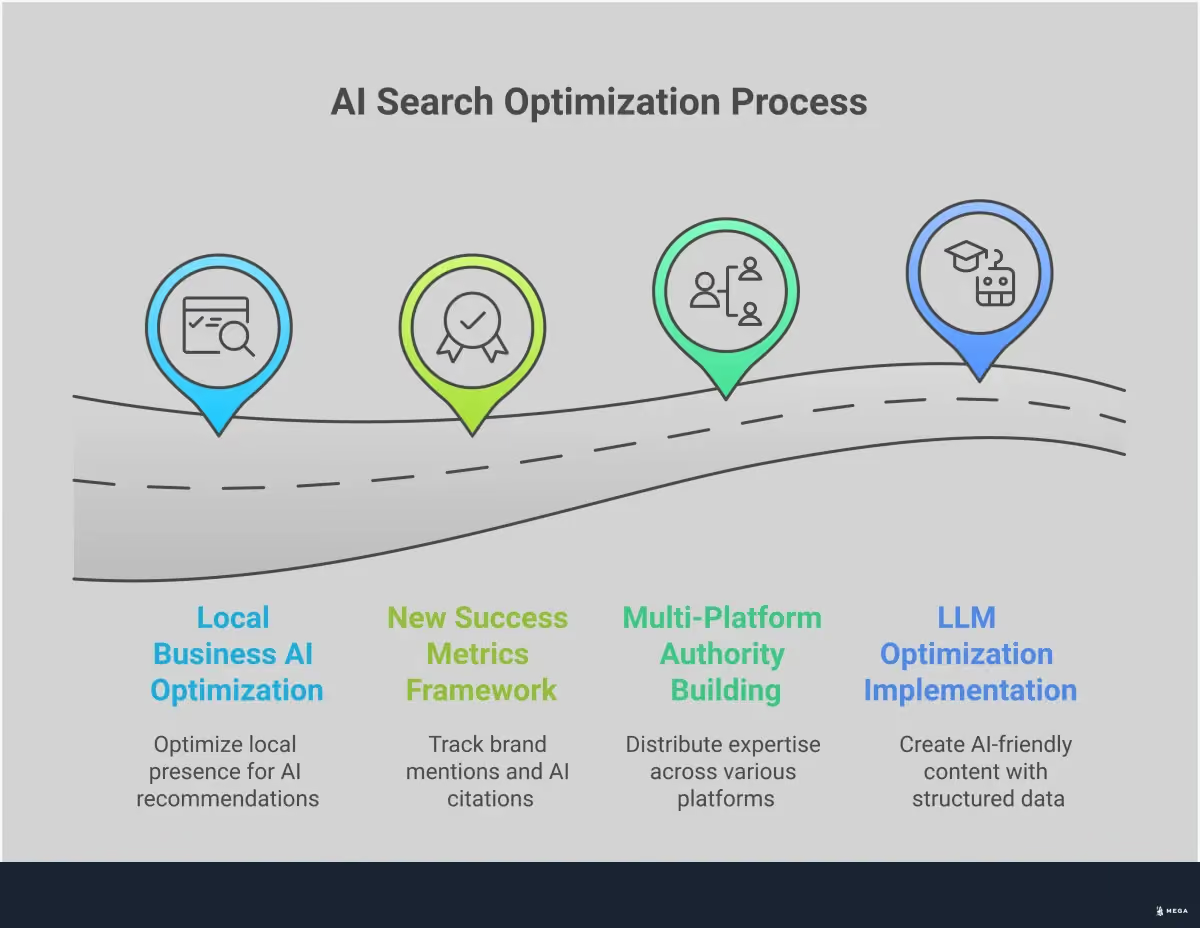
How to Adapt Your Content Strategy for AI Search
As AI Overviews become the first point of contact for users, your content must be the definitive source that AI systems trust and reference. This means shifting from generic articles to unique, high-value content that establishes your authority. The goal is no longer just to rank, but to be cited. Here’s how to adjust your content strategy for this new landscape.
Prioritize Conversational Keywords and Questions
People don’t type “local plumber” into a chatbot. They ask, “Who is the best emergency plumber near me that’s available on a weekend?” Your content strategy needs to reflect this shift toward natural language. Instead of focusing only on short keywords, you should optimize for natural language queries and the long-tail questions your customers are actually asking. Think about the specific problems they're trying to solve and the exact phrasing they would use. Creating content that directly answers these conversational questions not only helps you get noticed by AI but also builds a stronger connection with potential customers by showing you truly understand their needs.
Distinguish Between General and "Your Money or Your Life" (YMYL) Topics
Not all content is treated equally by AI. It's important to understand the difference between general topics and what Google calls "Your Money or Your Life" (YMYL) subjects. YMYL includes high-stakes areas like finance, health, and legal advice. For these topics, AI models will almost exclusively cite large, highly trusted sources like government websites or major academic institutions. However, for more general topics—like local business recommendations or hobbyist advice—smaller blogs and businesses have a real opportunity to be featured. As you plan your content, be realistic about where you can compete. Focusing on your specific niche expertise is often a more effective path to getting cited by AI than trying to challenge established authorities on YMYL topics.
How to Create Content AI Wants to Reference
To become a citable source for an AI, your content must offer a unique perspective, proprietary data, or deep expertise. Think about what you can provide that an AI can’t generate on its own: original research, case studies, or an expert-backed opinion. Using AI-driven keyword research helps you find topics where users want true expertise. This insightful content provides the raw material AI models need to build trustworthy answers, positioning your brand as an essential source.
Write for Scannability and Clarity
AI models, much like busy human readers, prefer content that is easy to scan and understand. To get your content featured in AI answers, you need to structure it for quick comprehension. This means breaking down complex ideas into simple, digestible formats. Instead of writing long, dense paragraphs, focus on creating content that is logically organized and visually clean. This approach not only helps AI systems parse your information but also improves the reading experience for your human audience. By making your content more accessible, you increase the likelihood that it will be recognized as a valuable resource and cited in AI-generated responses.
Use the "Inverted Pyramid" Writing Style
The inverted pyramid is a writing technique borrowed from journalism, and it’s perfectly suited for the age of AI. The principle is simple: put the most important information at the very beginning of your article or section. Instead of building up to a conclusion, you state the main point or answer the core question immediately. This method ensures that both AI crawlers and human readers can grasp the key takeaway without having to read the entire piece. According to AI optimization best practices, this direct approach makes your content a more effective source for AI-generated summaries, as the model can quickly identify the essential information it needs.
Create "Snippable" Content with Clear Formatting
AI systems often pull short, digestible pieces of content to construct their answers. To increase your chances of being featured, you need to make your content "snippable." This means breaking down your information into concise, self-contained chunks. Answer questions in one or two clear sentences. Use formats like Q&A blocks, bullet points, and numbered lists to present information in a structured way. As the Microsoft Ads blog suggests, this makes it easy for AI to pull your key details and incorporate them into a response. Think of each section of your content as a potential answer to a user's question.
Format with Lists, Tables, and Data Visuals
Structuring your content with clear visual formats is essential for both readability and AI optimization. Use bullet points for lists of items, numbered lists for step-by-step instructions, and tables for direct comparisons. These formats help break up walls of text and present complex information in a way that is easy to digest. For an AI, this structured data is simple to parse and understand, making it more likely to be used in a generated answer. If you have a lot of existing content, this can feel like a big project, but tools like MEGA AI's Maintenance Agent can help re-optimize your articles by automatically improving their structure and formatting for AI search.
Write with Extreme Clarity and Simple Punctuation
In the context of AI search, clarity trumps complexity. Your primary goal should be to answer a user's potential question as directly and simply as possible. Avoid jargon and convoluted sentence structures. Use simple, consistent punctuation, relying on periods and commas to guide the reader. This isn't about sacrificing quality; it's about making your content universally understandable. When you write with clarity, you're not just helping your human audience. You're also providing a clean, unambiguous signal to AI models that your content is a reliable and straightforward source of information, which is exactly what they are designed to look for.
Go Beyond Basic Informational Articles
The era of winning with generic ‘how-to’ guides is over. Creating this content is now just ‘feeding the AI the information that it wants’ to generate its own answers. Instead, focus on content that demonstrates your unique experience. Share the results of a specific project, detail a proprietary process, or offer an analysis that challenges conventional wisdom. This content is difficult for AI to replicate, making your website a destination rather than just another data point for a language model.
Target Mid-to-Bottom-Funnel Search Intent
AI is effective at answering top-of-funnel questions, but users still turn to trusted websites to make decisions. This is why you should focus your efforts on mid-to-bottom-funnel topics. Create in-depth product comparisons, case studies, and articles addressing the pain points of customers ready to buy. This content serves users who are past initial research and are actively evaluating options. Owning these high-intent topics helps you capture traffic that is more likely to convert.
Build Transparent Pricing and FAQ Pages
In an AI-driven search environment, clarity and trust are critical. AI models are designed to find and present factual, straightforward information. Building a detailed and transparent pricing page and a comprehensive FAQ section makes it easy for both users and AI to understand your offerings. This structured data is simple for language models to parse and present as a direct answer. Being upfront about costs and common questions removes friction and signals that you are a trustworthy authority.
Avoid Common Content Mistakes
Making your content easy for AI to read is just as important as making it easy for humans. Simple formatting mistakes can make your best information invisible to the very systems you’re trying to influence. How you structure your information on the page can determine whether an AI model sees your content as a reliable source or passes it over entirely. By avoiding a few common pitfalls, you can significantly improve how AI understands and uses your content. These adjustments are straightforward, but applying them consistently across your site is what makes the difference in becoming a citable authority.
Steer Clear of Long, Unbroken Blocks of Text
Large, dense paragraphs are difficult for anyone to read, and that includes AI. When a user lands on a page with a wall of text, they are likely to leave. Similarly, AI systems can struggle to parse and extract key information from long, unstructured blocks of text. To make your content more digestible, break it up into shorter paragraphs of just two or three sentences. Use bullet points and numbered lists to organize information clearly. According to guidance from Microsoft Advertising, this structured approach not only improves readability for your human audience but also makes it much easier for AI to identify and pull out specific facts for its answers.
Ensure Key Information is Easily Accessible
If a user has to click to find your business hours or pricing, you’re adding unnecessary friction. The same principle applies to AI. Important information hidden within interactive elements like tabs, accordions, or expandable menus might be missed by AI crawlers. These systems are designed for efficiency and may not engage with page elements that require a click to reveal content. To ensure your most critical details are seen, present them openly on the page. Your address, phone number, key services, and pricing should be in plain sight. This simple change makes your website more user-friendly and ensures AI can access the information it needs to recommend your business.
Prioritize Web Pages Over PDFs
Many businesses use PDFs for downloadable resources like menus, brochures, or white papers. While convenient, PDFs are not ideal for AI optimization. AI models can technically read the text in a PDF, but they often lack the clear, hierarchical structure of a standard HTML webpage. This makes it harder for the AI to understand the context and importance of the information. For your most valuable content, it’s better to use regular web pages. An HTML page with proper headings (H1, H2, H3), paragraphs, and lists gives the AI clear signals about your content's structure, making it a much more reliable source for generating answers.
Add Text Descriptions to Images
Images and infographics can make your content more engaging, but AI systems can’t “see” them the way humans do. If an image contains important information, like statistics or a diagram, the AI might miss it completely. To solve this, always provide descriptive alt text for your images. This not only helps AI understand the image's content but also improves accessibility for users with visual impairments who rely on screen readers. Furthermore, if an image contains text, you should also include that information directly on the page as standard HTML text. This ensures that no matter how a user or an AI interprets your page, the key details are never lost.
What Is the Role of Backlinks in the AI Era?
For years, backlinks were the gold standard of SEO. They acted as votes of confidence, telling search engines that your content was valuable and trustworthy. In the age of AI-driven search, that fundamental principle hasn’t disappeared, but it has evolved. While a link from a high-authority site is still a powerful signal, AI models are looking for a more holistic picture of your brand’s credibility. They want to see that you’re a legitimate, trusted entity, not just a website with good links.
Think of it this way: AI wants to provide the most reliable answers possible. To do that, it synthesizes information from countless sources to determine who the real experts are. It looks beyond simple link metrics to evaluate your overall digital footprint, brand mentions, and real-world reputation. This means your authority isn’t just built on who links to your website; it’s built everywhere your brand shows up online. For small businesses, this shift presents a huge opportunity to build trust through genuine expertise and community engagement, not just link-building campaigns. The goal is to become an entity that AI recognizes as a definitive source in your field, which is a core focus of modern SEO strategy.
Why Authority Signals Are Still Crucial
Authority signals are how AI systems decide who to trust. Backlinks have traditionally been a primary signal because they represent a third-party endorsement. As one expert puts it, “Backlinks have always been a really really huge ranking factor… but now we know that other third-party signals matter a lot aside from just backlinks.”
AI models are designed to verify information and avoid spreading inaccuracies. They achieve this by cross-referencing data and looking for consensus among reputable sources. A strong backlink profile still tells them your site is a credible player. However, they also weigh factors like unlinked brand mentions, author expertise, and the consistency of your information across the web. Your goal is to be seen as a reliable, authoritative entity in your niche, giving AI every reason to cite you as a source.
Focus on E-E-A-T (Experience, Expertise, Authoritativeness, Trustworthiness)
E-E-A-T is the framework Google uses to evaluate content quality, and it’s more critical than ever for AI search. It stands for Experience, Expertise, Authoritativeness, and Trustworthiness. AI models are designed to deliver reliable answers, so they actively seek these signals. Your content must demonstrate firsthand Experience through original research or unique perspectives that an AI can’t generate on its own. You need to prove your Expertise by becoming an indispensable source that AI systems trust. Your Authoritativeness is built everywhere your brand appears online, not just through backlinks. Finally, AI confirms your Trustworthiness by cross-referencing your information with other reputable sources. Focusing on these pillars is how you create content AI wants to reference, turning your brand into a citable authority.
How to Build Authority Beyond Your Website
To build trust with AI, you need to establish your expertise where your audience spends their time. A good rule of thumb is that around “50% of our SEO activities… should be off of your website on properties that your brand does not own.” This means actively participating in the digital communities relevant to your industry.
Instead of focusing solely on your blog, contribute valuable insights on platforms like LinkedIn, answer questions on Quora or Reddit, and engage with local community forums. Getting featured on industry podcasts or local news sites also builds your brand’s digital footprint. Each of these activities creates a signal that reinforces your authority. When an AI model sees your brand consistently providing value across the web, it learns to trust you as a source.
Which Third-Party Signals Influence AI Search?
For small and local businesses, third-party signals are especially powerful. AI models rely heavily on platforms like Google Business Profile, Yelp, and industry-specific directories to understand your business’s real-world reputation. Consistent and accurate information—your name, address, and phone number (NAP)—across these listings is a foundational trust signal.
Customer reviews are another critical data point. AI can analyze the sentiment, frequency, and content of your reviews to gauge customer satisfaction. As the Castle Rock Chamber of Commerce notes, AI helps businesses manage these signals to optimize for local search. When a user asks an AI for “the best coffee shop in my neighborhood,” the AI synthesizes review data and directory information to provide its recommendation. A strong presence on these platforms is no longer optional; it’s essential for being visible in AI-driven search.
Technical Optimization for AI Search
Even with the best content and strongest authority signals, your efforts can fall flat if AI systems can’t technically access and understand your website. This is where technical optimization comes in. It’s the process of ensuring your site’s foundation is solid, so search engines and AI models can efficiently crawl, interpret, and index your content. For many small business owners, the term “technical SEO” can sound intimidating, but it doesn’t have to be. At its core, it’s about making your website clean, fast, and easy for bots to read.
Getting the technical details right is crucial for showing up in AI-generated answers. If an AI crawler can’t make sense of your site, it will simply move on to a competitor whose site is easier to understand. This is an area where automation can be a huge help. Platforms like MEGA AI include automated technical SEO improvements, handling the complex backend work so you can focus on running your business. By ensuring your site is technically sound, you lay the groundwork for your content and authority-building efforts to succeed.
Ensure Your Site is Accessible to AI Crawlers
Before an AI can feature your content, its crawlers—specialized bots that browse the web—need to be able to access and read your site. If your website has technical barriers, these crawlers may not see your content at all. One common issue is a heavy reliance on complex JavaScript to display information. As some experts have noted, many AI crawlers don't handle website content that relies heavily on client-side JavaScript very well. This means if your key text, like product descriptions or service details, only appears after a user clicks a button, the AI might miss it entirely. Make sure your most important content is present in the initial HTML of the page, making it immediately visible to any bot that visits.
Maintain Strong Technical Hygiene and User Experience
A positive user experience is a powerful signal for AI systems. A website that is slow, difficult to use, or broken on mobile devices sends a message that the content may not be trustworthy. As Google’s own guidance states, even the best content can be undermined by a poor website experience. Your pages should load quickly and be easy to use on any device. Visitors, whether human or AI, should be able to easily find the main information they're looking for without confusion. Regularly checking for broken links, optimizing image sizes for faster loading, and ensuring your site has a clear, logical structure are all part of good technical hygiene that pays off in both user satisfaction and AI visibility.
Use Structured Data Correctly
Structured data is a way of labeling your content so that search engines can understand it on a deeper level. Think of it as adding descriptive tags to your information, like "business name," "address," "product price," or "customer review." This helps AI models quickly and accurately pull key details from your site. However, it’s critical to use it correctly. The information you include in your structured data must also be clearly visible to a human visitor on the page. This prevents misleading practices and builds trust. For a local business, correctly implementing structured data for your hours, services, and location can make a significant difference in whether an AI recommends you to a nearby customer.
Manage How Your Content Appears with Website Controls
As a website owner, you have control over how search engines and AI models use your content. Using specific tags, you can give instructions to crawlers about what they can and cannot do with your information. For example, the `noindex` tag tells a search engine not to include a specific page in its results at all, which is useful for private or internal pages. Another powerful tool is the `nosnippet` tag. This tag allows your page to appear in search results but prevents AI from generating a summary or snippet from its content. This can be a strategic choice if you want to encourage users to visit your site to get the full story, rather than just reading a summary on the results page.
How to Build a Multi-Platform Content Strategy
If your entire content strategy relies on people finding your website through Google, you’re putting your business at risk. With AI Overviews answering questions directly, you can no longer put all your eggs in the Google basket. The new approach is to meet your audience where they already are. Building a presence on multiple platforms creates a web of authority around your brand that both customers and AI algorithms can see.
This doesn’t mean abandoning your website. It means using your site as a home base while distributing valuable content across channels like YouTube, LinkedIn, and Reddit. Each platform offers a unique way to connect with people and build the trust signals that AI search engines look for. A smart, multi-platform strategy ensures your brand remains visible and credible, even if direct clicks from Google search decline. It’s about building a resilient brand that doesn’t depend on a single source of traffic.
Use YouTube as an Alternative Search Engine
Think of YouTube as the second-largest search engine in the world. People go there to find answers, learn new skills, and get reviews for products and services. You should be treating your informational content, like how-to guides and tutorials, as opportunities for video. Creating video content allows you to attack those queries on a different platform where you can capture attention and build an audience.
Video results often appear directly in Google’s search results and can be featured in AI Overviews, giving you another way to get discovered. Start by repurposing your most popular blog posts into short, engaging videos. This helps you reach a different segment of your audience and strengthens your brand’s authority on a given topic.
Engage Your Audience on LinkedIn
For many small businesses, especially those in the B2B space, LinkedIn is an essential platform for building professional authority. It’s a place to share your expertise, connect with peers, and engage in industry conversations. Consistently posting insightful content, case studies, or company updates helps establish you and your business as a credible voice.
This activity sends strong signals about your expertise, which AI models can interpret when evaluating sources. Don’t just post links to your blog. Instead, create native content for the platform that encourages discussion. Engaging with others and building a community on LinkedIn contributes to your overall brand presence, making you a more authoritative source in the eyes of both people and AI.
Tap into Reddit and Other Community Platforms
Platforms like Reddit and Quora are goldmines for understanding what real people are asking. They are also massive sources of data used to train and inform large language models. Participating in these communities allows you to engage directly with your target audience and establish your expertise in an authentic way.
Find subreddits or forums relevant to your industry and focus on being genuinely helpful. Answer questions, share your knowledge, and participate in discussions without being overly promotional. When you become a trusted resource in a community, you’re not just building brand awareness with potential customers. You’re also creating a footprint of expertise that AI systems can reference when generating answers.
Leverage Influencer Partnerships and Sponsored Content
Building authority doesn’t always have to be a slow, organic process. You can accelerate it by partnering with influencers and creators who have already earned the trust of your target audience. A positive mention from a respected YouTuber or industry expert can do more for your credibility than a dozen blog posts.
You can reach out to influencers for paid brand mentions or sponsored content. This strategy helps you tap into their established audience and borrow their authority. These third-party endorsements act as powerful social proof and create positive brand signals that influence how AI platforms perceive your business. This approach combines the best of organic authority with a targeted paid ads mindset to build your reputation faster.
How to Measure Success When Clicks Aren’t the Goal
If you’ve built your marketing strategy around driving organic clicks, the rise of AI-driven search can feel unsettling. When an AI answers a user’s question directly, that’s one less potential visitor to your site. But this shift doesn’t mean your SEO efforts are failing. It just means you need a new scorecard. Instead of focusing solely on website traffic, the goal is now to measure your influence and authority. Are you being seen as a trusted source by both AI and human users?
Success in this new landscape is about becoming the go-to answer in your niche. It’s about building a brand that AI models want to cite and that users remember. This requires looking at a broader set of signals that prove your content is resonating, even if it doesn’t result in a direct click. By tracking metrics that reflect brand awareness, engagement, and authority, you can get a much clearer picture of your true performance and adapt your strategy to what works now.
Look Beyond Traditional Traffic Metrics
While website traffic is still important, it’s no longer the only indicator of success. Start tracking the number of brand query searches—how many people are searching for your company name directly. This is a strong signal that your brand awareness is growing. Another key metric is share of voice, which measures your visibility in search results for your main keywords compared to your competitors. Tracking these content marketing KPIs helps you see if you’re becoming a recognized authority in your field, which is exactly what AI models look for when sourcing information. This tells a more complete story than traffic alone.
Track Brand Mentions and Source Citations
In an AI-driven search world, a citation in an AI Overview is the new top ranking. Your goal is to become a source that AI models trust and reference. You can measure this by tracking unlinked brand mentions across the web and monitoring when your content is cited in articles, forums, and social media. These mentions act as authority signals that both search engines and AI systems use to validate your expertise. Using AI-powered tools can help you monitor these mentions automatically, giving you insight into how your brand’s authority is growing over time and where your content is making an impact.
Measure Engagement Across All Your Platforms
Your content’s value isn’t just measured by clicks. It’s also measured by how people interact with it. Look at engagement metrics on your blog and social media channels, including comments, shares, and saves. High engagement shows that your content is valuable and resonant, which is a quality signal for search algorithms. When users find your content helpful enough to share or discuss, it indicates you’re building a loyal community. Staying on top of these essential content marketing KPIs reveals how your branding and content are performing, giving you a clear view of your marketing return on investment.
Monitor Referral Traffic from AI-Powered Answers
While overall organic clicks may be declining, a new and valuable traffic source is emerging: referrals from AI-generated answers. When an AI cites your website, the link it provides can drive highly qualified, high-intent traffic. Keep a close eye on your analytics to identify referral traffic from sources like Google’s AI Overviews or other AI search tools. Though reports show a general decline in click-through rates, the clicks you do get from these sources are often from users who are further along in their journey and ready to take action. This is a small but growing segment to watch.
How Automation Can Help Your Small Business Adapt
Adapting to this new search landscape can feel like a full-time job. For small businesses and startups, resources are already stretched thin. This is where automation becomes your most valuable asset. Instead of manually keeping up with every change, you can use AI-powered systems to do the heavy lifting. An autonomous system can execute a complete strategy, from research to optimization, freeing you to focus on running your business.
Using AI Tools for Content Optimization
Your existing content is a valuable asset, but it needs regular maintenance to perform in AI-driven search. AI tools can handle this by continuously optimizing your articles. This goes beyond simple keyword research. An effective SEO agent can analyze performance, identify opportunities to improve click-through rates, and find new topics to add to existing posts to make them more comprehensive. This process ensures your content is not only relevant for search engines but is also structured in a way that AI models are likely to use as a source.
Automate Your Multi-Platform Distribution
Visibility in AI search requires a presence across multiple platforms, not just your website. Automation helps you manage and distribute content efficiently. For example, AI tools can manage local business listings and monitor reviews, which are important signals for Google and other AI platforms. For paid campaigns, an AI agent can take your core content and automatically create hundreds of variations for platforms like Meta, Google, and LinkedIn. This ensures your message is consistent yet tailored to each channel, without requiring hours of manual work.
How Small Teams Can Win at AI Search Optimization
For small teams, the biggest challenge is often budget. Hiring a traditional agency is expensive, and DIY tools require a steep learning curve. Automation offers a middle ground, providing expert-level execution at a fraction of the cost. AI-powered platforms can manage your entire SEO and paid ads strategy, delivering results once only accessible to large companies. With transparent pricing and a clear scope of work, you get the benefits of a dedicated team without the overhead, making it a sustainable growth strategy for any small business.