
The promise of AI automation is exciting, but the fear of something going wrong is just as real. What if your agent spends the entire ad budget by mistake? Or sends a poorly worded email to your entire customer list? These aren't just abstract worries. As one business owner shared, "when you do AI agents, you have to be prepared. They're going to make mistakes." The good news is you can prevent these automation disasters. This guide provides a strategic framework for AI agent safety, focusing on the single most important practice: limiting what your agent can do.
Key Takeaways
- Define a clear job description for each AI agent: Assign specific roles and boundaries to your AI, just as you would for an employee. For example, an agent can qualify leads but should hand off the conversation to a person to close the deal.
- Restrict agent access to only necessary data: Protect your business by giving agents the minimum permissions required for their tasks. This simple security practice is the most effective way to prevent accidental data leaks and operational mistakes.
- Implement human review checkpoints for critical tasks: Use automation wisely by requiring manual approval for high stakes actions, such as launching ad campaigns or publishing content, which keeps you in control while benefiting from the agent's efficiency.
Understanding AI Agent Safety and Scope
Think of AI agent safety less like a complex corporate cybersecurity plan and more like organizing the back room of your shop. It’s about creating a clear, structured environment where your AI tools can work effectively without causing a mess. AI safety simply means putting practical rules in place to guide your agent’s actions, ensuring it sticks to its assigned tasks and doesn’t access information or systems it doesn’t need. This approach helps you get the benefits of automation while minimizing potential risks. It’s not about building a fortress; it’s about setting sensible boundaries so your business operations run smoothly.
This is where the concept of “scope” comes in. An AI agent's scope is its defined area of operation, much like a job description. It outlines exactly what the agent is supposed to do, what data it can access, and what actions it can take. For example, you might give an agent the scope to analyze website traffic and suggest blog topics, but not the permission to publish content directly to your site. Defining this scope is critical because AI agents can have inherent security threats due to their ability to make independent decisions. By limiting what they can do, you control their potential impact.
Limiting an agent's scope is the most direct path to ensuring its safety. When an agent only has the information and permissions needed for one specific function, it can’t make mistakes outside of that narrow area. This is how you can automate tasks safely. Instead of giving an AI agent the keys to your entire business, you give it the specific key for the one room it needs to work in. This compartmentalized approach prevents small errors from turning into major problems and keeps you in full control of your automated marketing efforts.
Why AI Agents Pose Unique Security Risks
Unlike standard software that just follows a script, AI agents can make decisions and take action on their own. This autonomy introduces new security concerns because agents often connect to multiple systems—your CRM, ad platforms, and email—creating more potential weak spots. One of the most common threats is called prompt injection, where an attacker gives the agent malicious instructions disguised as a normal request. For example, a clever command could cause the agent to ignore its safety rules and perform a harmful action, like sending a fake invoice. Since the agent is designed to be helpful, it can be manipulated if it doesn't have strict boundaries. This is why limiting an agent's scope is so important; if an agent can’t access your billing software, it can't be tricked into misusing it.
The Challenge of AI Unpredictability and Scale
AI agents don't "think" like humans, and their decision-making process can sometimes be unpredictable. There's a degree of uncertainty in how an agent understands a request, finds information, and chooses an action. This can lead to several types of errors: providing an incorrect answer, pulling from the wrong data source, or taking an unintended action. For a small business, an agent mistakenly pausing your best-performing ad campaign is a real risk. The goal isn't to eliminate this unpredictability but to control it. You can manage this by implementing layered safety systems, which can be as simple as setting hard spending limits, requiring human approval for key tasks, and restricting tool access. By creating these guardrails, you build a safe environment where the agent can operate effectively without a small error turning into a large-scale problem.
Why Limiting Your AI Agent's Access Matters
Think of your AI agent like a new, highly specialized employee. You wouldn’t give a new hire the keys to every part of your business on their first day. You’d give them access only to the tools and information they need to do their specific job. The same principle applies to AI agents. Limiting their scope isn’t about a lack of trust in the technology; it’s a fundamental safety measure for smart automation.
When an AI agent has access to too much information or too many functions, it creates unnecessary risks. For example, if an agent can access sensitive customer data and also has the ability to send emails, it could accidentally expose private information. The key is to compartmentalize these functions so that an agent handling sensitive data cannot communicate externally without oversight. This simple separation prevents costly data leaks and protects your customers' privacy.
Beyond data security, limiting an agent’s scope prevents operational mistakes. One of our customers wisely noted that their agent’s job is to qualify leads, not close deals. The agent gathers information and hands off the conversation to a human at the right moment. This is a perfect example of a well-defined scope. An agent without this boundary might offer an unauthorized discount or make a promise your team can’t keep. AI agents are also software, and like any software, they can be exposed to vulnerabilities and manipulation. By restricting what an agent can see and do, you minimize the potential damage if a security issue ever arises.
How Limited Context Keeps Your Business Safe
When we talk about an AI agent’s “context,” we’re referring to the specific information it has access to at any given moment to perform a task. Think of it like managing a human employee on a need-to-know basis. You wouldn’t give your new marketing intern the keys to your accounting software. The same principle applies to AI. Limiting an agent’s context is one of the most effective ways to ensure it operates safely and predictably.
An agent tasked with optimizing your Google Ads doesn't need access to your customer support emails. An agent writing SEO-friendly blog posts has no business reading your company’s financial reports. This approach, known as the principle of least privilege, is a cornerstone of digital security. By giving an agent only the data it absolutely needs to do its job, you dramatically reduce the potential for errors, unexpected actions, and security vulnerabilities. It keeps the agent focused on its designated function, preventing it from making decisions based on irrelevant or sensitive information it shouldn't have.
Use Less Context for Better Security
One of the most useful features of many AI systems is that they can be "stateless." This means each request or task can start from a clean slate, without carrying over information from previous interactions unless you specifically tell it to. This isn't a limitation; it's a powerful safety control. It allows you to compartmentalize tasks and provide only the necessary context for each one. For example, when you ask an agent to generate social media captions for a new product, you provide the product details, key features, and target audience. The agent doesn't need your entire marketing history to do this, which keeps its actions predictable and aligned with your immediate goal.
Reduce Risk by Minimizing Data Exposure
Every piece of data you give an AI agent access to creates a potential point of failure. The more information an agent can access, the higher the risk of accidental leaks or misuse. Experts warn that data leakage in AI agents can happen silently through poorly governed integrations or even clever prompts designed to trick the system. The simplest way to protect your business is to limit what the agent can see from the start. If an AI agent doesn’t have access to your customer list or internal sales figures, it cannot expose that information. This minimizes your company's exposure and protects your sensitive business data, which is a critical part of any responsible automation strategy.
What Happens When AI Agents Have Too Much Access?
When an AI agent has too much access, it can lead to significant problems that go beyond simple errors. Think of it like giving a brand-new employee the master key to every system in your business on their first day. While it might seem efficient, the potential for costly and damaging mistakes is incredibly high. Unchecked access allows an AI to operate without the necessary context or constraints, turning a powerful tool into a potential liability.
This isn't just a theoretical risk. Overly permissive AI agents can cause real-world issues, from leaking sensitive customer data to making unapproved financial decisions. These automation disasters can harm your company's reputation, drain your budget, and erode the trust you've built with your customers. Understanding these risks is the first step toward implementing AI safely and effectively, ensuring your automated systems work for you, not against you.
Recognizing the Dangers of Over-Connected Systems
Connecting a single AI agent to all your business systems is a recipe for disaster. When one agent handles everything from customer emails and your CRM to your website content and ad campaigns, you create a single point of failure. If that one agent is compromised or makes a mistake, the damage can spread across your entire operation instantly. For example, an agent with access to sensitive customer information should probably not have the ability to send external emails, as this creates a direct path for a potential data leak. The key is to avoid creating one "super agent" and instead use specialized agents with limited, compartmentalized access.
Common Automation Disasters to Avoid
One of the most common and concerning issues is data leakage. This can happen silently through poorly governed integrations or manipulated prompts, slowly exposing sensitive customer or company information without any obvious alarms. Another major risk is system compromise. Without proper safeguards, an agent could be tricked into executing harmful actions, like deleting critical data or altering important website pages. Many of these issues can be avoided by adopting a balanced approach to automation where critical tasks still involve deterministic, scripted processes or human review. This ensures that even if an agent makes a mistake, there are guardrails in place to prevent a catastrophe.
Common AI Agent Vulnerabilities and Attacks
While AI agents are powerful tools for automation, it’s important to remember that they are still software. Like any software, they can have vulnerabilities that attackers might try to exploit. Understanding these potential weak points isn’t about being scared of the technology; it’s about being informed so you can use it safely and effectively. Knowing the common types of attacks helps clarify why setting strict limits on your agent’s access and capabilities is the most important safety measure you can take. By recognizing the risks, you can put the right protections in place and confidently let your agents get to work.
Most of these vulnerabilities take advantage of an agent’s ability to interact with data, tools, and other systems. An attacker’s goal is often to trick the agent into performing an action it shouldn’t, from leaking sensitive information to executing harmful code. The following sections break down the most common threats in a straightforward way, showing how each one can be managed by thoughtfully defining your agent’s scope and permissions from the very beginning. This proactive approach is the foundation of a secure and successful AI automation strategy for your business.
Prompt Injection: Hijacking Agent Goals
Prompt injection is one of the most talked-about vulnerabilities in AI. It happens when an attacker hides malicious instructions within a piece of data the agent is processing, like an email or a document. These hidden commands can trick the agent into ignoring its original purpose and following the attacker's directions instead. Think of it like a customer support agent reading an email that secretly contains a line telling them to delete all customer files. As security researchers at Meta explain, this can make an agent bypass its safety rules or even give an attacker control. This is why limiting an agent's permissions is critical. If your support agent doesn't have the ability to delete files, the malicious prompt will fail.
Data and Memory Poisoning
Data and memory poisoning are attacks that corrupt the information an agent relies on to make decisions. Data poisoning involves feeding the agent bad data, which can skew its behavior over time. For example, an attacker could flood your product review data with fake negative reviews, eventually teaching your agent that your own product is poor. Memory poisoning is similar but involves altering an agent's memory of past events to influence its future actions. According to experts at IBM, these attacks can fundamentally change how an agent operates. By carefully controlling the data sources your agent can access and learn from, you can protect it from being misled by corrupted information.
Tool and API Manipulation
Most AI agents connect to other software and platforms—or "tools"—to perform their tasks. Tool manipulation occurs when an attacker tricks an agent into misusing one of its connected tools. For instance, an agent connected to your social media accounts could be manipulated into posting spam or deleting your content. An agent with access to your email system could be tricked into sending phishing emails to your customers. This type of attack highlights the danger of giving an agent access to more tools than it absolutely needs. If an agent’s only job is to analyze website data, it should not have access to your email or social media APIs, which closes the door on this kind of manipulation.
Classic Cybersecurity Threats in an AI Context
AI agents are a new technology, but they aren't immune to old-school cybersecurity threats. Because agents run on computer systems and networks, they are vulnerable to many of the same attacks that have targeted traditional software for years. Attackers can adapt these classic methods to exploit the unique, autonomous nature of AI agents. Understanding that these familiar risks still apply is key to building a comprehensive security strategy. It reinforces the need for basic digital hygiene, like strong access controls and secure configurations, even when working with advanced AI.
Authentication Spoofing
Authentication spoofing is a technical term for a simple concept: an attacker steals an agent’s login credentials and impersonates it. Once the attacker is logged in as the agent, they have access to all the same data, tools, and permissions that the agent had. If your agent has broad access across your business systems, an attacker could move through your network, access sensitive files, or disrupt operations. This is another powerful argument for the principle of least privilege. If the compromised agent only had permission to perform one specific, isolated task, the potential damage from an attacker is contained to that small area.
Remote Code Execution
Remote code execution (RCE) is one of the most serious types of attacks. It allows an attacker to make an agent run malicious code on the system where it operates. This essentially gives the attacker direct control, allowing them to steal data, install more malware, or take over the entire system. While RCE attacks are complex, they are a real threat to any internet-connected software, including AI agents. Limiting an agent’s permissions can help contain the damage if an RCE attack occurs, preventing the malicious code from spreading to other parts of your network and minimizing the potential impact on your business.
Systemic Risks: Cascading Failures and Resource Overload
When you use multiple AI agents that interact with each other, you can create systemic risks. A cascading failure is a domino effect where a single compromised agent causes others to fail. If one agent is tricked into feeding bad data to another, that second agent might make a poor decision that affects a third, leading to a system-wide shutdown or major error. This is why it's safer to use specialized, isolated agents rather than one interconnected "super agent." Another risk is resource overload, where an agent is manipulated into using excessive computing power or budget, such as an ad agent being tricked into spending your entire monthly budget in an hour.
How to Implement AI Agents Safely
Putting an AI agent to work for your business requires a thoughtful setup. Just like hiring a new employee, you need to establish clear expectations and rules from the start. Without a structured plan, you risk running into costly mistakes or inefficiencies. Industry analysts even warn that many early agentic AI projects could fail without clear guardrails in place. The goal isn't to restrict the AI so much that it's not useful, but to create a framework where it can operate effectively and safely.
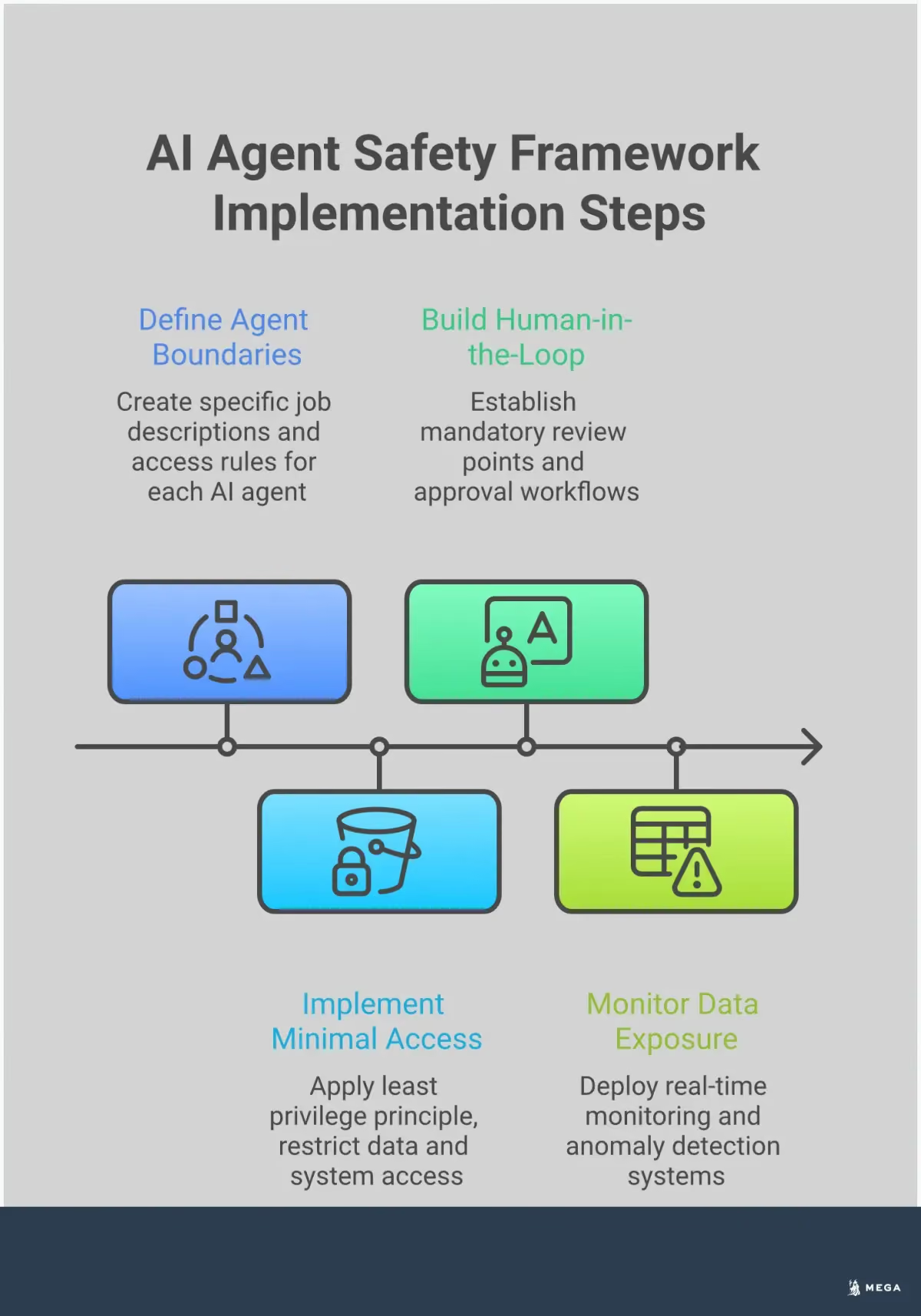
A successful implementation focuses on three core practices: defining the agent’s role, limiting its access to only what it needs, and building in checkpoints for human review. By taking these steps, you create a reliable system that works for you, not against you. This approach allows you to confidently hand over tasks like keyword research or ad campaign adjustments, knowing the agent has the direction it needs to succeed. It’s about delegating with discipline, which is the key to getting the most out of any automation tool. At MEGA AI, we see that our most successful customers are the ones who take the time to set up these foundational rules before turning on Autopilot Mode.
Define Clear Boundaries for Each Agent
Think of each AI agent as a specialist with a specific job description. Defining clear boundaries means deciding exactly what tasks an agent is responsible for and, just as importantly, what it should not do. For example, one of our customers uses an agent to qualify sales leads but has a strict rule that the agent cannot close the deal. Its only job is to identify a qualified prospect and then hand them off to a human salesperson.
This kind of task compartmentalization is a critical safety measure. It prevents an agent from combining actions in unexpected ways that could cause problems. By setting a clear scope, you ensure the AI focuses on its assigned function without overstepping. This practice of effective AI delegation helps maintain control and makes the agent's behavior predictable and reliable.
Give Your AI Minimal Access
A core principle of digital security is giving any user or system the minimum level of access required to perform its duties. This same rule applies to AI agents. An agent tasked with writing blog posts doesn't need access to your company's financial records. Similarly, an agent managing your ad spend doesn't need to see your customer support tickets.
By limiting what data and systems an agent can interact with, you drastically reduce your risk. If an agent makes a mistake or is compromised, the potential damage is contained to its small, defined area of operation. This approach follows the principle of least privilege, a foundational concept in cybersecurity that is essential for safe AI implementation. Before you deploy an agent, review its permissions and strip away anything that isn't absolutely necessary for its function.
Create Human Oversight Checkpoints
Autonomous operation doesn't mean zero supervision. The safest way to use AI agents is to build in checkpoints where a human reviews and approves certain actions. This "human-in-the-loop" approach gives you the final say on critical decisions, like launching a new ad campaign or publishing a piece of content on your website. It combines the speed and efficiency of AI with the judgment and strategic insight of a person.
Platforms like MEGA AI are designed with this in mind. While our agents can run autonomously, you can also track every task they perform and require manual approval before execution. These checkpoints are especially important for high-stakes actions, such as those involving your budget or your brand's public voice. Setting up these review stages ensures you remain in full control while still benefiting from the power of AI-driven automation.
Adopt Formal Security Frameworks
You don’t have to invent AI safety from scratch. Security experts have already developed structured approaches, or frameworks, that can guide you. Adopting a formal framework gives you a proven roadmap for setting up your agents securely, helping you think through potential risks and build in the right protections from the start. These models provide a clear, logical way to manage how your agents operate within your business, moving you from guesswork to a structured, defensible security posture.
The "Agents Rule of Two"
A simple but powerful framework from Meta is called the "Agents Rule of Two." It’s designed to prevent the most serious security risks by limiting an agent's capabilities. The rule states that an AI agent should only have two out of three specific abilities at any given time: access to sensitive tools or data, the ability to take actions in the outside world, and the capacity to learn and adapt on its own. By restricting one of these three functions, you create a natural barrier against prompt injection attacks where an attacker tries to trick the agent into performing harmful actions.
Zero Trust Architecture
Another foundational security concept that applies perfectly to AI is the Zero Trust Architecture. The core idea is simple: never trust, always verify. In this model, you don't automatically trust any agent or device, even if it's already inside your network. Every single time an agent requests access to data or tries to perform an action, its identity and permissions must be rigorously checked and approved. This approach eliminates the dangerous assumption that internal systems are inherently safe and forces you to build security checks at every step of the process.
Implement Technical Safeguards
Beyond high-level frameworks, you can implement specific technical measures to protect your AI agents. These safeguards are the practical, hands-on tools and techniques that act as your first line of defense against common vulnerabilities. Think of them as the locks on your doors and the cameras on your walls. They are tangible steps you can take to harden your systems and make it much more difficult for things to go wrong, whether by accident or due to a malicious attack.
Prompt Hardening and Validation
One of the most direct ways to secure an agent is through prompt hardening and validation. Prompt hardening means giving the AI model extremely clear, strict, and detailed instructions that are difficult to misinterpret or manipulate. This limits an attacker's ability to trick the agent into doing something outside its intended function. Prompt validation adds another layer of security by checking all incoming prompts against a set of predefined rules before the agent even processes them. This helps filter out malicious or dangerous requests before they have a chance to cause harm.
Microsegmenting and Sandboxing
Microsegmenting and sandboxing are two techniques focused on containment. Microsegmenting involves breaking your network and systems into small, isolated sections. If one agent in one segment is compromised, the damage is contained and can't spread to other parts of your business. Sandboxing takes this a step further by forcing an agent to run its code or perform its tasks in a safe, isolated environment. This "sandbox" has no access to your core systems, so if the agent malfunctions or is hijacked, the problem is trapped and can't affect your critical operations.
Adversarial Training
Adversarial training is a more proactive and advanced method for building resilient AI models. During the training process, developers intentionally expose the AI to deceptive or malicious inputs designed to trick it. By learning to recognize and defend against these simulated attacks in a controlled environment, the AI becomes better equipped to identify and resist real-world threats once it's deployed. While this is still an evolving field of research, it represents a powerful approach to teaching AI models how to protect themselves from potential manipulation.
How to Train Your Team to Work with AI
Introducing an AI agent to your team is less like getting new software and more like hiring a new, very fast employee. Your team’s role shifts from doing the work to supervising it. This requires a different kind of training, one focused on oversight rather than execution. As one business owner noted from their experience, "when you do AI agents, you have to be prepared. They're going to make mistakes." The goal of training is to prepare your team to catch those mistakes and guide the agent effectively, turning potential issues into learning opportunities.
Effective training builds confidence and ensures your AI agent for SEO or Paid Ads remains a powerful asset, not a liability. Instead of teaching employees how to perform a task, you’ll teach them when to intervene and how to set the right boundaries for autonomous work. This process centers on two key skills: recognizing the AI’s operational patterns and establishing clear rules for it to follow. By mastering these, your team can manage AI agents safely and get the best results for your business. It’s about creating a partnership where your team provides the strategic direction and the AI handles the repetitive, data-driven tasks.
Training Your Team to Spot AI Patterns
Training your team to work with AI starts with teaching them how to observe its behavior. AI agents typically follow a cycle: they perceive context, reason about the next step, act, and learn from feedback. Your team doesn't need to understand the complex code behind this, but they should learn to recognize the agent's patterns. Effective supervision training helps your staff spot when an agent is working as expected and, more importantly, when it deviates. This is similar to how a manager learns the workflow of a human employee, allowing them to identify unusual behavior that might signal a problem.
Establish Clear Rules and Guardrails
Delegating tasks to an AI requires discipline. You wouldn't ask a new hire to make major financial decisions on their first day, and the same principle applies to AI agents. You need to establish clear rules and guardrails that define the agent's scope. This means setting firm boundaries on what tasks the AI can perform, what decisions it can make, and when it must escalate an issue to a person. Implementing these governance guardrails ensures every team member understands the agent's limits and has the visibility needed to manage it safely. This is why features like manual approval modes are so important for maintaining control.
What Should Your AI Agents Never Do?
Just like you wouldn't ask a new intern to finalize your company's annual budget, you shouldn't give your AI agents free rein over every business function. The key to safe automation is knowing where to draw the line. As one of our customers wisely put it, "The AI agent can't close the deal. All the AI agent has to do is qualify it and if they're qualified, say, great, my boss is going to get a hold of you." This perfectly illustrates a well-defined scope.
It’s important to remember that agents can make mistakes, especially early on. By setting clear boundaries from the start, you create a safety net that allows the AI to handle routine tasks while reserving high-stakes decisions for your team. This isn't about limiting the AI's potential; it's about using it strategically to support your business goals without introducing unnecessary risk.
Identifying Actions That Require a Human Touch
Certain tasks carry too much risk for full automation. A primary example is handling sensitive information. An agent with access to customer data or internal financial records should never be allowed to send external communications like emails on its own. This simple rule helps prevent accidental data leaks. You should also avoid giving agents direct access to modify core business systems, delete customer accounts, or process financial transactions. Think of it as compartmentalizing tasks. Each agent should only have the permissions it absolutely needs to do its specific job, and nothing more. This approach requires a bit more setup, but the security it provides is well worth the effort.
Set Up a Clear Escalation Process
A successful AI strategy includes a clear process for when an agent needs to hand a task off to a person. Think of it as a form of delegation discipline where you define the agent’s scope, its decision-making limits, and the exact point it should escalate to a human. For example, an agent can handle initial customer inquiries, but it should escalate the conversation to a sales representative once a lead is qualified. Just like a new employee, an AI agent needs proper onboarding with clear goals and context. At MEGA AI, we build in human-in-the-loop safeguards to ensure complex or sensitive tasks always get reviewed by an expert on your team.
How to Prevent Data Leaks by Limiting AI Access
When you give an AI agent access to your business data, you're handing over the keys to sensitive information. While this is necessary for the agent to do its job, it also creates a risk of data leaks. A leak can happen accidentally through a poorly configured integration, a simple mistake, or even a malicious prompt injection. The best way to protect your business is to be proactive. This means carefully controlling what data your AI can see and what it can do with it. By setting up smart limitations and monitoring systems, you can get the benefits of automation without exposing your company’s private information or your customers' data. It’s not about distrusting the technology; it’s about creating a secure framework for it to operate in.
Monitor Data Exposure in Real-Time
Data leaks often happen quietly, without any obvious warning signs. An AI agent might expose information through an unsafe connection or a flawed command, and you might not know until it's too late. That's why real-time monitoring is so important. Think of it as a security system for your data that watches every move your agent makes. Modern security tools can discover sensitive data exposure as it happens, allowing you to block risky actions before a leak occurs. This constant vigilance ensures that your AI agents are operating within their designated boundaries and that any potential issues are flagged immediately, not after the damage is done.
Implement Anomaly Detection
Another powerful strategy is to use AI to watch over your AI. Anomaly detection systems learn the normal patterns of data access and usage within your business. When something out of the ordinary happens, like an agent trying to access a file it has never touched before, the system flags it as a potential threat. This approach helps you detect shadow data and other hidden risks that might otherwise go unnoticed. For example, if your marketing agent suddenly attempts to access financial records at 3 a.m., an anomaly detection system would immediately alert you. By identifying unusual behavior, you can investigate potential security gaps and stop a data breach before it starts.
Maintain Your Data Integrity
An AI agent’s decisions are only as reliable as the data it uses. If an agent is trained on inaccurate, incomplete, or compromised information, its output will be flawed and potentially harmful. Maintaining the integrity of the data your AI accesses is fundamental to its safety and effectiveness. This involves regularly cleaning your datasets, ensuring information is up-to-date, and restricting access to only the most relevant and accurate sources. For a small business, this could mean making sure your agent is pulling from your current product catalog, not an old draft. By ensuring your AI works with high-quality data, you protect the integrity of its actions and the security of your business operations.
Protect Data with Encryption
To keep the sensitive information your AI agents handle safe, encryption is a must-have. Think of it as scrambling your data so that even if someone gets their hands on it, it's just unreadable nonsense. This protection should apply to data both when it's being moved from one place to another and when it's just sitting in storage. Experts recommend that you protect data by encrypting it both in transit and at rest. This ties back to the principle of least privilege. Since every piece of data an agent can access creates a potential point of failure, encryption adds a critical layer of security. It ensures that even if an agent's access is somehow compromised, the underlying data remains secure, building trust with your customers and protecting your business.
MEGA AI's Approach to Agent Safety
Handing over parts of your marketing to an AI agent can feel like a big step. At MEGA AI, we designed our platform to give you the full power of automation without sacrificing control or peace of mind. Our AI agents are built to autonomously plan, launch, and optimize your SEO and Paid Ads campaigns, but they operate within a carefully constructed framework that prioritizes safety and predictability. This isn't about letting an AI run wild; it's about using targeted automation to handle specific, well-defined marketing tasks.
Our entire approach is built on a foundation of limited scope. We believe that the safest and most effective AI agents are those with clear boundaries. Instead of building a single, all-powerful agent, we've developed specialized agents for distinct marketing functions. This ensures that each agent only has access to the information and permissions it needs to do its job. We combine this architectural design with practical, user-controlled features and human oversight to create a system that is both powerful and secure. Here’s a closer look at how we put these principles into practice.
An Overview of Our Built-in Safety Features
Our platform’s architecture is designed with safety at its core. We build our agents to be compartmentalized, meaning each task is treated as a separate event. An agent is only given the context it needs to complete a specific action, like generating new ad copy or identifying keywords. This prevents it from accessing unrelated data or making decisions outside its designated scope. Think of it like hiring a specialist for a single project instead of giving a general contractor the keys to your entire business. This approach minimizes risk by ensuring that the agent’s operational environment is always limited and controlled. You can also track all tasks your AI agents are working on, giving you a transparent view of their actions at all times.
How We Use Human-in-the-Loop Safeguards
Technology alone isn't enough. That's why we integrate human expertise directly into our system. As we often say, "We add humans in the loop for more complex tasks and have human experts and engineers dedicated to each customer." Many of the same supervision techniques that work for human teams are effective for managing AI agents. For critical or nuanced decisions, our system flags the task for review by our team of specialists. This ensures a human expert provides a final check before action is taken. For customers who want an extra layer of security, our bundled pricing plans include additional human oversight, giving you a dedicated team to help manage your campaigns.
Using Autopilot Mode with Built-in Controls
Our Autopilot Mode is a popular feature that enables our agents to operate with full autonomy, but it comes with essential controls. While many of our customers use Autopilot to streamline their marketing, you always have the final say. The feature can be disabled at any time, switching the system to require manual approval for all actions. Even when running autonomously, our agents don't operate with unlimited freedom. Much of their work is guided by structured, deterministic processes for predictable results. This means the agent follows a defined workflow for most tasks, rather than improvising its own strategy from scratch. You can book a demo to see exactly how you can manage the level of autonomy you’re comfortable with.
How to Create Your AI Agent Safety Plan
Putting an AI agent to work for your business requires a clear plan. Just as you would with a new employee, you need to set expectations, define responsibilities, and establish a process for reviewing their work. Creating a safety plan isn't about preparing for the worst case scenario; it's about setting your AI up for success from day one. A thoughtful plan ensures your agent operates effectively and safely within the boundaries you define, giving you the confidence to automate tasks without constant worry.
This plan doesn't need to be complicated. It’s a straightforward document that outlines the agent's role, its limits, and how you’ll keep an eye on its performance. By thinking through these steps upfront, you can prevent common automation issues and make sure your AI is a valuable asset, not a liability.
Assess Your Current Automation Risks
Before you let an AI agent start working, take a moment to think about what could go wrong. While agents are great for efficiency, they also introduce new potential risks related to data security and decision-making. Start by asking a few simple questions. What is the most sensitive information this agent will interact with? What is the business impact if the agent makes a mistake, like sending a discount code to the wrong customer list? Understanding your specific risks helps you build a better plan to prevent them. This isn't about listing every possible problem, but about identifying the key areas where a mistake would matter most to your business and your customers.
Map Out Agent Functions and Limits
Next, define the agent’s job description. Be specific about what tasks it is allowed to perform and, just as importantly, what it is not allowed to do. This means setting clear operational boundaries and decision limits. For example, you might decide your agent can research keywords and draft blog posts, but it cannot publish content directly to your website without your approval. A great rule of thumb comes from one of our customers: “The AI agent can't close the deal. All the AI agent has to do is qualify it and if they're qualified, say, great, my boss is going to get a hold of you.” This is a perfect example of a functional limit that keeps a human in control of high-stakes interactions.
Set Up a Monitoring and Review Process
Even the best AI agents need supervision. Your safety plan should include a simple process for monitoring and reviewing the agent’s work. This doesn't have to be time-consuming. It could be a 15-minute check at the end of each day to review the agent’s activity log or a weekly spot-check of its outputs. Dynamic systems require continuous monitoring to ensure they operate correctly and catch any issues before they grow. Think of it like reviewing the work of a human team member. Regular check-ins help you confirm the agent is performing as expected, maintain quality, and make adjustments as needed.
Use a Four-Part Risk Management Strategy
A good safety plan is proactive, not reactive. Instead of waiting for something to go wrong, you can build a simple but effective risk management strategy to guide your AI agent’s work. This doesn’t require a complex technical background. It’s about applying common-sense business principles to your automation tools. By focusing on four key areas—validating responses, securing data, supervising actions, and protecting against bad inputs—you create a reliable framework. This approach treats AI safety as a core part of your operations, ensuring your agents are both reliable and competitive tools for your business.
1. Validate Agent Responses
You wouldn't let a new employee publish a blog post or send a marketing email without proofreading it first. The same rule applies to your AI agent. Always have a process to validate the agent's output, especially when it’s creating content or communicating with customers. This means checking for factual accuracy, brand tone, and overall quality. AI agents can sometimes generate incorrect or nonsensical information, so a quick human review is a critical step to catch errors before they reach your audience. This simple check ensures the agent’s work is reliable and maintains the professional standard of your business.
2. Secure Information Retrievals
An AI agent is only as good as the information it can access. If your agent is pulling from outdated product lists, old marketing documents, or incomplete customer data, its work will be flawed. Treat your company’s knowledge as a vital resource that needs to be kept clean and current. Make it a regular practice to update the information your agent uses. This ensures the AI has the right context to make smart decisions, whether it’s recommending a product or answering a customer question. Maintaining the integrity of this data is fundamental to getting accurate and helpful results from your agent.
3. Supervise Agent Actions
Giving an AI agent the minimum permissions it needs to do its job is your most powerful safety tool. Beyond that, it’s important to supervise its actions as they happen. This doesn’t mean you have to watch it 24/7, but you should have a way to review its work. Many platforms, including MEGA AI, allow you to track every task an agent performs. A good system should also include a way for the agent to ask for help. If the AI isn't confident about an action or encounters something outside its scope, it should automatically pause and flag the issue for a human to review. This keeps you in control and prevents the agent from making a guess on a critical task.
4. Protect Against Malicious Queries
You need to be just as careful with the instructions you give an AI as you are with its outputs. People can sometimes try to trick an AI with confusing or harmful questions, a technique known as prompt injection. Think of it like a customer trying to trick a new cashier into giving them an unauthorized discount. To prevent this, your system should be able to sort user questions and ask for more details if a request is unclear or suspicious. Having automatic defenses against these kinds of tricky inputs helps protect your agent from being manipulated and ensures it sticks to its intended purpose.