
Guest posting remains a powerful strategy for building authority and driving relevant traffic, but let's be honest, the process of finding the right opportunities can feel like searching for a needle in a haystack. For busy startups, small business owners, and marketing agencies juggling multiple clients, time is a precious commodity. Manually sifting through countless websites, trying to gauge their relevance and authority, can quickly become a resource drain. This is where a robust toolset can make all the difference. This guide will show you exactly how to use Ahrefs for guest posting?, transforming a potentially tedious task into a streamlined, efficient process. We'll explore specific features that help you quickly identify quality prospects, so you can focus your energy on crafting compelling content and building valuable relationships, rather than getting bogged down in the search.
Key Takeaways
- Choose your guest posting venues wisely with Ahrefs: Pinpoint relevant websites with solid Domain Rating and genuine organic traffic so your valuable content connects with the right readers and strengthens your site's authority.
- Develop compelling content and tailored pitches: Use Ahrefs to understand a site's popular articles and audience, helping you suggest topics that truly resonate and increase your likelihood of getting a "yes."
- Extend the life of your guest posts and measure their effect: Actively share your published work and use Ahrefs to keep an eye on new backlinks and referral traffic, which helps you see the real return and sharpen your future guest posting plans.
What is Guest Posting and Why is it Important for SEO?
Guest posting, sometimes called guest blogging, is essentially writing an article that gets published on someone else's website. You're like a guest author for that site. In return for your content, you usually get an author bio and, most importantly for us, a link back to your own website. It’s a straightforward concept, but it packs a punch in your digital marketing efforts, particularly for search engine optimization (SEO).
So, why is guest posting a big deal? Well, it offers several key advantages. First off, it’s a fantastic way to build relationships with other people and site owners in your niche. It also helps you reach a wider audience, tapping into communities that might not know about you yet, which can bring fresh visitors to your site. From an SEO perspective, guest posting is a highly effective link building strategy. When you earn links from credible, relevant websites, search engines view this as a strong signal of your site's authority and trustworthiness, which can really help your rankings. Plus, it helps establish you as a knowledgeable voice in your industry.
The great thing about guest posting is that it’s beneficial for everyone involved. The website that hosts your article gets valuable, often expert-level content for their readers. And you, the guest author, get that valuable exposure, potential referral traffic, and those crucial backlinks. However, the real secret to making guest posting work for your SEO is focusing on quality. It's vital to write high-quality posts for websites that are respected and relevant to your field. Aim to provide genuinely useful and well-crafted content that serves the host site's audience, rather than just churning out articles for any site that will take them.
Find Guest Posting Opportunities with Ahrefs
Finding the right places to guest post can feel like a significant challenge, but it doesn't have to be. Using a powerful toolset like Ahrefs can streamline your search, helping you uncover quality opportunities much more efficiently. Let's explore a few key Ahrefs features that can make a real difference in your guest posting strategy, turning a time-consuming task into a more manageable one.
Find Relevant Sites with Content Explorer
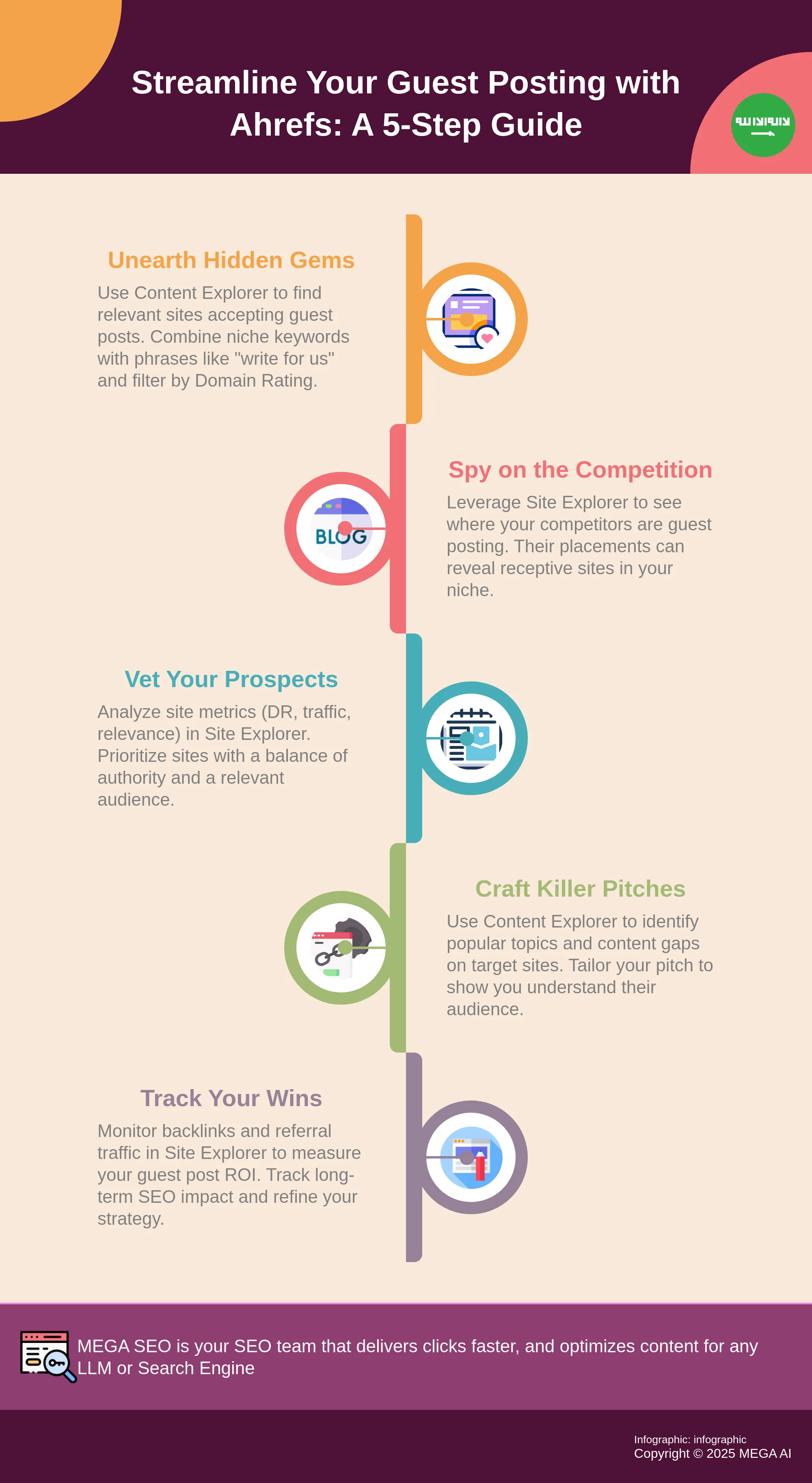
Ahrefs' Content Explorer is an excellent starting point for discovering websites that might welcome your contributions. This feature is essentially a massive, searchable database of web content. To begin, you can search for keywords relevant to your niche, perhaps combining them with phrases like "write for us" or "guest post guidelines." The real utility, however, comes from applying filters. For instance, you can filter by Domain Rating (DR), targeting sites in the 30-60 range to focus on those with decent authority. It's also helpful to exclude homepages and subdomains, which allows you to concentrate on specific article pages more likely to accept guest contributions. This targeted approach helps you sift through potential sites more effectively.
Analyze Competitors with Site Explorer
Your competitors can be an unexpectedly valuable resource for guest posting leads. If they are successfully placing guest posts, the websites they contribute to are likely open to similar content in your niche. Ahrefs' Site Explorer is the tool for this kind of detective work. Simply enter a competitor's domain and examine their backlink profile. Look for links originating from articles on other domains, as these often indicate guest posts. This analysis not only helps you find receptive sites but can also spark ideas for topics your competitors are covering that your target blogs might be missing, allowing you to fill content gaps.
Set Up Alerts for New Opportunities
Guest posting isn't just a one-time search; it's an ongoing effort. To stay on top of new possibilities, you can use Ahrefs to create alerts. Imagine receiving notifications when a target website publishes new content relevant to your expertise or when a competitor lands a new guest post. This proactive method, as detailed in guides on finding guest post opportunities, helps you spot openings as they appear, so you can reach out promptly. You can set up alerts for mentions of your keywords in new blog posts or track when specific domains publish content, ensuring you're often among the first to discover fresh opportunities.
Research and Select the Best Guest Posting Sites
So, you've used Ahrefs to unearth a list of potential guest posting opportunities. That's a fantastic start. But the journey doesn't end there; in fact, this is where your strategic thinking really comes into play. Choosing the right sites to pitch is just as important as finding them in the first place. Think of it like this: you wouldn't just throw seeds anywhere and expect a thriving garden, right? You’d pick fertile soil. Similarly, selecting the best platforms for your guest posts ensures your efforts will yield valuable results for your search engine optimization and brand visibility.
It’s tempting to aim for any site that will accept your content, but a more discerning approach pays off in the long run. You're looking for websites where your expertise will genuinely resonate with the audience, where the site's own authority can lend credibility to yours, and where a backlink will actually mean something to search engines. This careful vetting process helps you build a high-quality backlink profile, drive relevant referral traffic, and establish your brand as a thought leader in your niche. It’s about quality over mere quantity. The following steps will guide you through evaluating potential sites using Ahrefs, ensuring you focus your energy on opportunities that truly align with your goals and offer the best return on your content creation investment. This methodical approach helps simplify what can otherwise feel like an overwhelming task, allowing you to make informed decisions.
Evaluate Domain Rating and Organic Traffic
When you begin to narrow down your list of potential guest posting sites, two of the first metrics you'll want to check in Ahrefs are Domain Rating (DR) and organic traffic. Domain Rating offers a quick snapshot of a website's backlink profile strength, scored from 0 to 100. While a higher DR often indicates a more authoritative site, it's not the sole factor. Ahrefs itself suggests you can "use Ahrefs' Content Explorer to find relevant websites, filtering by Domain Rating (30-60), excluding homepages and subdomains." This DR range often hits a sweet spot, representing sites that carry authority but might be more receptive to guest contributions.
Organic traffic is just as critical. Your goal is to publish content on platforms that "get thousands of visitors each month." A website with a healthy flow of organic traffic means more potential readers for your guest post. This, in turn, increases the chances of click-throughs to your own site and broader exposure for your brand. You can find these traffic estimates using Ahrefs' Site Explorer, which helps you prioritize sites that offer genuine reach and engagement potential.
Assess Content Relevance and Quality
Beyond the numbers, the relevance and quality of a website's existing content are crucial. Your guest post needs to feel like a natural extension of what the site already offers its readers. Ahrefs' Content Explorer can be particularly helpful here, as it allows you to "find websites that already write about topics similar to yours." When your topic aligns well with the host site's niche, your pitch is more likely to be accepted, and your published post will better connect with their audience.
Before drafting a pitch, invest some time reading through several articles on the target site, paying close attention to any existing guest posts. Note the writing style, the depth of information provided, and the overall professionalism. Is the content well-researched, insightful, and engaging? Does the site uphold strong editorial standards? Associating your brand with platforms known for high-quality guest blogging content enhances your own credibility and ensures your message is delivered in a respected context.
Analyze Backlink Profiles
A website's backlink profile provides important clues about its authority and how search engines perceive it. Generally, a strong site will have a diverse portfolio of backlinks from other reputable and relevant websites. As Ahrefs' research indicates, "There's a strong correlation between organic traffic and the number of backlinks from unique websites." This connection highlights why earning backlinks through guest posts on various quality sites is a cornerstone of an effective SEO strategy.
When you're using Ahrefs' Site Explorer to evaluate a potential guest posting target, examine its referring domains. Are these linking sites relevant to the target site's industry? Does the overall backlink profile appear natural and earned, or are there signs of manipulative tactics? Securing a backlink from a site that Google trusts, and that has a clean, authoritative backlink profile itself, will provide more significant SEO value to your own website.
Consider Audience Engagement and Site Authority
Finally, look for evidence of an engaged audience and overall site authority. An active readership often translates into more comments, social media shares, and discussions around the content, all of which can amplify the reach of your guest post. See if readers are interacting with articles on the site. This is a good sign that the platform has a loyal community that values its content.
According to Mailchimp's guidance for marketers, it's wise to "check how well other guest posts on the site are doing, the site's overall reputation (domain authority), and who their audience is." Understanding the audience helps you tailor your content for maximum impact. While Ahrefs' Domain Rating is a useful quantitative measure of authority, also consider qualitative aspects like the site's standing within its industry and the expertise it showcases. Focusing on sites where your message will genuinely connect with an interested audience is key.
Craft Compelling Guest Post Pitches with Ahrefs
You've used Ahrefs to identify a list of promising websites for guest posting. That's a solid first step. However, finding the right sites is only part of the equation; the next crucial phase is crafting a pitch that actually gets a "yes." Site owners and editors are busy people, often sifting through dozens, if not hundreds, of guest post requests. A generic, one-size-fits-all email simply won't cut it. To capture their attention and earn a coveted spot on their blog, your pitch needs to be sharp, personalized, and demonstrate a clear understanding of their needs and their audience.
This is where Ahrefs transitions from a site discovery tool to an indispensable asset for pitch perfection. The platform offers a wealth of data that can help you understand a target site's content landscape and audience engagement. By digging into this information, you can tailor your approach with a level of detail that sets you apart. Instead of sending a hopeful shot in the dark, you can propose topics with confidence, knowing they align with what already works for the site or fill a genuine content gap. This shows the editor you’re not just looking for a backlink, but that you’re genuinely interested in contributing value. Using Ahrefs for pitch research means you can speak their language, address their specific interests, and ultimately, make your proposal too good to refuse.
Identify Popular Topics and Content Gaps
To make your pitch truly stand out, you need to propose a topic that not only interests their audience but also fills an existing void in their content library. Ahrefs' Content Explorer is your go-to tool for this. You can search for keywords relevant to your niche and then filter these findings to focus on websites that fit your criteria, such as those with a Domain Rating (DR) between 30 and 60, while excluding homepages to get to the actual content. By examining the articles that perform well, you can identify popular themes. The next step is to pinpoint unique angles or subtopics they haven't yet explored, allowing you to offer something fresh and valuable.
Analyze Existing Content Performance
Before you even think about writing your pitch, take the time to understand what successful content looks like on your target website. How well are their current articles, especially other guest posts, performing? Ahrefs can help you assess this by showing you the estimated organic traffic specific posts receive and the keywords they rank for. It's also important to evaluate the site's overall reputation, including its domain authority, and get a clear picture of who their audience is. Are they looking for beginner-friendly tutorials, or do they prefer in-depth, expert analyses? Knowing this allows you to tailor your proposed content’s style, tone, and depth to meet their readers' expectations, making your pitch significantly more persuasive.
Tailor Your Pitch to the Site's Audience
A generic pitch is the quickest way to get ignored. Personalization is absolutely essential. Your email needs to show that you've done your homework and have a genuine interest in the specific site you're contacting. If possible, address the editor or site owner by their name. Clearly introduce yourself, present your well-researched topic idea (backed by your Ahrefs findings), and explain why you are the right person to write it. Demonstrate your familiarity with their existing content and, most importantly, how your proposed article will benefit their specific audience. A thoughtfully personalized email that clearly articulates your idea's relevance dramatically improves your chances of getting that positive reply.
Maximize the Impact of Your Guest Posts
Getting your guest post published is a fantastic achievement, but the work doesn’t quite end when you hit "publish." To truly see the SEO benefits and expand your reach, you need a proactive strategy for what comes next. This phase is all about ensuring your carefully crafted content gets seen by the right people and delivers tangible results for your brand. Think of it as nurturing your investment. You’ve planted the seed by writing and publishing the post; now it’s time to help it grow. This involves keeping an eye on how your post is performing, engaging with the audience it attracts, and actively working to extend its lifespan and visibility.
Effectively maximizing your guest post's impact means you're not just hoping for passive benefits; you're actively pursuing them. This includes understanding the direct SEO value through backlink acquisition and the indirect value through brand mentions and referral traffic. Tools like Ahrefs are particularly useful in this post-publication phase. For instance, Ahrefs’ Site Explorer can help you discover new backlinks to your guest post and your own site, while its Content Explorer can track social shares. By consistently analyzing these metrics, you can refine your guest posting strategy over time, making each effort more impactful than the last. We'll explore specific tactics for tracking crucial data, monitoring social buzz, and effectively promoting your content to make the most of every guest posting opportunity you secure.
Track Backlinks and Referral Traffic
One of the primary goals of guest blogging is to earn a valuable backlink. As Ahrefs highlights, guest blogging involves writing for another website where "the guest blogger gets credit and a link back to their own site." These links are crucial signals to search engines, indicating your site's authority and relevance. To measure this, regularly check for new backlinks pointing to your guest post and, ideally, to your own website from that post. Tools like Ahrefs’ Site Explorer allow you to monitor these incoming links.
Beyond just the link itself, pay close attention to referral traffic in Google Analytics. This data shows you how many visitors are clicking through from the guest post to your site, giving you a direct measure of audience engagement and interest. Remember, there's a strong correlation between organic traffic and the number of backlinks from unique websites, so tracking this helps you see the direct SEO impact and understand which guest posts are driving qualified leads.
Monitor Social Shares and Engagement
After your guest post goes live, its journey is just beginning on social media. As the Ahrefs team advises, make sure to "share it on social media and engage with comments." Monitoring social shares helps you understand how well your content is resonating with the audience and its potential for wider reach. You can use tools like Ahrefs' Content Explorer to get an idea of share counts across major platforms, or simply keep an eye on notifications if you're tagged when others share your work.
Beyond shares, engagement in the comments section of the guest post itself, or on social media posts discussing it, is key. Responding to comments and questions fosters a sense of community, shows you're approachable, and can even spark ideas for future content. This active participation amplifies your message and extends the life of your guest post, keeping it relevant for longer.
Promote Your Guest Post Effectively
Simply publishing a guest post isn't enough; active promotion is essential to maximize its visibility and impact. As Mailchimp suggests, you should "Promote your post on social media. Engage with comments. Track your results using tools like Google Analytics." Start by sharing the post across all your relevant social media channels, and consider asking your team or professional network to share it too. Don’t just share it once; schedule a few follow-up shares over the next few weeks to catch different segments of your audience.
If you have an email newsletter, including a link to your guest post is another excellent way to drive traffic. Engaging with comments on the host site and on your social shares keeps the conversation going and encourages further interaction. Finally, tracking your results with Google Analytics will show you which promotional efforts are driving the most traffic and help you refine your strategy for future guest posts, ensuring each one performs better than the last.
Scale Your Guest Posting Efforts with Ahrefs
Finding a few guest posting opportunities is one thing; building a scalable strategy that consistently delivers results is quite another. As your guest posting ambitions grow, you'll discover that a simple list of potential sites isn't enough. You'll need efficient processes, strong relationships, and intelligent ways to manage your outreach efforts. Ahrefs offers a wealth of data that can certainly fuel this scaling process, helping you identify a larger pool of prospects and understand their potential value. However, transforming that data into a steady stream of published guest posts requires a truly systematic approach.
Scaling your efforts means you can reach broader audiences, build more backlinks, and establish greater authority in your niche more quickly. It involves a deliberate shift from sporadic, ad-hoc outreach to a more structured and repeatable system. This transition doesn't mean you have to sacrifice personalization or the quality of your pitches. Instead, it’s about creating well-defined, repeatable steps that allow you to handle a higher volume of opportunities effectively. Think of it as constructing a well-oiled machine for your guest posting, where Ahrefs provides some of the critical components and the insights to keep it running smoothly. By strategically using Ahrefs' tools, you can streamline your entire workflow, from initial prospect identification all the way to pitch management, ultimately making your guest posting efforts more impactful and sustainable in the long run.
Create a Systematic Outreach Process
To effectively scale your guest posting, a well-organized outreach system is essential. When you're managing a larger volume of potential sites, you need a clear, repeatable process. This involves more than just sending out emails; it's about thoughtfully managing your pipeline of opportunities. The Ahrefs Blog advises to "pitch multiple blogs simultaneously to increase your chances of success." This means you'll need to diligently read guest posting guidelines for each site, find the correct contact information—perhaps using a tool like Hunter—and then craft a compelling outreach email tailored to each specific blog. Using a spreadsheet or a CRM to track who you've contacted, when, and their response can prevent confusion and ensure timely follow-ups, making your scaled efforts manageable and professional.
Build and Maintain Relationships with Site Owners
Scaling your guest posting isn't solely about the quantity of posts; the quality of your connections matters immensely. As Ahrefs notes in its glossary, "guest blogging helps you make connections with people in your field and reach a wider audience. It’s important to network with other people in your industry." Think of each guest post as an opportunity to build a lasting bridge. Nurturing these relationships can lead to more guest posting opportunities in the future, valuable collaborations, or even referrals to other relevant sites. When you consistently provide high-quality content and are professional and easy to work with, site owners are much more likely to welcome your contributions again or introduce you to others in their network. This long-term perspective is key to sustainable guest posting success.
Use Content Explorer's Email Feature
Ahrefs' Content Explorer is a powerful tool for finding relevant websites, and its features can significantly aid in scaling your outreach. While the name might suggest a direct email finding feature within it, its strength lies in efficiently identifying suitable sites for your guest posts. As detailed in a guide by Scribe, you can "use Ahrefs' Content Explorer to find relevant websites, filtering by Domain Rating (30-60), excluding homepages and subdomains." This helps you quickly build a list of prospects. Once you have these target domains, you can then employ other tools or manual research methods to find specific editor email addresses. This makes the initial prospecting phase much more efficient when you're aiming for a higher volume of outreach.
Common Guest Posting Mistakes to Avoid (When Using Ahrefs)
Ahrefs is an incredibly powerful tool for uncovering guest posting opportunities, but like any tool, its effectiveness depends on how you use it. It's easy to fall into common traps that can limit your success, even with Ahrefs by your side. Understanding these pitfalls is the first step to avoiding them and truly making the most of your guest posting strategy. Think of it as having a top-of-the-line car; you still need to know the rules of the road and how to drive skillfully to reach your destination safely and efficiently. Guest posting isn't just about the sheer number of links you acquire; it's about strategic, quality placements that genuinely contribute to your SEO goals.
When you sidestep these frequent missteps, you're better positioned to refine your outreach, save valuable time, and build a robust backlink profile that search engines will view favorably. For businesses, especially startups and small teams where resources are precious, avoiding these mistakes from the outset can make a significant difference. The team at Ahrefs often shares insights on guest blogging best practices, and steering clear of these common errors aligns perfectly with achieving sustainable SEO results and building genuine authority in your niche. Focusing on a well-rounded strategy means you're not just chasing metrics, but building meaningful connections and providing real value, which ultimately supports long-term growth. Let's look at a few key mistakes to watch out for when using Ahrefs for your guest posting outreach so you can navigate the process more effectively.
Mistake: Focusing Only on High Domain Rating Sites
It's tempting to use Ahrefs to find sites with the highest Domain Rating (DR) and focus all your energy there. However, as Ahrefs points out, "Many marketers make the mistake of only targeting high Domain Rating (DR) sites for guest posting opportunities." While these high-DR sites offer strong backlinks, they're also incredibly competitive, and your pitches might get lost in the crowd. Plus, securing a spot can be a lengthy process. A more balanced approach involves using Ahrefs' Content Explorer to find relevant websites with a DR between 30 and 60. These sites often provide a sweet spot of achievable authority and are typically more accessible, giving you a better chance to land those valuable guest posts without facing overwhelming competition.
Mistake: Neglecting to Diversify Your Backlink Profile
Another common oversight is putting all your eggs in one basket by not diversifying your backlink profile. Ahrefs' own advice highlights this: "Relying too heavily on a few sources can limit your SEO potential." Instead, you should "aim to get links from a variety of websites that haven't linked to you before." A diverse backlink profile looks more natural to search engines and reduces your risk if one source stops providing value. Using Ahrefs to identify a wide range of relevant sites, rather than repeatedly targeting the same few, helps you build a healthier and more resilient backlink portfolio. This strategy not only strengthens your overall SEO but also maximizes the benefits you get from each guest post.
Mistake: Overlooking Content Quality
Guest posting isn't just a numbers game; the quality of your content is paramount. It's a mistake to think you can publish subpar articles just to get a backlink. As Ahrefs emphasizes, "Writing a high-quality post for a reputable website is essential for effective SEO." If you "avoid the temptation to publish low-quality content on unreliable sites," you protect your brand's reputation and your SEO efforts. Low-quality content can get your pitch rejected by desirable sites or, worse, associate your brand with poor standards. Use Ahrefs to find reputable platforms where well-crafted, valuable content is expected. This ensures your guest posts contribute positively to your authority and SEO.
Measure the Success of Your Guest Posting Strategy
Guest posting is a significant investment of your time and creative energy. You're not just writing an article; you're building relationships, reaching new audiences, and aiming to enhance your site's authority. Because of this, it's absolutely essential to have a clear plan for measuring whether your efforts are paying off. Without tracking your results, you're essentially working in the dark, unsure if your strategy is effective or if it needs adjustments. Think of it like this: you wouldn't launch a major marketing campaign without ways to see if it's working, and guest posting, when done strategically, is a powerful part of your marketing toolkit.
Measuring success in guest posting isn't just about seeing a quick spike in referral traffic on the day your post goes live, though that's certainly a nice perk. True success often unfolds over time, manifesting as improved search engine rankings, a stronger backlink profile, and increased brand recognition. These are the outcomes that truly move the needle for your business. Ahrefs provides a suite of tools that can help you look beyond the surface-level metrics and understand the deeper, long-term impact of your guest contributions. By consistently monitoring specific indicators, you can gain valuable insights into what’s working, what’s not, and how to refine your approach for even better results in the future. This data-driven approach transforms guest posting from a hopeful tactic into a predictable growth channel.
Set Clear Goals and KPIs
Before you even think about pitching your first guest post, it's crucial to define what success looks like for your specific campaign. Without clear objectives, you won't have a benchmark to measure against. Guest posting can help you achieve various marketing goals, such as building brand authority, driving targeted referral traffic to your website, acquiring valuable backlinks to improve your SEO, or simply expanding your reach to a new audience.
Once you've identified your primary goals, translate them into specific Key Performance Indicators (KPIs). For instance, if your goal is to increase referral traffic, a KPI might be "a 15% increase in referral traffic from guest post placements within three months." If acquiring backlinks is a priority, a KPI could be "secure 5 new backlinks from websites with a Domain Rating (DR) of 60+ each quarter." Having these precise targets will allow you to objectively assess the performance of your guest posting activities and make informed decisions.
Use Ahrefs to Track Long-Term SEO Impact
The SEO benefits of guest posting often build gradually, making long-term tracking essential. Ahrefs is an invaluable ally in this process, offering several features to monitor how your guest posts are influencing your site's search performance over time. Start by regularly checking the Referring Domains report in Ahrefs' Site Explorer. This will show you the new websites linking to you as a result of your guest posts. Pay close attention not just to the quantity but also the quality, indicated by metrics like Domain Rating (DR).
Additionally, use Ahrefs to monitor your organic keyword rankings for the specific pages on your site that are being linked to from your guest articles. Are these pages climbing the search results for their target keywords? You can also observe your website's overall Organic Traffic trend in Site Explorer. While multiple factors contribute to this, a consistent and high-quality guest posting strategy should contribute positively to your organic traffic growth over the months.
Analyze the ROI of Your Guest Posting Efforts
Understanding the return on investment (ROI) from your guest posting strategy involves looking at both quantitative and qualitative outcomes. It’s not always a straightforward calculation, as the benefits extend beyond immediate sales or leads. Consider the resources you've invested: the time spent on research, outreach, content creation, and relationship building.
Ahrefs can help quantify some of the SEO value. For example, the number and authority of the backlinks acquired contribute directly to your site's SEO performance, which Ahrefs can help you track. An increase in organic traffic due to improved rankings also has an associated monetary value, which Ahrefs can estimate. Research consistently shows a strong correlation between organic traffic and the number of backlinks from unique, authoritative websites. Beyond these numbers, also consider the less tangible, yet highly valuable, benefits like enhanced brand credibility, new industry connections, and your growing reputation as an expert in your field.
Key Metrics to Evaluate Potential Guest Posting Sites
Choosing the right websites for your guest posts is a critical step, especially for startups and small businesses looking to make a mark, or agencies managing multiple clients. You want to ensure your efforts lead to valuable backlinks, increased visibility, and relevant referral traffic. When you're sifting through potential sites, particularly when using a powerful tool like Ahrefs, focusing on a few key metrics can help you make informed decisions. These metrics will give you a clearer picture of a site's authority, audience engagement, and overall fit for your content, ensuring your message reaches the right people.
Think of it as a checklist to ensure you're investing your time and content wisely. By systematically evaluating potential guest posting sites, you can significantly improve the return on your guest blogging efforts, helping your own site gain traction and authority in your niche. This careful selection process is fundamental to a successful SEO strategy that incorporates guest contributions, and it's a smart move whether you're building your own brand or working on behalf of clients.
It’s not just about getting a link; it’s about getting the right link from the right place, and these metrics help you define what 'right' means for your specific goals. Taking the time for this analysis upfront can save you a lot of wasted effort down the line, freeing up resources that are often tight for growing businesses.
Domain Rating (DR)
One of the first numbers you'll likely look at is the Domain Rating or DR. This Ahrefs metric shows the relative strength of a website's backlink profile. When you're considering sites, it's helpful to have a target DR range; many SEO professionals suggest aiming for websites with a DR between 30 and 60, as these sites typically have a good balance of authority and traffic. Sites in this range are often realistically accessible for guest post opportunities, unlike super-high DR sites. A site with a solid DR indicates it has earned some respect in the eyes of search engines.
Traffic Volume
A strong DR is great, but you also want your guest post to be seen. That's where traffic volume comes in. Look for websites that attract a significant number of visitors each month. Ahrefs' Site Explorer can give you an estimate of a site's organic traffic, which is a good indicator of its reach. While there's no magic number, sites receiving thousands of visitors monthly are generally a good sign. This indicates an active, engaged audience, meaning more potential eyes on your content and a higher chance of click-throughs to your own site. More traffic often translates to more opportunities for your message to resonate.
Relevance of Content
This might seem obvious, but it's crucial: the site's content must be relevant to your niche or industry. A backlink from a high-DR, high-traffic site won't do you much good if its audience has zero interest in what you offer. Ensure the website's topics align with your expertise and that your guest post will provide genuine value to their readers. Relevant content not only makes your pitch stronger but also increases the likelihood that the readers will engage with your article and perceive you as an authority. Think about whether your ideal customer would naturally be reading that site. If the answer is yes, you're on the right track.
Engagement Metrics
Beyond just traffic numbers, look for signs of an engaged audience. How do other guest posts (and articles in general) perform on the site? Check for social shares, comments, and the number of backlinks other articles on the site have attracted. High engagement metrics suggest that readers are actively consuming and interacting with the content, which is exactly what you want for your guest post. A lively comments section, for instance, can provide opportunities for you to engage directly with readers and further establish your expertise. This shows the site has a community, not just passive readers.
Audience Fit
Finally, dig a little deeper into who the site's audience is. Does their reader demographic align with your target customer? Understanding the audience fit is key to maximizing the impact of your guest post. If you're targeting startups or small businesses, a guest post on a site popular with enterprise-level executives might not yield the best results, even if the site has impressive DR and traffic. The goal is to connect with people who are likely to be interested in your products or services, like those MEGA AI aims to help. This ensures your message lands with those who can truly benefit from it.
Analyze Existing Content on Target Sites with Ahrefs
Before you dive into writing a guest post pitch, it’s a smart move to understand what’s already performing well on the websites you’re targeting. Taking the time to analyze their existing content gives you a clear view of their audience, helps you spot popular topics, and shows you exactly where your unique perspective can make the biggest impact. Ahrefs provides some excellent tools that make this analysis process much smoother and more insightful, helping you ensure your guest post idea is both relevant and likely to be welcomed.
Think of this as doing your homework. When you understand the current content landscape of a site, you can create a pitch that truly resonates because it’s tailored, well-informed, and addresses a genuine interest or need for that site and its readers. This initial research significantly improves your chances of getting your guest post accepted.
Identify What Works: Popular Content and Audience Interests
Your first step is to figure out what types of articles and topics already capture the attention of the target site's audience. Ahrefs’ Content Explorer is a great tool for this. You can enter a target website’s domain and see which of their pieces have garnered the most social shares or attracted a significant number of backlinks. This data offers strong clues about the subjects and formats that have a proven track record of success with their readership.
Once you’ve identified some popular articles, dig a bit deeper to understand the keywords that are bringing traffic to these posts. You can use Ahrefs' Keywords Explorer to see what terms their audience is actively searching for. This information is invaluable because it allows you to align your proposed guest post topic with existing audience interest, making your contribution much more likely to perform well and satisfy what users are looking for.
Find Your Angle: Content Gaps and Link Opportunities
With a solid understanding of what’s popular, you can now look for opportunities where your contribution can offer something new or a fresh take. Carefully review the high-performing content on the target site. Are there articles that have high engagement but now feature outdated information? Or perhaps there's a popular topic that could be explored in more detail or from a different viewpoint? These situations present excellent chances for your guest post to fill a content gap and provide real value.
Ahrefs’ ‘Content Gap’ tool, often highlighted in their guest blogging resources, can also be very helpful here. It allows you to find keywords that the target site is already ranking for, but perhaps not as well as they could, or keywords their competitors rank for that they haven't yet targeted. Pitching a post on these topics can be quite attractive to site owners. Additionally, by examining the backlink profiles of their successful articles, you can get a sense of what kinds of content tend to attract links, which helps you craft a piece that is more likely to earn valuable backlinks itself.
Related Articles
- Smart Guest Posting Strategies to Build Quality Backlinks
- Smart Guest Posting: 4x Your Link Building Results
- Guest Posting for SEO: A Startup's Guide
Frequently Asked Questions
Why should I bother with guest posting if I'm already creating content for my own site? Think of guest posting as a way to introduce your expertise to a whole new crowd. It helps you build valuable links back to your site, which search engines really like, and it can bring fresh, interested readers directly to you. It's a great way to expand your reach beyond your current audience.
Ahrefs seems powerful, but how exactly does it help me find websites that are open to guest articles? Ahrefs has a couple of neat features for this. You can use its Content Explorer to search for sites in your niche that specifically mention they accept guest contributions, often using phrases like "write for us." Another smart approach is to look at where your competitors are guest posting using Site Explorer; if a site published their work, they might be open to yours too.
I've got a list of sites from Ahrefs. What are the most important things to check before I decide where to pitch? When you're looking at potential sites in Ahrefs, pay close attention to their Domain Rating and how much organic traffic they get – you want sites with some authority and real readers. Also, make sure their content is genuinely relevant to what you do, and see if their audience seems engaged with what they publish by checking for comments or social shares.
My guest post just went live. What can I do now to make sure it really helps my website? Once your article is published, your work isn't quite done. You'll want to share it on your social media channels and keep an eye on any comments so you can engage with readers. It's also a good idea to use tools like Ahrefs to see if you're getting backlinks and Google Analytics to check for referral traffic coming to your site from the post.
Should I only use Ahrefs to find guest posting sites with really high Domain Ratings? It's easy to think that only the highest Domain Rating sites are worth your time, but that's not always the case. While those sites are great, they're also very competitive. Ahrefs can help you find quality sites with more moderate Domain Ratings, perhaps in the 30-60 range, which can still offer excellent value and might be more receptive to your pitch.