
Many affiliate marketers work hard to drive traffic to their sites, but often overlook a crucial step: optimizing what happens once visitors arrive. You might have a steady stream of potential customers, but are you truly maximizing your chances of converting them into sales? A/B testing is a powerful technique that helps you unlock the untapped potential within your existing traffic. By systematically testing different elements—like your calls-to-action, page layouts, or even product descriptions—you can discover precisely what encourages your visitors to take the next step. This isn't about reinventing the wheel; it's about making smart, data-driven refinements that can lead to significant increases in your affiliate earnings. We'll explore how to get started with A/B testing, identify key areas for improvement, and turn those insights into tangible results for your affiliate website.
Key Takeaways
- Make Your Tests Count: Set up your A/B tests with a clear hypothesis for what you're changing and why, and ensure you gather enough visitor data before drawing conclusions about what works best on your affiliate pages.
- Let Data Guide Your Decisions: Improve your affiliate site by testing key elements like CTAs and page layouts, then dig into the numbers—checking for statistical significance and looking at different user groups—to understand what truly boosts conversions.
- Keep Improving Your Affiliate Game: Avoid common A/B testing slip-ups, always measure how changes impact your revenue, and use those valuable insights from winning tests to enhance other areas of your affiliate strategy.
What is A/B Testing for Affiliate Websites?
If you're running an affiliate website, you're always looking for ways to improve your conversion rates and earn more commissions. A/B testing is a fantastic approach to help you do just that. It takes the guesswork out of website optimization by allowing you to make data-backed decisions. By systematically testing changes, you can discover what truly resonates with your audience and refine your site for better performance. This process helps you understand your visitors better and ultimately, can lead to a more profitable affiliate business.
Define A/B Testing and Its Value
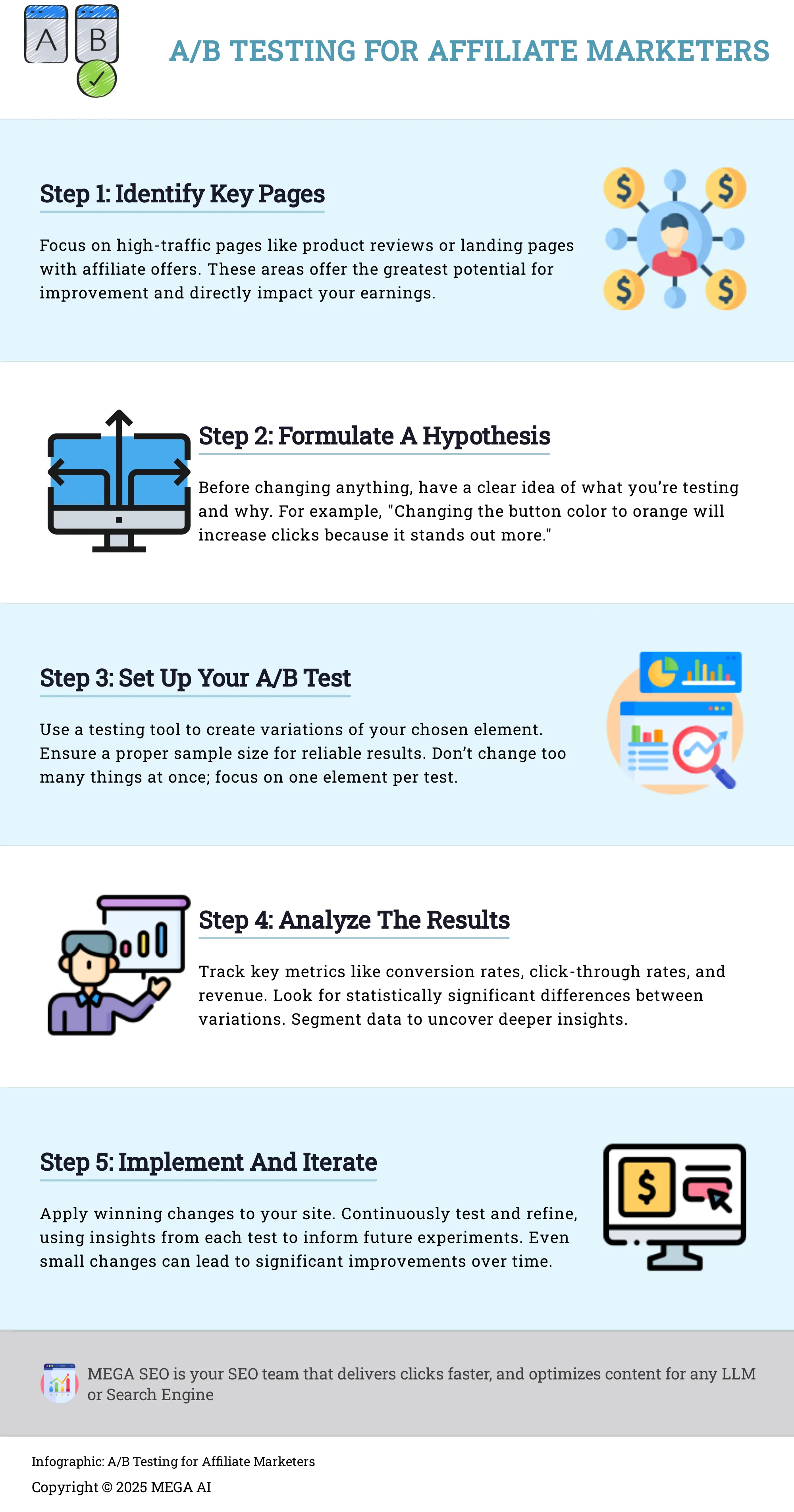
A/B testing, also known as split testing, is a method of comparing two versions of a webpage or an element on your page to see which one performs better. You show version A (the control) to one segment of your website visitors and version B (the variation) to another. By tracking how users interact with each version—like which one gets more clicks or leads to more sales—you can determine the winner. This approach is a cornerstone of data-driven decision-making. For affiliate marketers, A/B testing is valuable because it's relatively inexpensive, fast to implement, and can significantly increase your sales with the traffic you already have. It allows you to make incremental improvements that compound over time.
Identify Key Elements for Testing
When you're ready to start A/B testing on your affiliate site, you'll want to focus on elements that can directly impact user behavior and conversions. Some of the basic things that you can test are your call-to-action placement, what a button text might say, different colors, the layout and design of your website, and also the key areas of content. It's often a good idea to begin testing on pages that are most critical to your funnel, such as your top-performing product review pages or landing pages where visitors are expected to take a specific action. As Nicolas Fradet points out, "Most of the time, you should start to A/B test the pages of your funnel that contribute most to your conversions." Improving these key areas can lead to more substantial gains.
How to Set Up Effective A/B Tests
Setting up your A/B tests correctly from the start is key to getting reliable insights that can actually help you improve your affiliate site's performance. It’s not just about randomly changing things; it’s about a methodical approach to understanding what truly resonates with your audience. By focusing on a few core setup principles, you can ensure your tests are meaningful and your efforts lead to real improvements in conversions and revenue.
Choose the Right Testing Tools
Picking the right A/B testing tool is your first step towards getting clear, actionable results. You'll want a platform that not only fits your budget but also offers the features you truly need. Some tools are fantastic all-rounders. For instance, platforms like AB Tasty allow you to run various tests, including A/B tests, split tests, and even more complex multivariate tests across different devices. This kind of versatility can be a game-changer.
Other tools might specialize; FigPii is known for its user-friendly interface and strong analytics, which is great if you want to dive deep into the data without a steep learning curve. And if your affiliate site is heavily focused on eCommerce, a tool like Omniconvert is specifically designed with your needs in mind, helping you optimize product pages and checkout flows effectively.
Establish Clear Hypotheses
Before you even think about launching a test, you need a solid plan, and that starts with a clear hypothesis. Think of your hypothesis as your educated guess about what change will lead to a better outcome and why. For instance, you might hypothesize, "Changing the CTA button color from blue to orange will increase clicks because orange stands out more on our page design."
Building a strong hypothesis is so important because it guides your entire testing process and helps you understand if your changes are actually making a difference. Remember, A/B testing isn't just about picking a "winner." It's about gathering insights that help you continuously refine your affiliate marketing strategy and make smarter decisions for your site down the line.
Determine Sample Size and Test Duration
To get results you can trust, you need to be a bit scientific about your A/B tests. This means figuring out the right sample size – that’s the number of visitors who need to see your test. Key things that influence this are your current conversion rate, how big of a change you expect to see (this is called the minimum detectable effect), and your desired level of statistical significance, which is usually set around 95%.
Equally important is how long you run your test. You need to run tests long enough to gather enough data for reliable results, typically until you reach that 90-95% statistical significance. Cutting tests short or using too small a sample can lead you to make decisions based on shaky data, and nobody wants that.
How to Optimize Key Conversion Elements
Once your A/B testing framework is in place, it's time to focus on the specific parts of your affiliate website that can significantly influence your conversion rates. Small changes to these key elements can lead to noticeable improvements in your earnings. Think of it as fine-tuning your site to better meet your audience's needs and guide them toward making a purchase. We'll look at how to systematically test and refine your calls-to-action, page layout, user experience, product descriptions, and pricing strategies to help you get the most out of your affiliate traffic. This process is about making informed decisions based on data, rather than just guessing what might work best for your audience.
Test Call-to-Action (CTA) Placement and Design
Your call-to-action is arguably one of the most critical elements on your affiliate page. As Matt Diggity aptly puts it, "Having good call-to-action best practices is going to get you more sales without having to get more traffic." This means you can increase revenue simply by optimizing what you already have. Start by A/B testing different aspects of your CTAs. Consider the wording – are you using strong action verbs, and is the benefit clear? Also, experiment with the placement. Should it be above the fold, after a compelling product review, or perhaps sticky as the user scrolls? Don't overlook design elements like button color, size, and shape, as even subtle tweaks here can make a surprising difference in how users respond.
Optimize Layout and User Experience
The overall layout of your affiliate pages and the user experience they provide are fundamental to keeping visitors engaged and guiding them towards conversion. A cluttered or confusing layout can quickly lead to a high bounce rate, meaning lost opportunities. When testing different layouts, it's wise to "run that same test on multiple pages so that you know you're not getting some quirky result on one page," as Matt Diggity advises. This approach helps ensure your findings are reliable across your site. To truly understand how users interact with your different page variations, consider watching recordings of their sessions. This can reveal pain points or areas of confusion in one version compared to another, offering clear insights into what makes a layout more effective.
Refine Product Descriptions and Pricing Strategies
Well-crafted product descriptions and a clear presentation of value can significantly impact a potential buyer's decision. While as an affiliate you might not control the product's price, you absolutely control how you describe the product and frame its value to your audience. By analyzing the results of your A/B tests on different product descriptions, you can see which versions resonate most and lead to more clicks on your affiliate links. Try testing variations in tone, the length of the description, and the specific benefits you highlight. Furthermore, data segmentation can offer deeper insights, helping you understand if certain descriptions or value propositions appeal more strongly to specific segments of your audience.
How to Create Urgency and Use FOMO
Creating a sense of urgency and tapping into the Fear of Missing Out (FOMO) are effective psychological approaches that can significantly influence visitor behavior on your affiliate site. When people feel they might miss a great deal or an exclusive opportunity, they are more inclined to act quickly. This isn't about misleading your audience; it's about clearly showing the genuine value and time-sensitive nature of the offers you promote. By strategically incorporating these elements, you can encourage visitors to move from consideration to conversion more decisively. For affiliate marketers, this often translates directly into increased clicks and commissions. The key is to implement these tactics ethically and transparently, ensuring they align with the actual offers from your affiliate partners. When done correctly, you can motivate action without creating a negative user experience. This approach helps your audience make timely decisions, benefiting both them and your affiliate revenue.
Implement Limited-Time Offers and Countdown Timers
One of the most direct ways to create urgency is by featuring limited-time offers. When an offer has a clear expiration date, it prompts visitors to make a decision sooner. As Matt Diggity points out, "People have this innate fear of missing out, and if you create a sense of urgency, you can activate FOMO in order to get more sales." A highly effective tool for this is the countdown timer. Visually seeing the seconds tick down reinforces the scarcity of time. You can use these for special promotions, seasonal sales, or exclusive affiliate bonuses. Consider using "evergreen" countdown timers for offers that are always available but presented as time-sensitive to new visitors, which can consistently drive conversions. Always ensure the deadlines are genuine to maintain trust with your audience.
Highlight Exclusivity and Scarcity
People tend to value what they perceive as exclusive or scarce. If an offer feels special or difficult to obtain, it often becomes more desirable. You can highlight exclusivity by offering unique bonuses for your audience or by promoting products with limited stock or availability. Matt Diggity suggests, "Highlighting missed opportunities, such as past sales, can be effective. You can say something like, 'This product was on sale last month for 30% off; this month it's 15% off, and next month the sale is going away.'" This method helps visitors understand that good deals don't last forever. Clearly communicate if a product is a limited edition, if there are only a few spots available for a service, or if a special discount is only for a select group. This can make your audience feel privileged and more inclined to seize the opportunity.
Use Social Proof to Increase Conversions
Social proof acts as a strong persuader by showing visitors that others trust and value the products or services you're promoting. When people see that others have had positive experiences, it reduces their perceived risk and makes them more confident in their decision. You can incorporate social proof through customer testimonials, reviews, user-generated content, or even by displaying the number of people who have recently purchased or signed up. To refine how you present social proof, understanding user interactions is beneficial. As Contentsquare notes, "Using insights from Session Replay to define and refine your hypotheses, and watching recordings of users navigating and interacting with your A/B test page variations can help you understand what makes one page perform better than another." This can help you test which types of social proof resonate best with your audience and improve your conversion rates.
How to Analyze and Interpret Test Results
Once your A/B test has run its course, the real learning begins. Analyzing the data correctly is just as important as setting up the test properly. This is where you uncover what truly resonates with your audience and how you can make impactful changes to your affiliate site. It’s not just about picking a winner; it’s about understanding the 'why' behind the performance. This deeper understanding allows you to make smarter decisions for future tests and overall site optimization. Let's look at how to break down your results effectively.
Track Key Metrics
Before you even launch your A/B test, you should have a clear idea of which metrics will determine success. For affiliate sites, common metrics include conversion rates (how many visitors complete a desired action, like clicking an affiliate link or signing up for a newsletter), click-through rates on your affiliate offers, and perhaps even revenue per visitor. Keeping an eye on bounce rates and time on page can also offer clues about user engagement with each variation.
To truly understand why one version outperforms another, consider tools that offer insights beyond just numbers. For instance, "Use insights from Contentsquare’s Session Replay to define and refine your hypotheses, and watch recordings of users navigating and interacting with your A/B test page variations to understand what makes one page perform better than another." This qualitative data can be incredibly valuable in interpreting user behavior and refining future tests.
Understand Statistical Significance
It's easy to see one version of your page getting slightly more clicks and declare it the winner. However, it's crucial to ensure your results are statistically significant. This means the difference you're seeing is likely due to the changes you made, not just random chance. Most A/B testing tools will calculate this for you, often aiming for a 95% confidence level.
To get reliable results, you need an adequate sample size. As Data-Mania explains, "To determine the correct sample size for your A/B test to get reliable results, you need to consider a few key factors: the baseline conversion rate, the minimum detectable effect (the smallest difference you want to detect), your desired statistical significance level (commonly 95%), and the statistical power (typically 80%)." Understanding these factors helps you run tests that yield trustworthy data, forming a solid foundation for your affiliate strategy.
Segment Data for Deeper Insights
Sometimes, the overall results of an A/B test might not show a clear winner, or one variation might seem to perform worse. Before you discard a test as inconclusive or a failure, dig deeper by segmenting your data. This means looking at how different groups of users responded to your variations. You could segment by traffic source (organic search, social media, paid ads), device type (desktop, mobile, tablet), new versus returning visitors, or even geographic location.
As Dynamic Yield points out, "Only after taking the time to thoroughly analyze the results of one’s experiments for different segments can deeper optimization opportunities be identified, even for tests that are failing to produce uplifts for the average user." You might find that one variation performed exceptionally well for mobile users, for example, even if it didn't win overall. This kind of segmented analysis can reveal hidden opportunities and lead to more personalized user experiences.
Explore Advanced A/B Testing Strategies
Once you've gotten comfortable with the basics of A/B testing, you might find yourself asking what comes next. Moving beyond simple headline tweaks or button color swaps can really open up new ways to increase your affiliate revenue. Advanced strategies involve a more nuanced understanding of your audience and how they interact with your site from start to finish. Think of it as taking your testing skills to the next level, allowing you to achieve more precise and impactful results. These approaches can help you fine-tune the user experience in ways that genuinely connect with different visitor segments, ultimately leading to more conversions. It’s about working smarter with your testing efforts to achieve more significant gains. By digging deeper, you can uncover insights that simple tests might miss, giving you a real edge.
Use Personalization and Targeted Testing
Generic messages often fall flat. Personalization in A/B testing means tailoring the experience by showing different versions of your page to specific audience segments. For instance, you could present one set of affiliate offers to visitors who seem interested in budget-friendly options and a different set to those looking for premium products. Some platforms, like AB Tasty, support "engagement-based and psychographic segmentation," which allows you to deploy custom messages or features to specific audiences based on their behavior or inferred interests. This method makes your affiliate promotions feel more relevant and less like a blanket advertisement, which can significantly improve click-through rates and conversions.
Optimize Your Multi-Page Funnel
Your affiliate website is more than just a collection of individual pages; it’s a pathway guiding visitors toward making a purchase or clicking an affiliate link. Instead of testing elements on a single page in isolation, consider how changes affect the entire user journey. As marketing expert Nicolas Fradet notes, "most of the time, you should start to A/B test the pages of your funnel that contribute most to your conversions." For an affiliate site, this could mean testing the flow from a detailed review article to a product comparison table, and then to the click on your affiliate link. By focusing on conversion funnel optimization, you can identify weak points where users might be dropping off and test improvements to keep them engaged and moving toward your affiliate partners.
Conduct Mobile-Specific Tests for Affiliate Sites
A large portion of your affiliate traffic likely comes from users on mobile devices, and an experience designed for a desktop often doesn't translate perfectly to a smaller screen. It's really important to conduct A/B tests specifically for your mobile audience. This could involve testing different page layouts, simpler navigation menus, larger tap targets for calls-to-action, or even how content is presented. Understanding how users interact with your site on mobile is key. For example, using insights from tools that offer session replay can help you "watch recordings of users navigating and interacting with your A/B test page variations to understand what makes one page perform better than another" specifically on mobile devices. This ensures your affiliate offers are just as effective and easy to interact with on a smartphone as they are on a desktop.
How to Avoid Common A/B Testing Mistakes
A/B testing is a fantastic way to fine-tune your affiliate website for better performance, but it's easy to stumble if you're not careful. Think of it like baking: even with the best ingredients, a small misstep in the process can lead to a less-than-perfect cake. Similarly, certain common errors in A/B testing can lead you to draw the wrong conclusions, potentially harming your conversion rates instead of helping them.
The good news is that these mistakes are often easy to avoid once you know what to look for. By understanding these potential pitfalls, you can set up your tests for success and gather truly meaningful data. This will help you make informed decisions that genuinely improve your affiliate earnings. Let's walk through some of the most frequent missteps and how you can steer clear of them, ensuring your A/B testing efforts are both effective and reliable.
Don't Stop Tests Prematurely
One of the most tempting, and common, mistakes is calling a test complete too soon. You might see one variation performing significantly better after just a day or two and feel eager to implement the winner. However, as Nicolas Fradet highlights, "Every A/B test has to be run for a certain amount of time." Ending a test prematurely means you haven't collected enough data to account for natural fluctuations in user behavior or to reach statistical significance. For instance, traffic on a Monday morning might behave very differently from traffic on a Saturday afternoon. To get a true picture, allow your test to run for at least one full business cycle, or ideally two, to capture varied user patterns and ensure your results are reliable, not just a fluke.
Consider External Factors
Your website doesn't exist in a vacuum, and external events can significantly impact your A/B test results. Imagine running a test on a new call-to-action button during a major holiday sale or when a popular influencer unexpectedly links to your site. These events can skew your traffic and user behavior, making it difficult to tell if the changes you see are due to your test or these outside influences. As Qualaroo points out, issues like "not considering small wins; wasting your time testing insignificant elements; mistakes made before A/B testing" can all lead to misleading outcomes. Before starting a test, take note of any ongoing marketing campaigns, holidays, or even industry news that might affect your audience. If a significant external event occurs during your test, it's wise to acknowledge its potential impact or even consider rerunning the test during a more stable period to validate your findings.
Keep Your Test Design Simple
When you're enthusiastic about improving your site, it's easy to want to test multiple changes at once. Perhaps you want to change the headline, the button color, and the image on a landing page all in one go. While this might seem efficient, it makes it nearly impossible to determine which specific change caused the observed effect. If conversions go up, was it the new headline, the button, or the image? Or a combination? As Contentsquare (formerly Hotjar) wisely notes, "Basing your test on invalid A/B testing hypotheses can lead to poor results." A clearer approach is to test one variable at a time. This way, you can confidently attribute any performance difference to that single change, leading to more actionable insights and a better understanding of what truly resonates with your audience.
How to Measure ROI and Scale Success
Running A/B tests is just the first step; understanding their true impact on your bottom line and knowing how to build on that success is where the real value lies for your affiliate site. Measuring the return on investment (ROI) of your testing efforts helps you justify the resources spent and make informed decisions about where to focus your optimization energy. It’s about connecting the dots between a specific change you tested and the actual revenue it generated. For affiliate marketers, this means seeing a clear path from test results to increased commissions.
Once you identify a winning variation, the journey doesn’t end there. Scaling success means taking those valuable insights and applying them strategically. This could involve rolling out a winning design element across multiple pages, adapting a successful messaging approach for different affiliate offers, or even using the learnings to inform your broader content strategy. By systematically measuring ROI and scaling your wins, you create a powerful cycle of continuous improvement that can significantly grow your affiliate income over time. This approach transforms A/B testing from a series of isolated experiments into a core component of your revenue growth strategy, helping you make smarter decisions that directly affect your earnings.
Track Revenue Improvements Over Time
When you run an A/B test on your affiliate site, the ultimate goal is usually to see an increase in revenue. While metrics like click-through rates or sign-ups are important leading indicators, tracking how your tests directly impact your earnings provides the clearest picture of success. After implementing a winning variation, monitor your affiliate commissions and overall site revenue closely. Did the change lead to more sales or higher-value conversions?
A thorough A/B testing analysis will help you determine if the change you made had the desired effect on your chosen financial metric. Look at revenue trends before and after the test, considering any external factors that might have influenced sales. This long-term view helps you confirm that the uplift wasn't just a temporary blip but a sustainable improvement driven by your optimization efforts.
Assess the Cost-Effectiveness of A/B Testing
A/B testing requires an investment of your time, and potentially money if you're using paid tools or driving significant traffic to your test pages. To ensure your efforts are worthwhile, it's important to assess the cost-effectiveness of your testing program. Consider the resources you've allocated to planning, setting up, running, and analyzing tests. Compare this "cost" to the actual or projected revenue gains from your winning variations.
To avoid wasting resources, focus your A/B tests on pages that contribute most to your conversions, like high-traffic product review pages or landing pages with significant affiliate offers. As Nicolas Fradet points out, this strategic approach helps you avoid common A/B testing mistakes and ensures that the insights you gain are more likely to translate into meaningful financial returns, making your testing efforts truly cost-effective.
Apply Successful Tests Across Campaigns
Once you've identified a winning variation in an A/B test, don't let that knowledge sit idle. The real power comes from applying these successful elements across other relevant areas of your affiliate site and even into different marketing campaigns. For instance, if a particular call-to-action button design significantly increased conversions on one affiliate offer, consider implementing that design on other offer pages.
Think of each test as a learning opportunity. As Optimonk suggests, you shouldn't stop after one test; instead, use your learnings to refine your marketing strategy and iterate. If a specific headline style resonated well, try similar styles in your email subject lines or social media posts promoting your affiliate content. This systematic application of successful test results helps you scale your wins and continuously optimize your overall affiliate marketing performance.
How to Integrate A/B Testing into Your Affiliate Strategy
Integrating A/B testing into your affiliate strategy means weaving a data-driven approach into your marketing. Thoughtful testing can systematically improve affiliate income. Look beyond individual results to see how experiments contribute to larger objectives and build a stronger business. It’s about making informed decisions that compound for sustained growth.
Align Tests with Overall Marketing Goals
For effective A/B testing, align each test with your broader marketing goals. Focus on changes impacting key performance indicators. Nicolas Fradet notes a common misstep is testing "the wrong pages. Most of the times, you should start to A/B test the pages of your funnel that contribute most to your conversions."
Define success for your affiliate site: more clicks, sign-ups, or sales? Once objectives are clear, identify critical pages in your conversion funnel influencing these outcomes. Prioritize tests on high-impact areas to spend resources wisely.
Build a Culture of Continuous Improvement
A/B testing is an ongoing learning process, not a one-off task. Insights from one test fuel hypotheses for the next. OptiMonk advises, "Don't stop after one test. Use your learnings to refine your marketing strategy and iterate on tests for ongoing optimization." This iterative approach drives consistent growth.
Document every test result, including learnings from "losing" variations. Share insights or keep a detailed log. Review these learnings for patterns and future experiments. By building a culture of continuous improvement, A/B testing becomes a core strategic element.
Stay Updated with Industry Trends and Best Practices
Digital marketing and A/B testing constantly evolve. Staying informed about new tools, techniques, and consumer behaviors helps you adapt and compete. FigPii notes, "A thorough and well-conducted A/B testing analysis can provide valuable insights for product development and marketing campaigns."
Follow industry blogs, join communities, and consider online courses. Properly analyzing your A/B test results is vital. Dynamic Yield highlights that "deeper optimization opportunities" emerge after thorough analysis. This commitment to learning keeps your testing effective and uncovers new refinements.
Related Articles
- Affiliate Marketing: The Ultimate Guide (2024)
- Advanced Affiliate Marketing Strategies: Drive Explosive Growth
- Affiliate Marketing Guide: Drive Sales with Proven Strategies
- Proven Affiliate Marketing Strategies to Maximize Profits
Frequently Asked Questions
I'm new to A/B testing. What's a good starting point for my affiliate website? When you're just starting out, it's smart to focus your A/B testing efforts on the parts of your affiliate site that have the biggest potential to influence your visitors' actions. Think about your main call-to-action buttons or your most popular product review pages. Making improvements in these key areas can often lead to noticeable gains more quickly.
How do I know when an A/B test has run long enough to give me reliable results? It's important to let your A/B tests run for an adequate period to gather enough data. You're looking for results that are statistically significant, meaning the differences you see are likely real and not just due to chance. Most testing tools help with this, but generally, you'll want to run a test until you reach a high confidence level, often around 95%, and have captured a full cycle of your typical visitor behavior.
Are there A/B testing tools that are good for beginners or those on a budget? Yes, there's a range of A/B testing tools available, and you don't necessarily need to invest a lot to get started. Some platforms offer free versions or trials, and many are designed to be user-friendly, even if you're not a technical expert. The key is to find a tool that provides clear results and fits the types of tests you want to run on your affiliate site.
What should I do if my A/B test results are confusing or don't show one version as clearly better? If a test doesn't produce a clear winner, don't consider it a waste of time. You can often find valuable information by looking at the data more closely, perhaps by examining how different segments of your audience responded. Sometimes, a test might reveal that a particular change didn't have the impact you expected, and that itself is a useful piece of information for future tests.
Can small changes really make a big difference in A/B testing, or should I only test major redesigns? Absolutely, small, well-considered changes can indeed lead to significant improvements over time. While testing major redesigns has its place, consistently testing smaller elements like headlines, button text, or image placement can help you fine-tune your affiliate pages. These incremental gains often add up, leading to better overall performance.