
Is your website playing hide-and-seek with potential customers, and mostly winning at hiding? It's a common frustration for many businesses trying to make their mark online. The digital world is vast, and getting noticed can feel like searching for a specific grain of sand on an endless beach. This article offers you a clear map. We've put together an essential SEO checklist, breaking down the journey to higher search engine rankings into manageable, actionable steps. From building a solid technical base to creating content that connects and understanding the power of links, this guide will walk you through each crucial stage, helping you find your way to better online visibility.
Key Takeaways
- Build a Strong SEO Core: Prioritize a technically sound website, conduct thorough keyword research, create valuable content, and establish a robust linking plan to enhance your search visibility.
- Continuously Refine Your Approach: Regularly track your SEO performance, analyze the data, and adjust your strategies—including local and advanced methods—to stay competitive and improve rankings.
- Leverage AI for Enhanced Efficiency: Use artificial intelligence to streamline key SEO processes like keyword discovery, content development, and site maintenance, allowing you to achieve more with your optimization efforts.
Your Essential SEO Checklist: Steps to Rank Higher
Feeling like your website is lost in the vast ocean of the internet? You're not alone. Many startups, small businesses, and even digital marketing agencies struggle to get their content seen by the right people. That's where a solid Search Engine Optimization (SEO) strategy comes in, and a comprehensive checklist is your roadmap to effectively implement it. Think of this checklist as your guide to making sure all your SEO bases are covered, from the technical nuts and bolts of your website to the engaging content your audience is searching for.
This isn't just about ticking boxes; it's about systematically improving your website's visibility and climbing those search engine rankings. We'll walk through ten crucial areas, starting with building a robust technical foundation, then diving into smart keyword research, creating content that truly connects, and developing a strong linking strategy. We'll also cover how to make an impact with local SEO, explore some advanced techniques, and emphasize the importance of tracking your progress and adapting your approach. Staying current is key, as is understanding how to tackle common SEO challenges and measure your return on investment. Finally, we'll look at how AI is transforming SEO, offering powerful new ways to optimize your efforts. Following these steps will help you attract more organic traffic, reach your target audience, and ultimately, grow your business. Let's get started.
1. Build a Strong Technical SEO Foundation
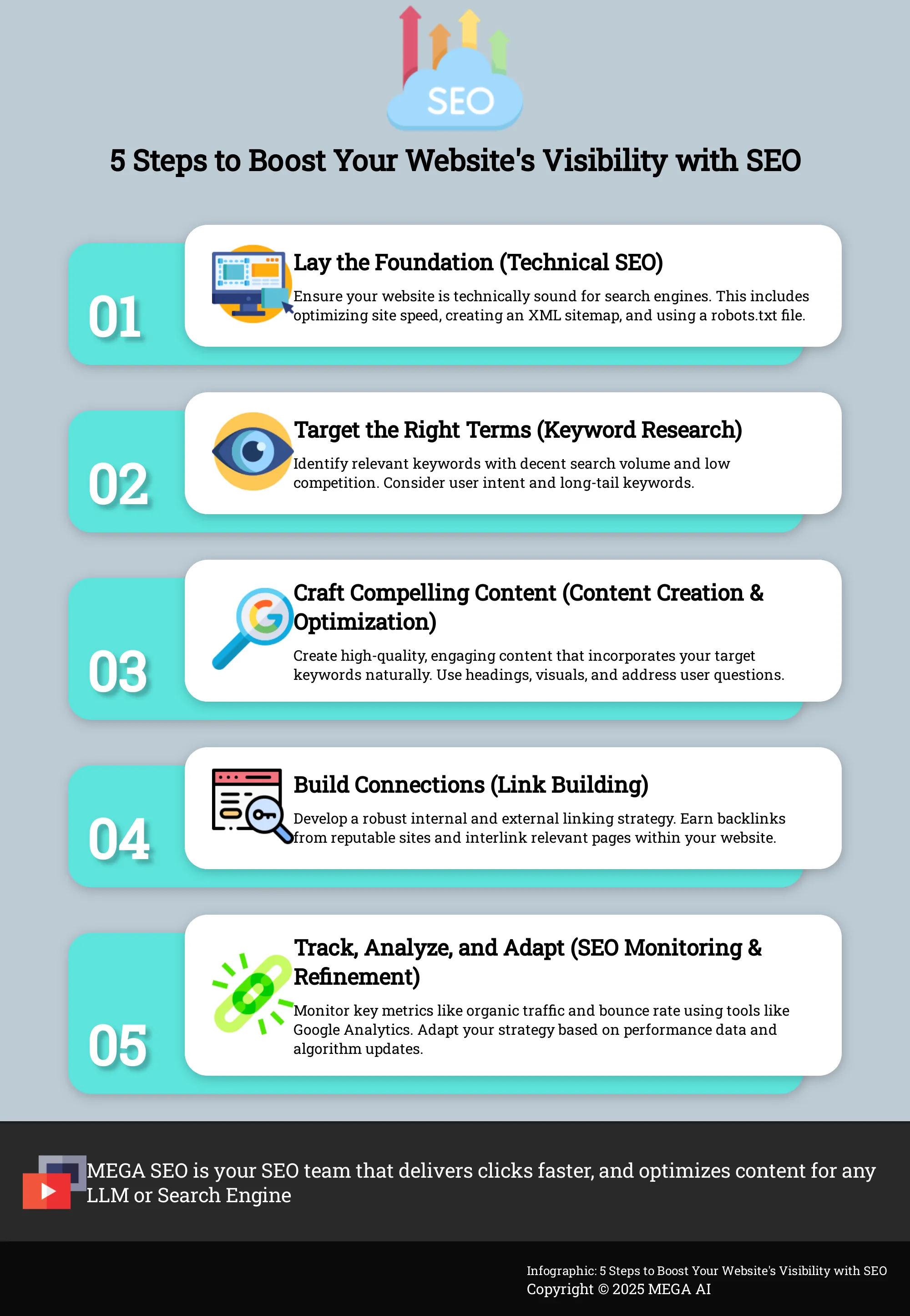
Before you even think about keywords or content, your website needs a solid technical backbone. This is the groundwork that allows search engines to find, crawl, and index your site efficiently. One of the first things to do, as Matt Diggity suggests, is to install an SEO plugin like Rank Math or Yoast SEO; these tools simplify many technical tasks.
Next, create a robots.txt file. This file tells search engines like Google which parts of your site they can and cannot access. You'll also want to implement an XML sitemap. Think of it as a table of contents for your website, making it easier for search engines to discover all your important pages. Lastly, focus on performance. Google prioritizes pages that load quickly, so use a tool like Pingdom to check your site speed and ensure it’s mobile-friendly. Many platforms, including MEGA AI, can help with technical SEO improvements to ensure your site is primed for search engines.
2. Find the Right Keywords
Keyword research is the compass of your SEO strategy, guiding you to the terms your potential customers are actually searching for. The goal is to find low-competition keywords that you can realistically rank for, terms that have decent search volume but aren't already dominated by major players. It's also crucial to match your keywords with user intent. What is someone hoping to find when they type a particular phrase into Google? A good tip is to type your main topic into the Google search bar and see what related keywords Google suggests.
Don't forget the power of long-tail keywords – these are longer, more specific phrases. Using a tool like answerthepublic.com can help you find common questions related to your topic, which you can then address in your content to attract highly targeted traffic. For businesses looking to streamline this, MEGA AI offers automated keyword research to simplify the process and uncover valuable opportunities.
3. Create and Optimize Content That Converts
Once you have your keywords, it's time to create content that not only ranks but also resonates with your audience and encourages them to take action. A strong introduction paragraph is key to hook your reader right away, ideally incorporating your target keyword naturally within the first few sentences. Also, ensure your main target keyword appears within the first 100 words of your content.
Structure your content for both readability and SEO using headings, subheadings, bullet points, and short paragraphs. Visuals are important too; add rich media like images and videos to make your page engaging. To help search engines better understand your content, add Schema markup, which can lead to informative rich snippets in search results. Addressing common questions directly in your content can also improve engagement. If content creation feels daunting, MEGA AI provides AI-powered content generation to help you produce optimized articles efficiently.
4. Develop a Strong Linking Strategy
Links are like votes of confidence for your website, signaling to search engines that your content is valuable and authoritative. Your linking strategy should include both internal links (connecting relevant pages on your own site) and external links (backlinks from other websites to yours). For internal linking, it's best to interlink relevant pages that naturally relate to each other. This helps distribute link equity and guides users to more of your useful content.
Earning quality backlinks is also crucial, as link building remains a significant ranking factor. This can be achieved by creating high-quality, shareable content, engaging in guest blogging, and conducting outreach. Don't overlook social media; promoting your content there can drive traffic and indirectly lead to backlinks. Tools like MEGA AI can assist with developing internal and external linking strategies, ensuring your site architecture is strong and well-connected.
5. Win at Local SEO
If your business serves a specific geographic area, local SEO is essential. It helps you connect with nearby customers actively searching for your products or services. A cornerstone of local SEO is to optimize your Google Business Profile. Ensure all your information is accurate, complete, and regularly updated, including your address, phone number, hours, and services. Encouraging customer reviews is also beneficial, as these build trust and can influence rankings.
Beyond your Google Business Profile, focus on building and managing local citations. This means ensuring your business information is consistent across all relevant local directories like Yelp, Yellow Pages, and industry-specific sites. Inconsistent information can confuse both search engines and potential customers. Finally, creating content that is specific to your local area can help improve your local search rankings. Think about blog posts discussing local events, case studies featuring local clients, or service pages dedicated to specific neighborhoods you serve.
6. Explore Advanced SEO Techniques
Once you've mastered the fundamentals, you can explore more advanced SEO techniques to gain a competitive edge. Voice search is one such area; understanding how users phrase their queries, often using natural, conversational language, is key to optimizing for voice search. Another significant development is the role of artificial intelligence. AI can help create and optimize content, and even automate various SEO tasks. This is where platforms like MEGA AI truly shine with their comprehensive SEO automation capabilities.
Video content is also increasingly important. If you're creating videos, be sure to optimize your video titles and descriptions with relevant keywords. Finally, aim for featured snippets – those answer boxes that appear at the top of Google search results. Optimizing your content to directly answer specific questions can help you earn these coveted spots, providing excellent visibility for your brand.
7. Track, Analyze, and Adapt Your SEO
SEO isn't a one-time task. To ensure your efforts are paying off and to identify areas for improvement, you need to consistently track, analyze, and adapt your strategy. Key SEO metrics to watch, as Semrush highlights, include organic traffic, bounce rate, and conversion rate. These metrics offer insights into how users are finding and interacting with your site.
To monitor these metrics, utilize tools like Google Analytics and Google Search Console. These platforms provide invaluable data on your site's performance and how search engines perceive it. The digital landscape is always evolving, so regularly updating your strategy based on algorithm changes and performance data is crucial for maintaining and improving your rankings. Be prepared to adjust your tactics to stay ahead.
8. Keep Your SEO Strategy Current
The world of SEO is dynamic, with search engine algorithms constantly evolving and new best practices emerging. To maintain and improve your rankings, it's essential to keep your strategy fresh and up-to-date. One key aspect of this is to regularly update and refresh your content. Content can become outdated, so revisit your existing posts to ensure they remain accurate, relevant, and comprehensive. MEGA AI's Maintenance Agent can even help automate article updates to improve click-through rates and rankings.
Performing regular SEO audits is also vital. Conducting these audits can help identify areas for improvement, whether they're technical issues, content gaps, or backlink opportunities. Finally, make a commitment to staying informed about the latest SEO trends and updates. Follow industry blogs, attend webinars, and continuously learn to ensure your SEO efforts remain effective and deliver results.
9. Tackle SEO Challenges and Measure ROI
Every SEO journey encounters challenges, from technical glitches to competitive pressures. Addressing technical SEO hurdles promptly is crucial for improving your site's performance, so don't shy away from troubleshooting issues like slow site speed or crawl errors. It's also important to manage expectations. SEO takes time, so setting realistic SEO goals and KPIs can help you measure your success and keep your team motivated throughout the process.
Ultimately, your SEO efforts need to contribute to your business objectives. It's important to connect your SEO efforts to tangible business results. Track how your improved rankings and organic traffic translate into leads, sales, and revenue. This not only demonstrates the value of SEO but also helps you refine your strategy to maximize your return on investment (ROI). Understanding this connection is key for sustainable, long-term success in the competitive online space.
10. Use AI for Smarter SEO
Artificial intelligence is rapidly changing the SEO landscape, offering powerful tools to enhance and automate various aspects of optimization. AI can significantly assist in generating content ideas and optimizing existing content. This means you can create high-quality, relevant content more efficiently and ensure it’s perfectly tuned for search engines and your target audience.
Beyond content, AI excels at automating repetitive SEO tasks, which can save significant time and resources. Think of tasks like keyword research, competitor analysis, and even technical SEO audits. By implementing AI-driven SEO strategies, you can stay ahead of the competition. Platforms like MEGA AI leverage end-to-end AI automation to streamline everything from keyword discovery and content creation to ongoing optimization, making advanced SEO accessible for users at all levels of expertise. If you're looking to make your SEO efforts more efficient and effective, exploring AI tools is a smart move. You can even book a demo to see how these tools can transform your workflow.
Related Articles
- SEO Checklist: Your Guide to Better Rankings
- Mastering Technical SEO: A Complete Guide
- Ultimate Keyword Research Checklist for SEO
- Essential Tips for Writing SEO-Optimized Content
- Mastering SEO Content: Best Practices for Effective Linking
Frequently Asked Questions
This checklist covers a lot. If I'm just starting out with SEO, what's the absolute first thing I should focus on? If you're new to SEO, begin by ensuring your website has a solid technical foundation. This means making sure search engines can easily find, crawl, and understand your site's content. Simple steps like installing an SEO plugin to guide you and submitting an XML sitemap can make a big difference before you dive deeper into keywords or content creation.
I'm eager to see my site climb the rankings. Realistically, how long should I expect to wait before seeing significant results from these SEO activities? Patience is definitely key with SEO. While you might see some small improvements relatively quickly, achieving substantial and lasting results typically takes several months, sometimes six months or even longer. This timeframe can vary based on factors like your industry's competitiveness and the consistency of your efforts.
You mentioned AI tools for SEO. As a small business owner with a tight budget and limited time, how can AI really make a difference for me? AI tools can be incredibly helpful for small businesses by taking over some of the more time-consuming SEO tasks. For instance, AI can assist with initial keyword research, help generate outlines or drafts for content, or even automate parts of your site audits. This allows you to accomplish more with limited resources, freeing you to concentrate on other important aspects of your business.
With so many aspects to SEO, like technical details and content, what's a common pitfall I should watch out for? A frequent misstep is creating content without deeply considering what your audience is actually looking for – this is often called "user intent." You might target certain keywords, but if the content doesn't genuinely address the questions or needs behind those search terms, it's unlikely to rank well or engage visitors. Always prioritize understanding and satisfying your audience.
How often should I be reviewing and updating my SEO strategy based on this checklist? It's a good practice to treat your SEO strategy as an ongoing project rather than a set-it-and-forget-it task. Plan to review your performance data and revisit key checklist items at least once a quarter. However, also stay adaptable and be prepared to make adjustments more often if you notice significant shifts in your rankings or when major search engine algorithm updates occur.